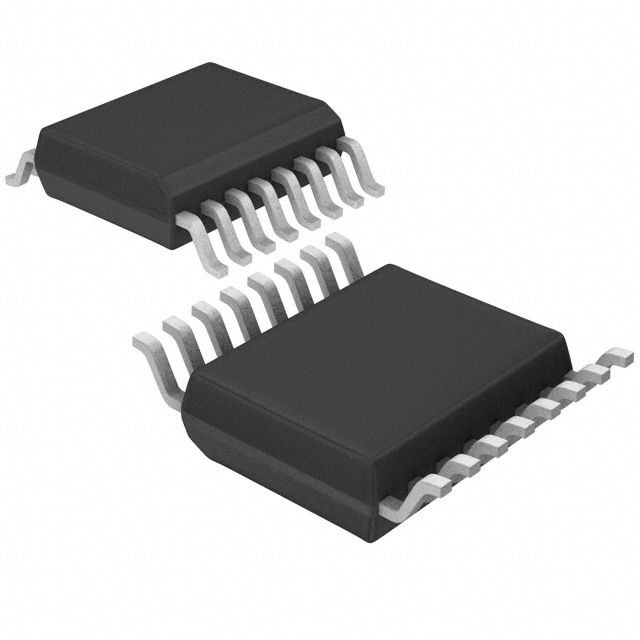
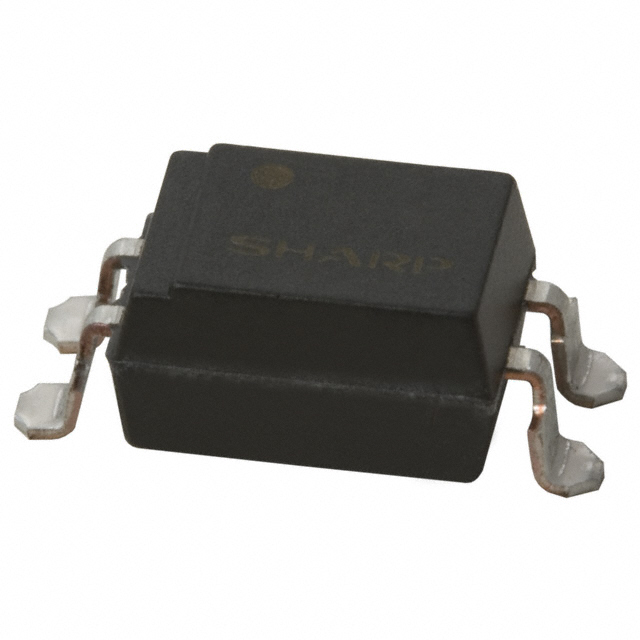
PC81713NIP0F >
PC81713NIP0F
Sharp Microelectronics
OPTOISOLATOR 5KV TRANS 4SMD
10026 Pcs New Original In Stock
Optoisolator Transistor Output 5000Vrms 1 Channel 4-SMD
Request Quote (Ships tomorrow)
*Quantity
Minimum 1
PC81713NIP0F Sharp Microelectronics
5.0 / 5.0 - (160 Ratings)

PC81713NIP0F

Product Overview

7929445

DiGi Electronics Part Number

PC81713NIP0F-DG
PC81713NIP0F

Description

OPTOISOLATOR 5KV TRANS 4SMD

Inventory

10026 Pcs New Original In Stock
Optoisolator Transistor Output 5000Vrms 1 Channel 4-SMD
Quantity
Minimum 1

Purchase and inquiry

Quality Assurance

365 - Day Quality Guarantee - Every part fully backed.

90 - Day Refund or Exchange - Defective parts? No hassle.

Limited Stock, Order Now - Get reliable parts without worry.

Global Shipping & Secure Packaging

Worldwide Delivery in 3-5 Business Days

100% ESD Anti-Static Packaging

Real-Time Tracking for Every Order

Secure & Flexible Payment

Credit Card, VISA, MasterCard, PayPal, Western Union, Telegraphic Transfer(T/T) and more

All payments encrypted for security

Request Quote (Ships tomorrow)
* Quantity
Minimum 1
(*) is mandatory
We'll get back to you within 24 hours

PC81713NIP0F Technical Specifications

Category Optoisolators, Transistor, Photovoltaic Output Optoisolators

Manufacturer Sharp Microelectronics

Packaging -

Series -

Product Status Obsolete

Number of Channels 1

Voltage - Isolation 5000Vrms

Current Transfer Ratio (Min) 200% @ 500µA

Current Transfer Ratio (Max) 500% @ 500µA

Turn On / Turn Off Time (Typ) -

Rise / Fall Time (Typ) 4µs, 3µs

Input Type DC

Output Type Transistor

Voltage - Output (Max) 80V

Current - Output / Channel 50mA

Voltage - Forward (Vf) (Typ) 1.2V

Current - DC Forward (If) (Max) 10 mA

Vce Saturation (Max) 200mV

Operating Temperature -30°C ~ 100°C

Mounting Type Surface Mount

Package / Case 4-SMD, Gull Wing

Supplier Device Package 4-SMD

Datasheet & Documents

HTML Datasheet

PC81713NIP0F-DG

Environmental & Export Classification

Moisture Sensitivity Level (MSL) 1 (Unlimited)
REACH Status REACH Unaffected
ECCN EAR99
HTSUS 8541.49.8000

Additional Information

Other Names
425-2182-6
425-2182-2
425-2182-1
Standard Package
2,000

Alternative Parts

PART NUMBER
MANUFACTURER
QUANTITY AVAILABLE
DiGi PART NUMBER
UNIT PRICE
SUBSTITUTE TYPE
HCPL-817-50LE
Broadcom Limited
20275
HCPL-817-50LE-DG
0.1271
Similar
HCPL-817-50CE
Broadcom Limited
1624
HCPL-817-50CE-DG
0.0031
Similar
HCPL-817-50AE
Broadcom Limited
20316
HCPL-817-50AE-DG
0.0020
Similar
HCPL-817-50DE
Broadcom Limited
5643
HCPL-817-50DE-DG
0.0151
Similar
HCPL-817-50BE
Broadcom Limited
3712
HCPL-817-50BE-DG
0.0034
Similar

Reviews

5.0/5.0-(Show up to 5 Ratings)
Schatt***andler
December 02, 2025
5.0
Ich schätze die breite Produktpalette, die zuverlässig und bezahlbar ist.
Nob***est
December 02, 2025
5.0
Every interaction with Di Digi Electronics' staff has been positive and welcoming.
FreshP***pective
December 02, 2025
5.0
Delivery was flawless with complete and secure packaging, making the unboxing experience pleasant.
Wand***reams
December 02, 2025
5.0
Their commitment to customer care is evident in their excellent after-sales service.
Publish Evalution
* Product Rating
(Normal/Preferably/Outstanding, default 5 stars)
* Evalution Message
Please enter your review message.
Please post honest comments and do not post ilegal comments.

Frequently Asked Questions (FAQ)

What are the key design risks when replacing the obsolete PC81713NIP0F optoisolator in an existing 24V industrial control circuit, and how can I ensure signal integrity during the transition?

Replacing the obsolete PC81713NIP0F requires careful evaluation of timing, CTR stability, and output saturation behavior under load. Since the PC81713NIP0F has a guaranteed CTR of 200% at 500µA but may degrade over temperature and lifetime, substitute parts like the HCPL-817-50AE must be tested under worst-case conditions (e.g., -30°C and 100°C) to avoid marginal logic-level signaling. Additionally, the 4µs rise and 3µs fall times of the PC81713NIP0F may not be matched exactly by alternatives—verify propagation delay skew if used in PWM or high-speed digital isolation. Always validate output transistor saturation voltage (Vce(sat)) under your actual load current (up to 50mA) to prevent excessive power dissipation or logic threshold violations in downstream circuitry.

Can the PC81713NIP0F be safely used in a 48V automotive application requiring reinforced isolation, and what derating considerations apply given its 5kVrms rating?

While the PC81713NIP0F offers 5kVrms isolation, using it in 48V automotive systems (e.g., EV battery management) demands strict derating for long-term reliability. The 5kVrms rating is a 1-minute test voltage, not a continuous operating limit—apply a safety factor of at least 2×, meaning sustained working voltages should not exceed 2.5kV. In automotive environments with high dv/dt transients and thermal cycling, consider that the PC81713NIP0F’s epoxy package may experience partial discharge over time. For reinforced isolation per IEC 60664-1, pair it with adequate creepage (≥8mm) on the PCB and conformal coating. However, due to its obsolete status and lack of AEC-Q101 qualification, we recommend migrating to a qualified alternative like the HCPL-817-50DE for new designs.

How does the current transfer ratio (CTR) degradation over time affect long-term reliability when using the PC81713NIP0F in a 10-year lifecycle medical device, and what mitigation strategies are effective?

The PC81713NIP0F suffers from CTR degradation due to LED aging, especially under high forward current or elevated temperatures—critical in medical devices with 10-year lifespans. Even though its initial CTR is 200–500% at 500µA, real-world data shows 20–40% degradation after 5,000 hours at 50°C. To mitigate this, operate the input LED well below its 10mA maximum (e.g., 1–2mA) to extend lifetime, and design the output stage with sufficient headroom (e.g., use a pull-up resistor that allows correct logic high even at 60% of initial CTR). Include periodic self-test routines if possible, and avoid using the PC81713NIP0F in safety-critical feedback loops without redundancy. Given its obsolete status, consider redesigning with a modern, medical-certified isolator such as the HCPL-817-50LE.

What layout and PCB design precautions are necessary when integrating the PC81713NIP0F in a high-noise SMPS feedback loop to prevent false triggering or oscillation?

When using the PC81713NIP0F in a switch-mode power supply (SMPS) feedback path, parasitic coupling and ground bounce can cause instability. Maintain a minimum 8mm creepage distance between input and output sides on the PCB, and use a split ground plane with a single-point connection to avoid noise injection through shared return paths. Place a 100nF bypass capacitor close to the output transistor’s collector to suppress high-frequency ringing, and avoid routing high-di/dt traces (e.g., switch node) near the optoisolator. The 4-SMD gull-wing package is susceptible to mechanical stress—ensure symmetrical solder joints and avoid placing vias under the body. Also, account for the 3–4µs propagation delay in your control loop compensation; mismatched timing can lead to subharmonic oscillation in peak-current-mode converters.

Is it safe to substitute the PC81713NIP0F with an HCPL-817-50BE in a UL-certified industrial I/O module, and what certification gaps must be addressed?

Substituting the PC81713NIP0F with the HCPL-817-50BE is electrically feasible due to similar CTR, isolation voltage (5kVrms), and package footprint, but certification compliance must be revalidated. The PC81713NIP0F’s UL recognition (if previously certified in your system) may not transfer automatically—the HCPL-817-50BE carries its own UL file (E115410), but you must confirm it meets the same isolation coordination level (e.g., Pollution Degree 2, Overvoltage Category III). Additionally, verify that the replacement’s partial discharge performance and long-term insulation resistance align with your safety standard (e.g., IEC 61010-1). Since the PC81713NIP0F is obsolete, this substitution offers a path to continuity, but full system re-certification testing—including hipot and endurance trials—is strongly recommended before deployment.

Quality Assurance (QC)

DiGi ensures the quality and authenticity of every electronic component through professional inspections and batch sampling, guaranteeing reliable sourcing, stable performance, and compliance with technical specifications, helping customers reduce supply chain risks and confidently use components in production.

Quality Assurance
Counterfeit and defect prevention

Counterfeit and defect prevention

Comprehensive screening to identify counterfeit, refurbished, or defective components, ensuring only authentic and compliant parts are delivered.

Visual and packaging inspection

Visual and packaging inspection

Electrical performance verification

Verification of component appearance, markings, date codes, packaging integrity, and label consistency to ensure traceability and conformity.

Life and reliability evaluation

DiGi Certification
Blogs & Posts
PC81713NIP0F CAD Models
productDetail
Please log in first.
No account yet? Register