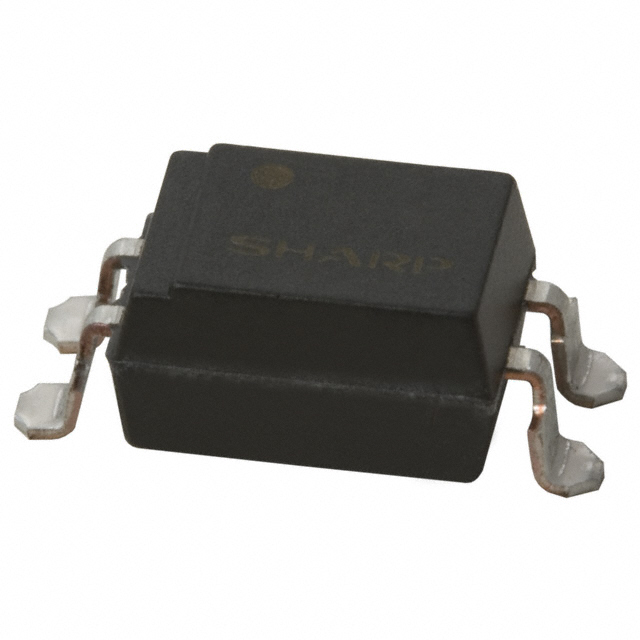
PC4H520NIP >
PC4H520NIP
Sharp Microelectronics
OPTOISOLATOR 2.5KV DARL 4SMD
1989 Pcs New Original In Stock
Optoisolator Darlington Output 2500Vrms 1 Channel 4-Mini-Flat
Request Quote (Ships tomorrow)
*Quantity
Minimum 1
PC4H520NIP Sharp Microelectronics
5.0 / 5.0 - (177 Ratings)

PC4H520NIP

Product Overview

7929465

DiGi Electronics Part Number

PC4H520NIP-DG
PC4H520NIP

Description

OPTOISOLATOR 2.5KV DARL 4SMD

Inventory

1989 Pcs New Original In Stock
Optoisolator Darlington Output 2500Vrms 1 Channel 4-Mini-Flat
Quantity
Minimum 1

Purchase and inquiry

Quality Assurance

365 - Day Quality Guarantee - Every part fully backed.

90 - Day Refund or Exchange - Defective parts? No hassle.

Limited Stock, Order Now - Get reliable parts without worry.

Global Shipping & Secure Packaging

Worldwide Delivery in 3-5 Business Days

100% ESD Anti-Static Packaging

Real-Time Tracking for Every Order

Secure & Flexible Payment

Credit Card, VISA, MasterCard, PayPal, Western Union, Telegraphic Transfer(T/T) and more

All payments encrypted for security

Request Quote (Ships tomorrow)
* Quantity
Minimum 1
(*) is mandatory
We'll get back to you within 24 hours

PC4H520NIP Technical Specifications

Category Optoisolators, Transistor, Photovoltaic Output Optoisolators

Manufacturer Sharp Microelectronics

Packaging -

Series -

Product Status Obsolete

Number of Channels 1

Voltage - Isolation 2500Vrms

Current Transfer Ratio (Min) 1000% @ 1mA

Current Transfer Ratio (Max) -

Turn On / Turn Off Time (Typ) -

Rise / Fall Time (Typ) 100µs, 20µs

Input Type DC

Output Type Darlington

Voltage - Output (Max) 350V

Current - Output / Channel 120mA

Voltage - Forward (Vf) (Typ) 1.2V

Current - DC Forward (If) (Max) 50 mA

Vce Saturation (Max) 1.4V

Operating Temperature -40°C ~ 100°C

Mounting Type Surface Mount

Package / Case 4-SOIC (0.173", 4.40mm Width)

Supplier Device Package 4-Mini-Flat

Datasheet & Documents

HTML Datasheet

PC4H520NIP-DG

Environmental & Export Classification

RoHS Status RoHS non-compliant
Moisture Sensitivity Level (MSL) 1 (Unlimited)
ECCN EAR99
HTSUS 8541.49.8000

Additional Information

Other Names
425-1379-2
425-1379-1
Standard Package
3,000

Alternative Parts

PART NUMBER
MANUFACTURER
QUANTITY AVAILABLE
DiGi PART NUMBER
UNIT PRICE
SUBSTITUTE TYPE
TCMD1000
Vishay Semiconductor Opto Division
105857
TCMD1000-DG
0.0060
Similar
PS2833-1-F3-A
Renesas Electronics Corporation
73737
PS2833-1-F3-A-DG
0.7550
Similar

Reviews

5.0/5.0-(Show up to 5 Ratings)
Rêves***hantés
December 02, 2025
5.0
Je suis impressionné par leur rapidité de livraison et la qualité de leur support.
Pu***oy
December 02, 2025
5.0
Their tracking system allows for easy rescheduling or rerouting if needed.
Flow***hLife
December 02, 2025
5.0
Their support team is knowledgeable and responsive.
Publish Evalution
* Product Rating
(Normal/Preferably/Outstanding, default 5 stars)
* Evalution Message
Please enter your review message.
Please post honest comments and do not post ilegal comments.

Frequently Asked Questions (FAQ)

Can the PC4H520NIP optoisolator be safely replaced with a TCMD1000 in a high-noise industrial control circuit without redesigning the PCB layout?

While the TCMD1000 offers similar isolation voltage (2500Vrms) and Darlington output configuration, it has a lower current transfer ratio (CTR) of 500% at 5mA compared to the PC4H520NIP’s 1000% at 1mA, which may reduce signal integrity in low-drive applications. Additionally, the TCMD1000 uses a different package (4-SOP vs. 4-Mini-Flat), so direct drop-in replacement is not feasible without footprint modification. For noise-sensitive designs, verify that the slower rise/fall times of the PC4H520NIP (100µs/20µs) are acceptable, as faster alternatives could introduce unintended switching transients. Always validate CTR margin under actual load conditions to avoid marginal operation.

What are the key reliability risks when using the PC4H520NIP in a 24V automotive environment with frequent load dump transients?

The PC4H520NIP has a maximum output voltage rating of 350V and 120mA per channel, which is sufficient for 24V systems, but automotive load dumps can exceed 100V spikes. Without proper external clamping (e.g., TVS diodes), repeated transients may degrade the output transistor over time. Also, although its operating temperature range (-40°C to 100°C) meets automotive requirements, the Darlington output’s Vce(sat) of 1.4V leads to higher power dissipation under continuous load—monitor thermal derating near 100°C. Since the part is obsolete and RoHS non-compliant, long-term supply risk and potential counterfeit exposure further complicate lifecycle reliability.

How does the PC4H520NIP compare to the PS2833-1-F3-A for isolating a microcontroller GPIO in a medical device requiring IEC 60601-1 compliance?

The PS2833-1-F3-A is a better fit for medical applications due to its reinforced insulation certification and higher creepage/clearance in the 4-SOP package, which simplifies compliance with IEC 60601-1. In contrast, the PC4H520NIP lacks medical-grade certification and has a lower isolation voltage (2500Vrms vs. 3750Vrms for reinforced insulation). While both use Darlington outputs, the PS2833-1-F3-A also offers better CTR stability over temperature. Given that the PC4H520NIP is obsolete and non-RoHS, sourcing compliant replacements for regulated markets becomes a significant design risk—making the PS2833-1-F3-A a more sustainable choice despite minor layout adjustments.

Is it safe to drive the PC4H520NIP input directly from a 3.3V microcontroller GPIO without a series resistor, given its 1.2V forward voltage?

No—direct connection risks exceeding the PC4H520NIP’s maximum forward current (50mA). A 3.3V GPIO can source 20–40mA depending on the MCU, and without current limiting, the LED may draw excessive current during transients or due to process variation, leading to premature failure. Always include a series resistor (e.g., ~100Ω for ~20mA at 3.3V) to ensure If stays within spec. Also, consider that lower If reduces CTR; since the PC4H520NIP’s CTR is specified at 1mA, verify output saturation under your actual If to avoid marginal switching, especially in feedback loops or safety-critical isolation paths.

Can the PC4H520NIP handle inductive load switching at 120mA without a flyback diode, and what failure modes should I anticipate?

Switching inductive loads (e.g., relays, solenoids) at 120mA without a flyback diode risks catastrophic failure due to voltage spikes exceeding the 350V output rating. The PC4H520NIP’s Darlington output lacks internal protection, so back-EMF from inductive kick can avalanche the output transistor, causing latent or immediate damage. Always include a reverse-biased flyback diode across the load. Additionally, the high Vce(sat) of 1.4V increases power dissipation during conduction—combine this with inductive turn-off stress, and thermal runaway becomes a concern in enclosed environments. Given the part’s obsolete status, consider migrating to a modern optoisolator with built-in output protection or external snubber support for robust inductive switching.

Quality Assurance (QC)

DiGi ensures the quality and authenticity of every electronic component through professional inspections and batch sampling, guaranteeing reliable sourcing, stable performance, and compliance with technical specifications, helping customers reduce supply chain risks and confidently use components in production.

Quality Assurance
Counterfeit and defect prevention

Counterfeit and defect prevention

Comprehensive screening to identify counterfeit, refurbished, or defective components, ensuring only authentic and compliant parts are delivered.

Visual and packaging inspection

Visual and packaging inspection

Electrical performance verification

Verification of component appearance, markings, date codes, packaging integrity, and label consistency to ensure traceability and conformity.

Life and reliability evaluation

DiGi Certification
Blogs & Posts
PC4H520NIP CAD Models
productDetail
Please log in first.
No account yet? Register