



Request Quote
(Ships tomorrow)
VLZ30C-GS18 Equivalent & Substitute Parts
Part Overview
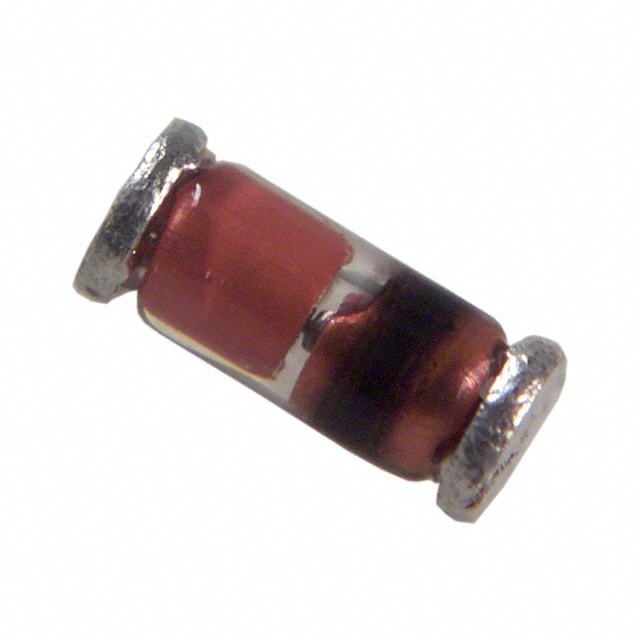
The VLZ30C-GS18 is a Zener diode rated at 29.09 V nominal voltage with 500 mW power dissipation, manufactured by Vishay General Semiconductor - Diodes Division. This component is packaged in SOD-80 QuadroMELF surface mount configuration and is qualified to AEC-Q101 automotive standards. The part is currently classified as obsolete, necessitating identification of equivalent substitute components that maintain functional compatibility while ensuring continued supply chain availability.
Substiute Parts
Key Parameters
| Parameter | Value | Unit |
|---|---|---|
| Voltage - Zener (Nom) | 29.09 | V |
| Power - Max | 500 | mW |
| Impedance (Max) | 55 | Ohms |
| Current - Reverse Leakage @ Vr | 40 | µA @ 26.9 V |
| Voltage - Forward (Vf) (Max) @ If | 1.5 | V @ 200 mA |
| Operating Temperature Range | -65 to 175 | °C |
| Mounting Type | Surface Mount | - |
| Package / Case | SOD-80 QuadroMELF | - |
| Grade | Automotive | - |
| Qualification | AEC-Q101 | - |
| RoHS Status | ROHS3 Compliant | - |
Substitute Part Grouping Explanation
Substitution eligibility for the VLZ30C-GS18 is determined by the following critical parameters:
Primary Substitution Criteria:
- Zener voltage nominal rating within acceptable circuit tolerance
- Power dissipation rating of 500 mW minimum
- Operating temperature range of -65°C to 175°C minimum
- Surface mount configuration
- Automotive-grade qualification or equivalent reliability standard
Secondary Compatibility Factors:
- Forward voltage characteristics at specified current levels
- Reverse leakage current specifications
- Impedance characteristics
- RoHS and REACH compliance status
The VLZ30C-GS18 has been identified with two substitute components: TLZ30C-GS18 (direct Vishay manufacturer alternative) and 1N5545BUR-1 (Microchip Technology equivalent). Both substitutes meet the core electrical and thermal requirements while offering active product status and improved supply availability.
Parameter Comparison
| Parameter | VLZ30C-GS18 | TLZ30C-GS18 | 1N5545BUR-1 |
|---|---|---|---|
| Manufacturer | Vishay General Semiconductor | Vishay General Semiconductor | Microchip Technology |
| Voltage - Zener (Nom) | 29.09 V | 30 V | 30 V |
| Power - Max | 500 mW | 500 mW | 500 mW |
| Impedance (Max) | 55 Ohms | 80 Ohms | 100 Ohms |
| Current - Reverse Leakage @ Vr | 40 µA @ 26.9 V | 40 nA @ 26.9 V | 10 nA @ 27 V |
| Voltage - Forward (Vf) (Max) @ If | 1.5 V @ 200 mA | 1.5 V @ 200 mA | 1.1 V @ 200 mA |
| Operating Temperature | -65 to 175°C | -65 to 175°C | -65 to 175°C |
| Mounting Type | Surface Mount | Surface Mount | Surface Mount |
| Package / Case | SOD-80 QuadroMELF | SOD-80 MiniMELF | DO-213AA |
| Product Status | Obsolete | Active | Active |
| RoHS Status | ROHS3 Compliant | ROHS3 Compliant | RoHS non-compliant |
Engineering Selection Recommendations
TLZ30C-GS18 (Primary Substitute): This Vishay component is the preferred substitute for the VLZ30C-GS18. It maintains identical power rating (500 mW) and operating temperature range (-65°C to 175°C). The zener voltage is rated at 30 V nominal, representing a 0.91 V increase from the original 29.09 V specification. Both components are ROHS3 compliant and manufactured by the same supplier, ensuring consistent quality and reliability standards. The TLZ30C-GS18 is currently in active production status with confirmed inventory availability. Package configuration differs (SOD-80 MiniMELF versus QuadroMELF), requiring PCB layout verification. Reverse leakage current is significantly lower (40 nA versus 40 µA), indicating improved device characteristics.
1N5545BUR-1 (Secondary Substitute): This Microchip Technology component provides an alternative substitute option with identical 500 mW power rating and -65°C to 175°C operating temperature range. Zener voltage is specified at 30 V nominal. The component is currently in active production. Critical consideration: this part is RoHS non-compliant, which may restrict use in applications requiring full RoHS compliance. Package configuration is DO-213AA, differing from both the original and primary substitute. Forward voltage is lower (1.1 V versus 1.5 V), and reverse leakage current is superior (10 nA). Selection of this substitute requires confirmation that RoHS non-compliance is acceptable for the intended application.
Frequently Asked Questions (FAQ)
Q: Can TLZ30C-GS18 be used as a direct replacement for VLZ30C-GS18 without circuit modification?
A: The TLZ30C-GS18 is electrically compatible within standard circuit tolerance margins. The zener voltage difference of 0.91 V (29.09 V to 30 V) falls within typical ±5% design tolerances for zener diode applications. However, PCB layout modification is required due to package configuration change from SOD-80 QuadroMELF to SOD-80 MiniMELF. Footprint verification is mandatory before implementation.
Q: What is the significance of the reverse leakage current difference between VLZ30C-GS18 and its substitutes?
A: The VLZ30C-GS18 specifies 40 µA reverse leakage at 26.9 V, while TLZ30C-GS18 specifies 40 nA and 1N5545BUR-1 specifies 10 nA. Lower reverse leakage current indicates superior device performance and reduced power dissipation in reverse bias conditions. Both substitutes demonstrate improved leakage characteristics, which is advantageous for circuit performance.
Q: Are package differences between these three components critical for substitution?
A: Yes. The VLZ30C-GS18 uses SOD-80 QuadroMELF, TLZ30C-GS18 uses SOD-80 MiniMELF, and 1N5545BUR-1 uses DO-213AA. These are distinct physical packages with different footprints, lead spacing, and PCB land patterns. Direct board-level substitution without PCB redesign is not possible. Component selection must align with existing PCB layout or require layout modification.
Q: What compliance considerations apply when selecting between these substitutes?
A: The VLZ30C-GS18 and TLZ30C-GS18 are both ROHS3 compliant. The 1N5545BUR-1 is RoHS non-compliant. Applications subject to RoHS regulations (EU Directive 2011/65/EU or equivalent) must use either the original part or TLZ30C-GS18. All three components are REACH unaffected and carry EAR99 ECCN classification.
Q: How does the impedance specification affect substitute selection?
A: Impedance values are 55 Ohms (VLZ30C-GS18), 80 Ohms (TLZ30C-GS18), and 100 Ohms (1N5545BUR-1). Higher impedance indicates increased dynamic resistance in the zener breakdown region. For voltage regulation applications requiring low output impedance, the VLZ30C-GS18 specification is superior. However, both substitutes remain within acceptable ranges for most standard zener diode circuit applications. Circuit simulation or testing is appropriate for impedance-sensitive designs.
Q: What is the automotive qualification status of each component?
A: The VLZ30C-GS18 carries explicit AEC-Q101 automotive qualification. The TLZ30C-GS18 and 1N5545BUR-1 specifications provided do not explicitly state AEC-Q101 qualification. For automotive applications requiring AEC-Q101 compliance, verification of substitute component qualification status with the respective manufacturers is required before implementation.
Alternative Parts

SJ6012L2TP
Littelfuse Inc.
6 Alternative Parts

JMK107BBJ476MA-RE
Taiyo Yuden
10 Alternative Parts

GMK107BBJ475MA-T
Taiyo Yuden
5 Alternative Parts
SJ6020N2ARP
Littelfuse Inc.
3 Alternative Parts
SJ6025R2ATP
Littelfuse Inc.
4 Alternative Parts

2474-05L
API Delevan Inc.
1 Alternative Parts

4590R-684K
API Delevan Inc.
1 Alternative Parts

CM6560R-334
API Delevan Inc.
1 Alternative Parts

CM6460-104
API Delevan Inc.
1 Alternative Parts

5526-12
API Delevan Inc.
1 Alternative Parts