




Request Quote
(Ships tomorrow)
VLZ12C-GS18 Equivalent & Substitute Parts
Part Overview
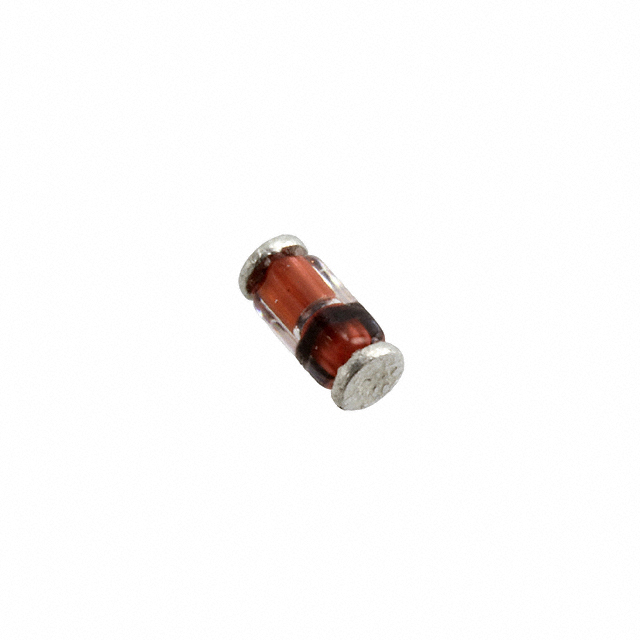
The VLZ12C-GS18 is a Zener diode rated at 24.09 V, 500 mW, manufactured by Vishay General Semiconductor - Diodes Division in the SOD-80 QuadroMELF surface mount package. This component is classified as Obsolete, necessitating identification of equivalent and substitute parts for ongoing design requirements and procurement needs. The part carries AEC-Q101 automotive qualification and ROHS3 compliance.
Substiute Parts
Key Parameters
| Parameter | Value | Unit |
|---|---|---|
| Voltage - Zener (Nom) | 24.09 | V |
| Power - Max | 500 | mW |
| Impedance (Max) | 12 | Ohms |
| Current - Reverse Leakage @ Vr | 40 µA @ 11.2 V | µA |
| Voltage - Forward (Vf) (Max) @ If | 1.5 V @ 200 mA | V |
| Operating Temperature Range | -65 to 175 | °C |
| Mounting Type | Surface Mount | - |
| Package / Case | SOD-80 QuadroMELF | - |
| Grade | Automotive | - |
| Qualification | AEC-Q101 | - |
| RoHS Status | ROHS3 Compliant | - |
Substitute Part Grouping Explanation
Substitution of the VLZ12C-GS18 is constrained by the following critical parameters:
Zener Voltage (Vz): The nominal Zener voltage of 24.09 V is the primary functional specification. Substitute parts must operate at this voltage level to maintain circuit regulation and protection characteristics.
Power Dissipation (Pmax): The 500 mW maximum power rating defines thermal and current handling capability. Substitute parts must support this power level or higher.
Impedance (Zzt): The 12 Ohm maximum impedance specification affects voltage regulation quality and transient response.
Operating Temperature Range: The -65°C to 175°C range establishes environmental operating limits.
Mounting Type and Package: Surface mount configuration with SOD-80 package form factor determines PCB compatibility and assembly requirements.
Compliance Requirements: AEC-Q101 automotive qualification and ROHS3 compliance are mandatory for automotive applications.
The substitute parts listed (1N963BUR-1, 1N5532BUR-1, 1N759AUR-1, 1N4106UR-1, TLZ12C-GS18) operate at 12 V nominal Zener voltage, which differs from the main part specification of 24.09 V. These parts are functionally distinct and cannot serve as direct electrical substitutes for the VLZ12C-GS18 in applications requiring 24.09 V regulation or protection.
Parameter Comparison
| Parameter | VLZ12C-GS18 | TLZ12C-GS18 | 1N4106UR-1 | 1N5532BUR-1 | 1N759AUR-1 | 1N963BUR-1 |
|---|---|---|---|---|---|---|
| Manufacturer | Vishay | Vishay | Microchip | Microchip | Microchip | Microchip |
| Voltage - Zener (Nom) | 24.09 V | 12 V | 12 V | 12 V | 12 V | 12 V |
| Power - Max | 500 mW | 500 mW | 500 mW | 500 mW | 500 mW | 400 mW |
| Impedance (Max) | 12 Ohms | 12 Ohms | 200 Ohms | 90 Ohms | 10 Ohms | 11.5 Ohms |
| Current - Reverse Leakage @ Vr | 40 µA @ 11.2 V | 40 nA @ 11.2 V | 50 nA @ 9.2 V | 50 nA @ 10.8 V | 1 µA @ 9 V | 1 µA @ 9.1 V |
| Voltage - Forward (Vf) (Max) @ If | 1.5 V @ 200 mA | 1.5 V @ 200 mA | 1.1 V @ 200 mA | 1.1 V @ 200 mA | 1.1 V @ 200 mA | 1.1 V @ 200 mA |
| Operating Temperature | -65 to 175°C | -65 to 175°C | -65 to 175°C | -65 to 175°C | -65 to 175°C | -65 to 175°C |
| Mounting Type | Surface Mount | Surface Mount | Surface Mount | Surface Mount | Surface Mount | Surface Mount |
| Package / Case | SOD-80 QuadroMELF | SOD-80 MiniMELF | DO-213AA | DO-213AA | DO-213AA | DO-213AA |
| Product Status | Obsolete | Active | Active | Active | Active | Active |
| RoHS Status | ROHS3 Compliant | ROHS3 Compliant | RoHS non-compliant | RoHS non-compliant | RoHS non-compliant | Not specified |
Engineering Selection Recommendations
Product Status Consideration: The VLZ12C-GS18 is classified as Obsolete. The TLZ12C-GS18 is the only listed substitute with Active product status from the original manufacturer (Vishay). However, the TLZ12C-GS18 operates at 12 V nominal Zener voltage, not 24.09 V, and therefore cannot serve as an electrical substitute in applications requiring the original voltage specification.
Compliance and Qualification: The VLZ12C-GS18 carries AEC-Q101 automotive qualification and ROHS3 compliance. The TLZ12C-GS18 maintains ROHS3 compliance and is from the same manufacturer, supporting continuity in automotive applications. The Microchip alternatives (1N4106UR-1, 1N5532BUR-1, 1N759AUR-1, 1N963BUR-1) are RoHS non-compliant, which may restrict their use in applications with RoHS compliance requirements.
Package Compatibility: The VLZ12C-GS18 uses SOD-80 QuadroMELF packaging. The TLZ12C-GS18 uses SOD-80 MiniMELF packaging, which differs in physical dimensions. The Microchip alternatives use DO-213AA packaging, which is distinct from both SOD-80 variants and requires PCB layout modification.
Voltage Specification Mismatch: All listed substitute parts operate at 12 V nominal Zener voltage. For applications requiring 24.09 V regulation or overvoltage protection, these substitutes are not functionally equivalent and cannot replace the VLZ12C-GS18 without circuit redesign.
Frequently Asked Questions (FAQ)
Q: Can the TLZ12C-GS18 directly replace the VLZ12C-GS18 in my circuit?
A: No. While both are Vishay Zener diodes in SOD-80 packages, the TLZ12C-GS18 operates at 12 V nominal Zener voltage, whereas the VLZ12C-GS18 operates at 24.09 V. Direct substitution would alter circuit voltage regulation and protection characteristics. Additionally, the TLZ12C-GS18 uses MiniMELF packaging while the VLZ12C-GS18 uses QuadroMELF packaging, requiring PCB layout verification.
Q: What is the difference between SOD-80 QuadroMELF and SOD-80 MiniMELF packages?
A: Both are SOD-80 surface mount packages but differ in physical dimensions and thermal characteristics. QuadroMELF is larger than MiniMELF. PCB footprints are not interchangeable without layout modification.
Q: Are the Microchip alternatives (1N4106UR-1, 1N5532BUR-1, 1N759AUR-1, 1N963BUR-1) suitable for automotive applications?
A: These parts are RoHS non-compliant, which may conflict with automotive compliance requirements. Additionally, they operate at 12 V, not 24.09 V, and use DO-213AA packaging instead of SOD-80. They are not suitable as direct replacements for the VLZ12C-GS18 in automotive circuits.
Q: Why do all substitute parts have 12 V Zener voltage instead of 24.09 V?
A: The substitute parts listed represent available alternatives in the Vishay and Microchip product portfolios. However, the voltage mismatch indicates these are not true electrical equivalents. For applications requiring 24.09 V Zener regulation, alternative sources or custom specifications must be evaluated.
Q: What is the impedance difference between these parts, and does it matter?
A: Impedance (Zzt) affects voltage regulation quality and transient response. The VLZ12C-GS18 specifies 12 Ohms maximum. The Microchip alternatives range from 10 to 200 Ohms. Higher impedance results in poorer voltage regulation. The 1N4106UR-1 at 200 Ohms represents significantly degraded regulation performance compared to the original specification.
Q: Can I use 1N963BUR-1 instead of VLZ12C-GS18 if my circuit can tolerate lower power dissipation?
A: No. The 1N963BUR-1 is rated at 400 mW maximum power, which is lower than the VLZ12C-GS18 specification of 500 mW. More critically, it operates at 12 V instead of 24.09 V, making it functionally incompatible regardless of power rating.
Q: What should I do if I need to replace an obsolete VLZ12C-GS18?
A: Evaluate your circuit requirements for the specific Zener voltage needed. If 24.09 V regulation is required, consult alternative manufacturers for equivalent 24.09 V Zener diodes in compatible packages. If circuit redesign is possible, the 12 V alternatives may be considered, but compliance requirements (RoHS, AEC-Q101) and package compatibility must be verified for your application.
Alternative Parts

SJ6012L2TP
Littelfuse Inc.
6 Alternative Parts

JMK107BBJ476MA-RE
Taiyo Yuden
10 Alternative Parts

GMK107BBJ475MA-T
Taiyo Yuden
5 Alternative Parts
SJ6020N2ARP
Littelfuse Inc.
3 Alternative Parts
SJ6025R2ATP
Littelfuse Inc.
4 Alternative Parts

2474-05L
API Delevan Inc.
1 Alternative Parts

4590R-684K
API Delevan Inc.
1 Alternative Parts

CM6560R-334
API Delevan Inc.
1 Alternative Parts

CM6460-104
API Delevan Inc.
1 Alternative Parts

5526-12
API Delevan Inc.
1 Alternative Parts