



Request Quote
(Ships tomorrow)
USB50812C-A/TR13
Part Overview
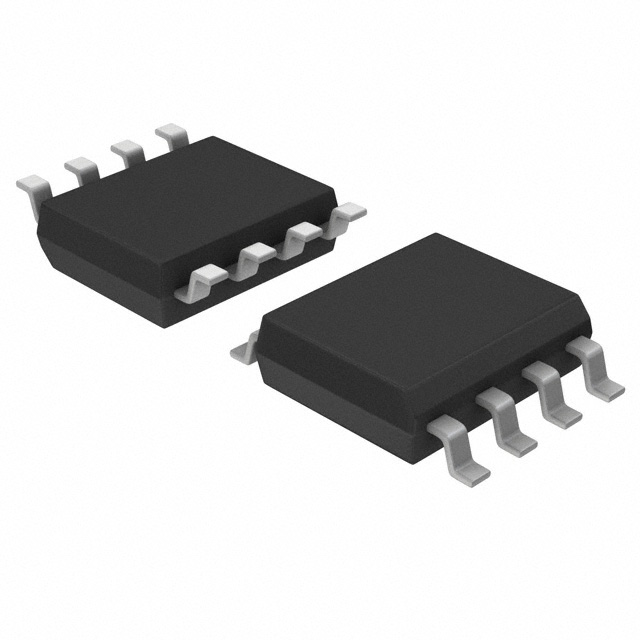
The USB50812C-A/TR13 is a transient voltage suppressor (TVS) diode manufactured by Microchip Technology, designed for surface mount applications in Ethernet protection circuits. This bidirectional, 2-channel Zener diode is in active production status. Finding alternative components becomes necessary when the primary part reaches end-of-life, experiences supply constraints, or when design requirements demand alternative electrical or mechanical characteristics within the same functional category.
Substiute Parts
Key Parameters
| Parameter | Value |
|---|---|
| Manufacturer | Microchip Technology |
| Category | Transient Voltage Suppressors (TVS) |
| Package Type | 8-SOIC (0.154", 3.90mm Width) |
| Mounting Type | Surface Mount |
| Voltage - Reverse Standoff (Typ) | 12V |
| Voltage - Breakdown (Min) | 13.3V |
| Voltage - Clamping (Max) @ Ipp | 26V |
| Current - Peak Pulse (8/20µs) | 5A |
| Power - Peak Pulse | 500W |
| Operating Temperature Range | -55°C to 150°C (TJ) |
| Capacitance @ 1MHz | 3pF |
| Product Status | Active |
Substitute Part Grouping Explanation
The SMDA12C.TBT from Semtech Corporation qualifies as an electrical substitute based on the following critical parameters:
Matching Parameters:
- Voltage - Reverse Standoff (Typ): 12V
- Voltage - Breakdown (Min): 13.3V
- Package / Case: 8-SOIC (0.154", 3.90mm Width)
- Mounting Type: Surface Mount
- Operating Temperature Range: -55°C to 125°C (TJ)
The substitute maintains identical standoff and breakdown voltage specifications, ensuring functional compatibility in the same circuit applications. Both devices use the 8-SOIC surface mount package, allowing direct physical replacement on PCBs without layout modifications.
Parameter Comparison
| Parameter | USB50812C-A/TR13 (Main) | SMDA12C.TBT (Substitute) |
|---|---|---|
| Manufacturer | Microchip Technology | Semtech Corporation |
| Type | Zener (Bidirectional, 2 Channels) | Zener (Bidirectional, 4 Channels) |
| Voltage - Reverse Standoff (Typ) | 12V | 12V (Max) |
| Voltage - Breakdown (Min) | 13.3V | 13.3V |
| Voltage - Clamping (Max) @ Ipp | 26V | 24V |
| Current - Peak Pulse (8/20µs) | 5A | 12A |
| Power - Peak Pulse | 500W | 300W |
| Operating Temperature Range | -55°C to 150°C (TJ) | -55°C to 125°C (TJ) |
| Capacitance @ 1MHz | 3pF | 120pF |
| Package / Case | 8-SOIC (0.154", 3.90mm Width) | 8-SOIC (0.154", 3.90mm Width) |
| RoHS Status | RoHS non-compliant | ROHS3 Compliant |
Engineering Selection Recommendations
The SMDA12C.TBT serves as a viable substitute when the primary USB50812C-A/TR13 is unavailable. The SMDA12C.TBT offers ROHS3 compliance, providing regulatory advantage in applications where RoHS compliance is required. However, the main part maintains superior thermal performance with an extended operating temperature range of 150°C compared to the substitute's 125°C maximum.
The clamping voltage differential (26V versus 24V) and higher peak pulse current capability (12A versus 5A) of the substitute indicate different performance characteristics. The substitute features increased channel count (4 versus 2) and significantly higher capacitance (120pF versus 3pF), which may affect circuit performance in time-sensitive applications.
Selection should be based on compliance requirements, available inventory, and whether the substitute's higher capacitance and temperature limitations are compatible with the end application.
Frequently Asked Questions (FAQ)
Q: Are USB50812C-A/TR13 and SMDA12C.TBT pin-compatible?
A: Yes. Both devices use the 8-SOIC surface mount package with identical physical dimensions (0.154", 3.90mm Width), enabling direct PCB replacement without layout modifications.
Q: Do both parts have identical voltage specifications?
A: Both devices share the same Voltage - Reverse Standoff (12V) and Voltage - Breakdown (13.3V) specifications. The main difference is the Voltage - Clamping specification: USB50812C-A/TR13 clamps at 26V maximum, while SMDA12C.TBT clamps at 24V maximum.
Q: What is the significance of the different capacitance ratings?
A: Capacitance values (3pF versus 120pF) affect high-frequency circuit behavior. The lower capacitance of the USB50812C-A/TR13 is preferred for high-speed digital interfaces like Ethernet, while the substitute's higher capacitance may introduce additional impedance variations in fast-switching applications.
Q: Are there temperature limitations I should be aware of?
A: The USB50812C-A/TR13 operates to 150°C, while the SMDA12C.TBT operates to 125°C. Applications requiring thermal operation above 125°C necessitate the main part.
Q: Does the substitute offer better current handling?
A: The SMDA12C.TBT supports a peak pulse current of 12A compared to 5A for the USB50812C-A/TR13. However, the substitute's lower peak pulse power (300W versus 500W) reflects its overall power dissipation capability.
Q: Which part should I select for RoHS-compliant applications?
A: The SMDA12C.TBT is ROHS3 compliant, making it the required choice for applications subject to RoHS regulations. The USB50812C-A/TR13 is RoHS non-compliant.
Alternative Parts

SJ6012L2TP
Littelfuse Inc.
6 Alternative Parts

JMK107BBJ476MA-RE
Taiyo Yuden
10 Alternative Parts

GMK107BBJ475MA-T
Taiyo Yuden
5 Alternative Parts
SJ6020N2ARP
Littelfuse Inc.
3 Alternative Parts
SJ6025R2ATP
Littelfuse Inc.
4 Alternative Parts

2474-05L
API Delevan Inc.
1 Alternative Parts

4590R-684K
API Delevan Inc.
1 Alternative Parts

CM6560R-334
API Delevan Inc.
1 Alternative Parts

CM6460-104
API Delevan Inc.
1 Alternative Parts

5526-12
API Delevan Inc.
1 Alternative Parts