


Request Quote
(Ships tomorrow)
TVS528 Transient Voltage Suppressor — Equivalent & Substitute Parts
Part Overview
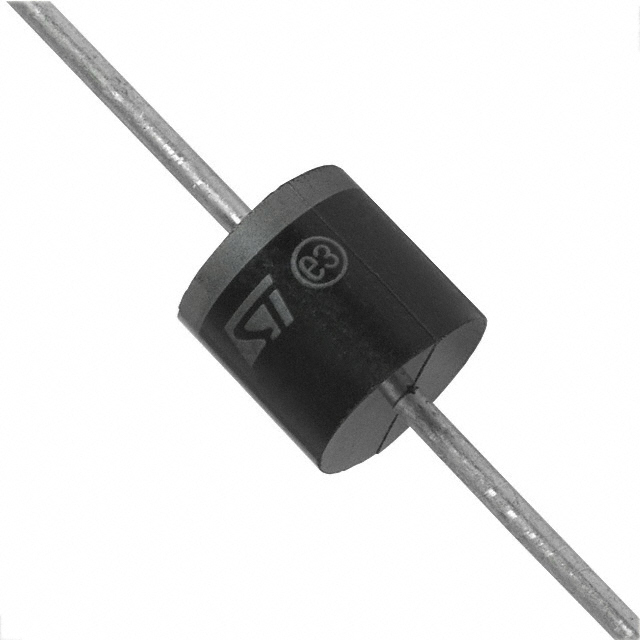
The TVS528 is a unidirectional transient voltage suppressor diode manufactured by Microchip Technology, designed for general-purpose overvoltage protection in through-hole axial applications. With a 28V reverse standoff voltage and 46.5V maximum clamping voltage, this active product provides 10.7A peak pulse current handling (8/20µs) with 500W peak pulse power dissipation across an operating temperature range of -65°C to 175°C.
Finding equivalent or substitute components is necessary when inventory constraints occur, when RoHS3 compliance is required, or when application performance margins permit selection from qualified alternatives with comparable electrical characteristics.
Substiute Parts
Key Parameters
| Parameter | Value | Unit |
|---|---|---|
| Voltage - Reverse Standoff (Typical) | 28 | V |
| Voltage - Breakdown (Minimum) | 30.7 | V |
| Voltage - Clamping (Maximum) @ Ipp | 46.5 | V |
| Current - Peak Pulse (8/20µs) | 10.7 | A |
| Power - Peak Pulse | 500 | W |
| Mounting Type | Through Hole, Axial | - |
| Operating Temperature Range | -65 to 175 | °C |
| Type | Zener | - |
| Unidirectional Channels | 1 | - |
Substitute Part Grouping Explanation
Substitution between the TVS528 and the LDP24A/LDP24ARL series is determined by the following electrical and mechanical parameters:
Substitution-Critical Parameters:
- Voltage class compatibility: Reverse standoff voltage (24V for substitutes vs. 28V for main part)
- Peak pulse current handling: Minimum 10.7A requirement
- Clamping voltage performance: Maximum 46.5V threshold
- Mounting type: Through-hole axial configuration
- Unidirectional protection: Single-channel suppression
Substitution Constraints:
- The LDP24A and LDP24ARL both operate at 24V reverse standoff (lower than the 28V TVS528), making them suitable for applications where the protected circuit operates at or below 24V nominal voltage.
- Current handling: LDP substitutes provide 30A peak pulse, exceeding the TVS528's 10.7A specification.
- Both substitute parts maintain the same through-hole axial package requirement and general-purpose application profile.
Parameter Comparison
| Parameter | TVS528 (Microchip) | LDP24A (STMicroelectronics) | LDP24ARL (STMicroelectronics) |
|---|---|---|---|
| Manufacturer Part Number | TVS528 | LDP24A | LDP24ARL |
| Voltage - Reverse Standoff (Typical) | 28V | 24V | 24V |
| Voltage - Breakdown (Minimum) | 30.7V | 25V | 25V |
| Voltage - Clamping (Maximum) @ Ipp | 46.5V | 40V | 40V |
| Current - Peak Pulse (8/20µs) | 10.7A | 30A | 30A |
| Type | Zener | Zener | Zener |
| Mounting Type | Through Hole, B Axial | Through Hole, R-6 Axial | Through Hole, R-6 Axial |
| Operating Temperature Range | -65 to 175°C | Not specified | Not specified |
| Product Status | Active | Active | Active |
| RoHS Status | Non-compliant | ROHS3 Compliant | ROHS3 Compliant |
| Capacitance @ 1MHz | Not specified | 8000pF | 8000pF |
Engineering Selection Recommendations
Product Status: All three parts maintain active production status with current inventory availability.
RoHS Compliance: The TVS528 is RoHS non-compliant, while both LDP24A and LDP24ARL are ROHS3 compliant. Selection of LDP-series substitutes is required for applications subject to RoHS3 regulatory requirements or supply chain restrictions on non-compliant components.
Electrical Performance: The LDP24A and LDP24ARL operate at a lower voltage class (24V standoff vs. 28V), requiring circuit validation to confirm the application can operate within this voltage specification. Both substitutes provide superior current handling (30A vs. 10.7A), offering additional margin for transient suppression.
Packaging: The TVS528 uses B-axial packaging, while LDP substitutes use R-6 axial packaging. Physical board layout and component lead spacing must be verified for mechanical compatibility.
Selection Logic: Choose LDP24A or LDP24ARL when RoHS3 compliance is mandatory. Choose TVS528 when higher voltage standoff (28V) is required and RoHS compliance is not a constraint.
Frequently Asked Questions (FAQ)
Q: Can LDP24A or LDP24ARL directly replace TVS528 in my circuit? A: Direct replacement requires verification that your circuit operates at or below 24V nominal voltage. The substitute parts are rated for 24V reverse standoff, which is 4V lower than the TVS528. Peak pulse current performance (30A for substitutes vs. 10.7A for TVS528) provides additional margin.
Q: What is the difference between LDP24A and LDP24ARL? A: Both parts are electrically identical with identical electrical specifications. The primary difference is packaging designation: LDP24A and LDP24ARL both use R-6 axial configuration and are supplied in cut tape format. No functional difference exists for circuit performance.
Q: Does the different package designation (B axial vs. R-6 axial) affect substitution? A: Package geometry must be verified for physical compatibility on your PCB. The axial lead spacing, wire gauge, and body dimensions may differ between B and R-6 configurations. Component lead length and pitch require measurement and validation against board layout constraints.
Q: Which substitute should I select if both LDP24A and LDP24ARL have identical specifications? A: Selection between LDP24A and LDP24ARL is based on supplier availability and procurement preference, as both provide identical electrical performance and RoHS3 compliance. Inventory levels differ (LDP24A: 2697 pcs, LDP24ARL: 1577 pcs), which may influence lead time and supply chain continuity.
Q: What happens if I use a 24V-rated part in a 28V application? A: Using a 24V rated part (LDP24A/LDP24ARL) in a circuit designed for 28V protection will result in earlier clamp activation and increased power dissipation at design voltage. Circuit redesign or alternative protection topology is required for 28V applications.
Q: Are all three parts suitable for general-purpose applications? A: Yes. All three parts are classified for general-purpose transient voltage suppression. Application-specific margins for voltage, current, and thermal performance must be calculated based on your circuit requirements and operating conditions.
Alternative Parts

SJ6012L2TP
Littelfuse Inc.
6 Alternative Parts

JMK107BBJ476MA-RE
Taiyo Yuden
10 Alternative Parts

GMK107BBJ475MA-T
Taiyo Yuden
5 Alternative Parts
SJ6020N2ARP
Littelfuse Inc.
3 Alternative Parts
SJ6025R2ATP
Littelfuse Inc.
4 Alternative Parts

2474-05L
API Delevan Inc.
1 Alternative Parts

4590R-684K
API Delevan Inc.
1 Alternative Parts

CM6560R-334
API Delevan Inc.
1 Alternative Parts

CM6460-104
API Delevan Inc.
1 Alternative Parts

5526-12
API Delevan Inc.
1 Alternative Parts