




Request Quote
(Ships tomorrow)
TST30U60C Equivalent & Substitute Parts
Part Overview
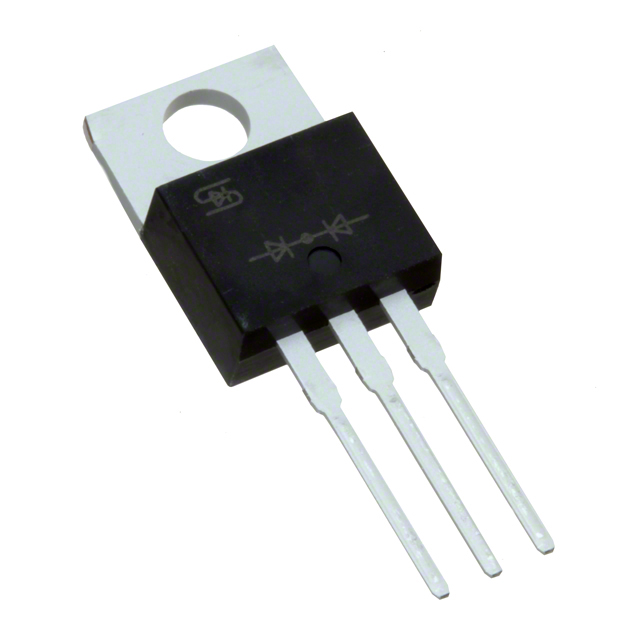
The TST30U60C is an active Schottky diode rectifier manufactured by Taiwan Semiconductor Corporation, rated for 60 V DC reverse voltage and 15 A average rectified current in a Through Hole TO-220AB package. This component is designed for fast recovery applications with switching speeds ≤ 500 ns and forward voltage of 570 mV at 15 A. The part is ROHS3 compliant and carries unlimited moisture sensitivity level (MSL 1), making it suitable for general industrial and commercial rectification applications. Equivalent and substitute parts are identified for applications requiring alternative voltage ratings, package configurations, or manufacturer sourcing options while maintaining functional compatibility within specified electrical parameters.
Substiute Parts
Key Parameters
| Parameter | Value | Unit |
|---|---|---|
| Voltage - DC Reverse (Vr) (Max) | 60 | V |
| Current - Average Rectified (Io) | 15 | A |
| Voltage - Forward (Vf) (Max) @ If | 570 mV @ 15 A | mV |
| Speed | Fast Recovery ≤ 500 ns, > 200 mA (Io) | ns |
| Current - Reverse Leakage @ Vr | 500 | µA @ 60 V |
| Operating Temperature - Junction | -55 to 150 | °C |
| Mounting Type | Through Hole | - |
| Package / Case | TO-220-3 | - |
| Technology | Schottky | - |
| RoHS Status | ROHS3 Compliant | - |
Substitute Part Grouping Explanation
Substitute parts for the TST30U60C are identified based on the following critical parameters that determine functional compatibility:
Primary Substitution Criteria:
- Mounting Type: Through Hole (required for mechanical compatibility)
- Package Family: TO-220 series (TO-220-3, TO-220AB, TO-204AA/TO-3 acceptable)
- Current Rating: Minimum 15 A average rectified current
- Voltage Rating: Minimum 60 V DC reverse voltage
- Technology: Schottky or Standard rectifier diodes
- Speed Classification: Fast Recovery or Standard Recovery
- Operating Temperature Range: Minimum -55°C to 150°C junction temperature
- Compliance: ROHS3 compliant preferred; REACH status noted
Substitution Logic: Parts are grouped as equivalent when they maintain or exceed the electrical performance specifications of the main part while accommodating different voltage ratings, diode configurations (single vs. array), and recovery speeds. Voltage ratings above 60 V provide design margin for higher-voltage applications. Diode array configurations (1 Pair Common Cathode) are acceptable substitutes when individual diode ratings meet or exceed the TST30U60C specifications.
Parameter Comparison
| Parameter | TST30U60C | ST30200C | ST3060C |
|---|---|---|---|
| Manufacturer | Taiwan Semiconductor Corporation | SMC Diode Solutions | Microchip Technology |
| Voltage - DC Reverse (Vr) (Max) | 60 V | 200 V | 600 V |
| Current - Average Rectified (Io) | 15 A | Per Diode: Not Specified | 15 A (per Diode) |
| Voltage - Forward (Vf) (Max) @ If | 570 mV @ 15 A | 1.1 V @ 15 A | 1.2 V @ 15 A |
| Speed | Fast Recovery ≤ 500 ns | Fast Recovery ≤ 500 ns | Standard Recovery > 500 ns |
| Current - Reverse Leakage @ Vr | 500 µA @ 60 V | 160 µA @ 200 V | 10 µA @ 600 V |
| Operating Temperature - Junction | -55°C to 150°C | -55°C to 150°C | -65°C to 200°C |
| Mounting Type | Through Hole | Through Hole | Through Hole |
| Package / Case | TO-220-3 | TO-220-3 | TO-204AA, TO-3 |
| Technology | Schottky | Schottky | Standard |
| Diode Configuration | Single Diode | 1 Pair Common Cathode | 1 Pair Common Cathode |
| RoHS Status | ROHS3 Compliant | ROHS3 Compliant | Not Specified |
| Packaging Type | Tube | Tube | Bulk |
Engineering Selection Recommendations
ST30200C (SMC Diode Solutions): This substitute provides a 200 V rated Schottky diode array with 1 Pair Common Cathode configuration. It maintains fast recovery speed (≤ 500 ns) and identical operating temperature range (-55°C to 150°C). The higher voltage rating (200 V vs. 60 V) accommodates applications requiring additional voltage margin. Both parts are ROHS3 compliant and packaged in TO-220-3 through-hole format. The diode array configuration requires circuit design consideration for common cathode topology. Forward voltage is higher at 1.1 V compared to 570 mV, resulting in increased power dissipation. This substitute is suitable for higher-voltage applications where the common cathode configuration is compatible with circuit requirements.
ST3060C (Microchip Technology): This substitute is a standard recovery diode array rated for 600 V with 15 A per diode current rating and 1 Pair Common Cathode configuration. It provides significantly higher voltage capability (600 V) and extended operating temperature range (-65°C to 200°C). Recovery speed is standard (> 500 ns) rather than fast recovery, making it unsuitable for high-frequency switching applications. Forward voltage is 1.2 V at 15 A, resulting in higher power dissipation than the main part. The TO-204AA (TO-3) package differs from the TO-220-3 format, requiring different PCB footprint and thermal management considerations. This substitute is applicable for high-voltage, low-frequency rectification applications where the standard recovery speed and diode array configuration are acceptable.
Compliance and Sourcing: All three parts maintain Through Hole mounting type and support industrial temperature ranges. The TST30U60C and ST30200C are ROHS3 compliant with identical MSL ratings. ST3060C RoHS status is not specified in available data. Selection between substitutes depends on voltage requirements, switching speed requirements, thermal dissipation tolerance, and circuit topology compatibility with diode array configurations.
Frequently Asked Questions (FAQ)
Q: Can ST30200C replace TST30U60C in a 60 V application? A: Yes, ST30200C is electrically compatible for 60 V applications. The 200 V rating provides design margin above the 60 V requirement. However, the diode array configuration (1 Pair Common Cathode) requires verification that the circuit topology accommodates common cathode connection. Forward voltage is higher (1.1 V vs. 570 mV), increasing power dissipation by approximately 93%.
Q: Is ST3060C suitable for fast-switching applications? A: No. ST3060C uses standard recovery technology (> 500 ns) compared to TST30U60C fast recovery (≤ 500 ns). Standard recovery diodes are not suitable for high-frequency switching applications where fast recovery is required. ST3060C is limited to low-frequency rectification circuits.
Q: What is the impact of the diode array configuration on circuit design? A: Both ST30200C and ST3060C are configured as 1 Pair Common Cathode diode arrays, meaning two diodes share a common cathode connection. This differs from the single-diode TST30U60C. Circuit design must accommodate the common cathode topology. These substitutes are suitable for bridge rectifier configurations or dual-diode applications where common cathode connection is required.
Q: Are all three parts pin-compatible? A: TST30U60C and ST30200C share identical TO-220-3 package and pin configuration, making them mechanically and electrically pin-compatible. ST3060C uses TO-204AA (TO-3) package, which has different pin configuration and requires different PCB footprint. ST3060C is not pin-compatible with the main part.
Q: What are the thermal dissipation differences between these parts? A: Forward voltage differences directly impact thermal dissipation. TST30U60C dissipates 570 mV × 15 A = 8.55 W at full current. ST30200C dissipates 1.1 V × 15 A = 16.5 W (93% higher). ST3060C dissipates 1.2 V × 15 A = 18 W (111% higher). Higher dissipation requires enhanced thermal management and heatsinking.
Q: Are all parts available in the same packaging quantities? A: No. TST30U60C and ST30200C are supplied in Tube packaging. ST3060C is supplied in Bulk packaging. Tube packaging is standard for component handling and automated assembly. Bulk packaging may require additional processing for integration into production workflows.
Q: What is the significance of REACH status differences? A: TST30U60C and ST3060C carry REACH Unaffected status, indicating no regulatory restrictions under REACH regulations. ST30200C carries REACH Affected status, requiring compliance verification for applications in REACH-regulated markets. This does not affect technical performance but may impact supply chain and regulatory documentation requirements.
Alternative Parts

SJ6012L2TP
Littelfuse Inc.
6 Alternative Parts

JMK107BBJ476MA-RE
Taiyo Yuden
10 Alternative Parts

GMK107BBJ475MA-T
Taiyo Yuden
5 Alternative Parts
SJ6020N2ARP
Littelfuse Inc.
3 Alternative Parts
SJ6025R2ATP
Littelfuse Inc.
4 Alternative Parts

2474-05L
API Delevan Inc.
1 Alternative Parts

4590R-684K
API Delevan Inc.
1 Alternative Parts

CM6560R-334
API Delevan Inc.
1 Alternative Parts

CM6460-104
API Delevan Inc.
1 Alternative Parts

5526-12
API Delevan Inc.
1 Alternative Parts