


Request Quote
(Ships tomorrow)
TSHA4400 Equivalent & Substitute Parts
Part Overview
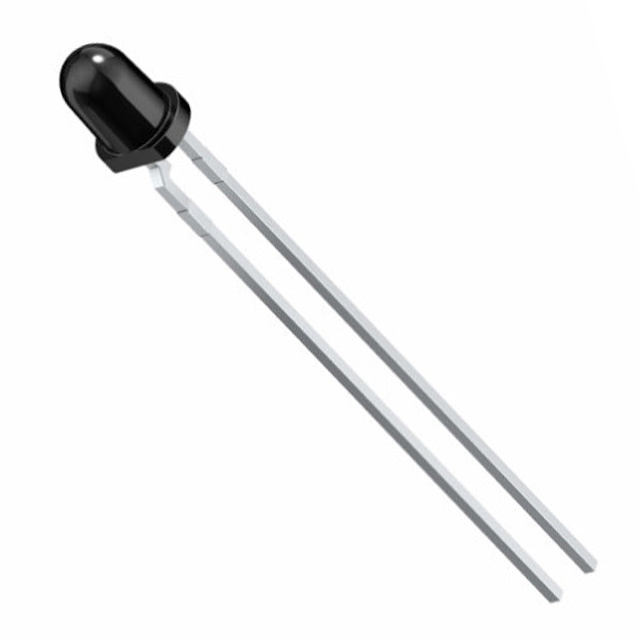
The TSHA4400 is an infrared (IR) emitter manufactured by Vishay Semiconductor Opto Division, designed for applications requiring 875nm wavelength emission at 100mA forward current. This component features a radial, 3mm diameter (T-1) through-hole package and delivers 12mW/sr radiant intensity with a 40° viewing angle.
The TSHA4400 is classified as obsolete. Identifying suitable substitute components is necessary to maintain design continuity and ensure component availability for new production runs and field replacements.
Substiute Parts
Key Parameters
| Parameter | Value | Unit |
|---|---|---|
| Wavelength | 875 | nm |
| Current - DC Forward (If) Max | 100 | mA |
| Voltage - Forward (Vf) Typical | 1.5 | V |
| Radiant Intensity (Ie) Min @ If | 12 | mW/sr @ 100mA |
| Viewing Angle | 40 | ° |
| Operating Temperature Range | -40 to 85 | °C |
| Mounting Type | Through Hole | — |
| Package / Case | Radial, 3mm Dia (T-1) | — |
| RoHS Status | ROHS3 Compliant | — |
Substitute Part Grouping Explanation
Substitution of the TSHA4400 is determined by the following critical parameters:
- Wavelength compatibility: The substitute must operate within the near-infrared spectrum suitable for the application. The TSHA4400 operates at 875nm; acceptable substitutes may operate at adjacent wavelengths (850nm–900nm range) depending on application requirements.
- Forward current rating: The substitute must support the same maximum DC forward current (100mA) to ensure circuit compatibility without redesign.
- Forward voltage: The substitute forward voltage must be compatible with existing circuit bias networks. The TSHA4400 operates at 1.5V typical; substitutes with similar voltage ratings minimize circuit modifications.
- Radiant intensity: The substitute must deliver sufficient radiant intensity to meet application performance requirements.
- Viewing angle: The substitute viewing angle must be compatible with the optical system design.
- Package and mounting: The substitute must use through-hole radial packaging to ensure mechanical and electrical compatibility with existing PCB layouts.
- Compliance certifications: The substitute must maintain RoHS3 compliance and REACH unaffected status.
Parameter Comparison
| Parameter | TSHA4400 (Vishay) | SFH 4356 (ams-OSRAM) | Compatibility Notes |
|---|---|---|---|
| Wavelength | 875 nm | 850 nm | 25nm difference; verify application tolerance |
| Current - DC Forward (If) Max | 100 mA | 100 mA | Matched |
| Voltage - Forward (Vf) Typical | 1.5 V | 1.7 V | 0.2V difference; circuit bias adjustment may be required |
| Radiant Intensity (Ie) Min @ If | 12 mW/sr @ 100mA | 40 mW/sr @ 100mA | SFH 4356 delivers higher intensity |
| Viewing Angle | 40° | 20° | SFH 4356 has narrower beam; verify optical system compatibility |
| Operating Temperature Range | -40 to 85°C | -40 to 100°C | SFH 4356 supports extended upper temperature limit |
| Mounting Type | Through Hole | Through Hole | Matched |
| Package / Case | Radial, 3mm Dia (T-1) | Radial | Both radial through-hole; mechanical compatibility confirmed |
| RoHS Status | ROHS3 Compliant | ROHS3 Compliant | Matched |
Engineering Selection Recommendations
The SFH 4356 (ams-OSRAM USA INC.) is the manufacturer-recommended substitute for the obsolete TSHA4400. Both components maintain ROHS3 compliance and REACH unaffected status, ensuring regulatory alignment.
Selection of the SFH 4356 requires verification of the following application-specific factors:
- Wavelength shift: The 25nm difference (875nm to 850nm) must be compatible with the optical receiver or sensor used in the application.
- Forward voltage adjustment: The 0.2V increase in typical forward voltage may require circuit bias network recalibration to maintain proper operating point.
- Viewing angle narrowing: The reduction from 40° to 20° affects the spatial distribution of infrared emission; optical system geometry must accommodate this narrower beam profile.
- Radiant intensity increase: The SFH 4356 delivers 40mW/sr compared to 12mW/sr, providing higher optical power output; circuit current limiting must be verified to prevent over-driving the component.
- Extended temperature range: The SFH 4356 supports operation to 100°C, providing additional thermal margin for high-temperature applications.
Frequently Asked Questions (FAQ)
Q: Can the SFH 4356 be used as a direct drop-in replacement for the TSHA4400?
A: The SFH 4356 shares the same through-hole radial package and 100mA current rating, enabling mechanical and electrical compatibility. However, differences in wavelength (850nm vs. 875nm), forward voltage (1.7V vs. 1.5V), viewing angle (20° vs. 40°), and radiant intensity (40mW/sr vs. 12mW/sr) require application-level verification before deployment.
Q: What is the impact of the wavelength difference between TSHA4400 and SFH 4356?
A: The TSHA4400 operates at 875nm while the SFH 4356 operates at 850nm. This 25nm difference may affect receiver sensitivity and system performance depending on the optical receiver's spectral response curve. Applications with narrowband receiver filters or specific wavelength requirements must validate compatibility.
Q: Does the narrower viewing angle of the SFH 4356 affect system performance?
A: The SFH 4356 has a 20° viewing angle compared to the TSHA4400's 40° angle. This narrower beam concentrates optical power in a smaller spatial region. Applications requiring wide-angle emission must evaluate whether the reduced beam width is acceptable for the intended optical geometry.
Q: Are circuit modifications required when substituting the SFH 4356 for the TSHA4400?
A: The forward voltage difference (1.7V vs. 1.5V) may require adjustment of bias resistors or current-limiting networks. The higher radiant intensity of the SFH 4356 must be verified against circuit current limits to prevent component over-stress. Detailed circuit analysis is necessary before implementation.
Q: Do both components meet the same compliance standards?
A: Yes. Both the TSHA4400 and SFH 4356 are ROHS3 compliant and REACH unaffected, ensuring regulatory alignment for applications subject to these standards.
Alternative Parts

SJ6012L2TP
Littelfuse Inc.
6 Alternative Parts

JMK107BBJ476MA-RE
Taiyo Yuden
10 Alternative Parts

GMK107BBJ475MA-T
Taiyo Yuden
5 Alternative Parts
SJ6020N2ARP
Littelfuse Inc.
3 Alternative Parts
SJ6025R2ATP
Littelfuse Inc.
4 Alternative Parts

2474-05L
API Delevan Inc.
1 Alternative Parts

4590R-684K
API Delevan Inc.
1 Alternative Parts

CM6560R-334
API Delevan Inc.
1 Alternative Parts

CM6460-104
API Delevan Inc.
1 Alternative Parts

5526-12
API Delevan Inc.
1 Alternative Parts