


Request Quote
(Ships tomorrow)
TLV2711IDBVR Equivalent & Substitute Parts
Part Overview
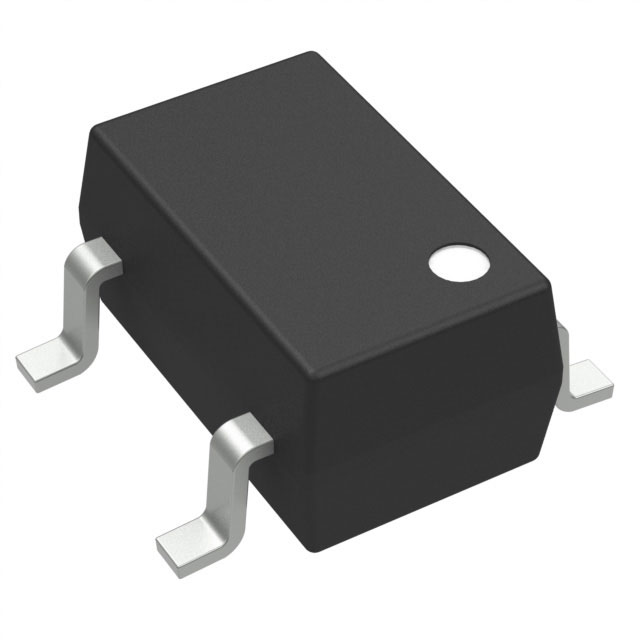
The TLV2711IDBVR is a general-purpose operational amplifier manufactured by Texas Instruments, designed for rail-to-rail signal processing applications. This device is classified as a linear amplifier with a single circuit configuration in SOT-23-5 surface mount packaging. The part is currently in active production status with 2046 units available in inventory.
Substitute parts are identified when equivalent functional performance can be achieved within the specified electrical and mechanical parameters of the original component. The TLV2711IDBVR operates across a supply voltage range of 2.7 V to 10 V with low input bias current and is suitable for battery-powered and low-power applications requiring rail-to-rail output capability.
Substiute Parts
Key Parameters
| Parameter | Value | Unit |
|---|---|---|
| Amplifier Type | General Purpose | — |
| Number of Circuits | 1 | — |
| Output Type | Rail-to-Rail | — |
| Slew Rate | 0.025 | V/µs |
| Gain Bandwidth Product | 65 | kHz |
| Current - Input Bias | 1 | pA |
| Voltage - Input Offset | 450 | µV |
| Current - Supply | 13 | µA |
| Current - Output / Channel | 50 | mA |
| Voltage - Supply Span (Min) | 2.7 | V |
| Voltage - Supply Span (Max) | 10 | V |
| Operating Temperature | -40 to 85 | °C |
| Mounting Type | Surface Mount | — |
| Package / Case | SC-74A, SOT-753 | — |
| RoHS Status | ROHS3 Compliant | — |
| Moisture Sensitivity Level | 1 (Unlimited) | — |
Substitute Part Grouping Explanation
Substitution eligibility for the TLV2711IDBVR is determined by the following critical parameters:
Functional Equivalence Criteria:
- Amplifier Type: General Purpose
- Number of Circuits: 1
- Output Type: Rail-to-Rail
- Operating Temperature Range: -40°C to 85°C
- Mounting Type: Surface Mount
Electrical Compatibility Criteria:
- Supply voltage range must encompass or be compatible with 2.7 V to 10 V
- Input bias current: 1 pA (maximum specification)
- Output current capability: minimum 50 mA per channel
Mechanical & Compliance Criteria:
- Package compatibility: SOT-23-5 or equivalent footprint
- RoHS3 Compliance required
- Moisture Sensitivity Level: 1 (Unlimited)
The NCS7101SN1T1G from onsemi qualifies as a manufacturer-recommended substitute based on matching functional classification, supply voltage compatibility, and compliance certifications.
Parameter Comparison
| Parameter | TLV2711IDBVR (Texas Instruments) | NCS7101SN1T1G (onsemi) | Unit |
|---|---|---|---|
| Amplifier Type | General Purpose | General Purpose | — |
| Number of Circuits | 1 | 1 | — |
| Output Type | Rail-to-Rail | Rail-to-Rail | — |
| Slew Rate | 0.025 | 1.2 | V/µs |
| Gain Bandwidth Product | 65 | 1000 | kHz |
| Current - Input Bias | 1 | 1 | pA |
| Voltage - Input Offset | 450 | 600 | µV |
| Current - Supply | 13 | 1130 | µA |
| Current - Output / Channel | 50 | 72 | mA |
| Voltage - Supply Span (Min) | 2.7 | 1.8 | V |
| Voltage - Supply Span (Max) | 10 | 10 | V |
| Operating Temperature | -40 to 85 | -40 to 85 | °C |
| Mounting Type | Surface Mount | Surface Mount | — |
| Package / Case | SC-74A, SOT-753 | SOT-23-5 Thin, TSOT-23-5 | — |
| RoHS Status | ROHS3 Compliant | ROHS3 Compliant | — |
| Moisture Sensitivity Level | 1 (Unlimited) | 1 (Unlimited) | — |
Engineering Selection Recommendations
Primary Part: TLV2711IDBVR
The TLV2711IDBVR is the original specification component. Current inventory status shows 2046 units available. This part is ROHS3 compliant and carries unlimited moisture sensitivity rating (MSL 1), indicating no special storage or handling requirements. The device is classified as active product status with full manufacturer support.
Substitute Part: NCS7101SN1T1G
The NCS7101SN1T1G is the manufacturer-recommended equivalent from onsemi. This substitute maintains functional equivalence as a general-purpose, single-circuit, rail-to-rail operational amplifier. Both parts share identical operating temperature range (-40°C to 85°C), input bias current specification (1 pA), and compliance certifications (ROHS3, MSL 1).
Key Differences in Electrical Performance:
The NCS7101SN1T1G exhibits higher slew rate (1.2 V/µs versus 0.025 V/µs) and significantly higher gain bandwidth product (1 MHz versus 65 kHz), indicating faster signal processing capability. Supply current consumption is substantially higher in the substitute (1.13 mA versus 13 µA), which is a critical consideration for battery-powered applications. Output current capability is improved in the substitute (72 mA versus 50 mA).
The substitute part operates at a lower minimum supply voltage (1.8 V versus 2.7 V), providing broader supply compatibility. Input offset voltage is slightly higher (600 µV versus 450 µV).
Selection Basis:
Both parts are active products with full compliance certifications. Selection between the primary and substitute should be based on application-specific requirements regarding power consumption, signal bandwidth, and minimum supply voltage constraints. The substitute provides enhanced performance metrics but at the cost of increased quiescent current draw.
Frequently Asked Questions (FAQ)
Q: Can the NCS7101SN1T1G directly replace the TLV2711IDBVR in all applications?
A: Both devices share the same functional classification (general-purpose, single-circuit, rail-to-rail operational amplifier) and identical operating temperature range. However, the substitute exhibits different electrical characteristics. The higher supply current (1.13 mA versus 13 µA) may impact battery-powered designs. The enhanced slew rate and bandwidth may introduce different circuit behavior in frequency-dependent applications. PCB layout and circuit design validation is required for each substitution instance.
Q: Are the packages physically compatible?
A: Both parts use SOT-23-5 surface mount packaging. The TLV2711IDBVR is specified as SC-74A/SOT-753, while the NCS7101SN1T1G is specified as SOT-23-5 Thin/TSOT-23-5. These designations refer to the same five-pin surface mount footprint. Physical placement and soldering compatibility are equivalent.
Q: What are the compliance and regulatory differences?
A: Both parts are ROHS3 compliant and carry MSL 1 (unlimited moisture sensitivity) rating. Both are classified under ECCN EAR99 and HTSUS 8542.33.0001. Regulatory and environmental compliance requirements are identical between the primary and substitute parts.
Q: Which part should be selected for low-power applications?
A: The TLV2711IDBVR is the appropriate choice for ultra-low-power designs, with supply current of 13 µA compared to 1.13 mA for the NCS7101SN1T1G. This represents a 87-fold difference in quiescent current consumption.
Q: What is the minimum supply voltage requirement for each part?
A: The TLV2711IDBVR requires a minimum supply voltage of 2.7 V. The NCS7101SN1T1G operates at a lower minimum of 1.8 V, providing compatibility with single-cell battery applications (1.5 V nominal) when supply regulation is employed.
Q: Are there bandwidth or frequency response considerations?
A: The TLV2711IDBVR has a gain bandwidth product of 65 kHz, suitable for low-frequency signal conditioning. The NCS7101SN1T1G provides 1 MHz bandwidth, appropriate for higher-frequency applications. Application frequency requirements determine which part is suitable.
Q: What is the inventory status for each part?
A: The TLV2711IDBVR has 2046 units in stock. The NCS7101SN1T1G has 35100 units available. Inventory levels may influence procurement decisions for high-volume production.
Alternative Parts

SJ6012L2TP
Littelfuse Inc.
6 Alternative Parts

JMK107BBJ476MA-RE
Taiyo Yuden
10 Alternative Parts

GMK107BBJ475MA-T
Taiyo Yuden
5 Alternative Parts
SJ6020N2ARP
Littelfuse Inc.
3 Alternative Parts
SJ6025R2ATP
Littelfuse Inc.
4 Alternative Parts

2474-05L
API Delevan Inc.
1 Alternative Parts

4590R-684K
API Delevan Inc.
1 Alternative Parts

CM6560R-334
API Delevan Inc.
1 Alternative Parts

CM6460-104
API Delevan Inc.
1 Alternative Parts

5526-12
API Delevan Inc.
1 Alternative Parts