



Request Quote
(Ships tomorrow)
TLV2548IDWR Equivalent & Substitute Parts
Part Overview
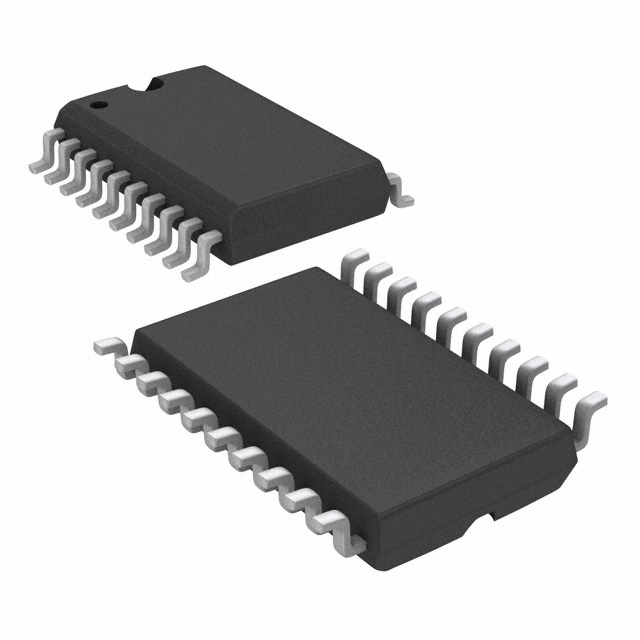
The TLV2548IDWR is a 12-bit Analog to Digital Converter (ADC) manufactured by Texas Instruments, designed for data acquisition applications requiring 8 single-ended inputs with a 200 kSPS sampling rate. The device features a Successive Approximation Register (SAR) architecture with integrated multiplexer and sample-and-hold functionality, housed in a 20-SOIC surface mount package.
This part has reached Last Time Buy status, making identification of functionally equivalent alternatives essential for ongoing design support and production continuity. The TLV2548IDWR operates across a wide supply voltage range of 2.7V to 5.5V for both analog and digital domains, with an extended operating temperature range of -40°C to 85°C.
Substiute Parts
Key Parameters
| Parameter | Value |
|---|---|
| Resolution | 12 Bits |
| Number of Inputs | 8 |
| Input Type | Single Ended |
| Sampling Rate | 200 kSPS |
| Architecture | SAR |
| Data Interface | SPI, DSP |
| Configuration | MUX-S/H-ADC |
| Analog Supply Voltage | 2.7V ~ 5.5V |
| Digital Supply Voltage | 2.7V ~ 5.5V |
| Operating Temperature | -40°C ~ 85°C |
| Package | 20-SOIC |
| RoHS Status | ROHS3 Compliant |
Substitute Part Grouping Explanation
Substitution of the TLV2548IDWR is determined by the following critical parameters:
- Resolution and Input Count: Both the main part and substitute must maintain 12-bit resolution with 8 single-ended inputs to preserve signal acquisition capability.
- Architecture: SAR architecture is required to maintain conversion methodology and timing characteristics.
- Data Interface Compatibility: The substitute must support SPI protocol as a minimum to ensure digital communication compatibility.
- Supply Voltage Compatibility: The substitute must operate within overlapping voltage ranges to function in existing power distribution designs.
- Operating Temperature Range: The substitute must support the required temperature envelope for the application.
- Compliance and Certification: RoHS3 compliance and REACH unaffected status ensure regulatory alignment.
The ADS7038IRTER qualifies as a manufacturer-recommended substitute based on these criteria, despite differences in package type, sampling rate, and additional integrated features.
Parameter Comparison
| Parameter | TLV2548IDWR | ADS7038IRTER |
|---|---|---|
| Manufacturer | Texas Instruments | Texas Instruments |
| Resolution | 12 Bits | 12 Bits |
| Number of Inputs | 8 | 8 |
| Input Type | Single Ended | Single Ended |
| Sampling Rate | 200 kSPS | 1 MSPS |
| Architecture | SAR | SAR |
| Data Interface | SPI, DSP | SPI |
| Number of A/D Converters | 1 | 1 |
| Analog Supply Voltage | 2.7V ~ 5.5V | 2.35V ~ 5.5V |
| Digital Supply Voltage | 2.7V ~ 5.5V | 1.65V ~ 5.5V |
| Operating Temperature | -40°C ~ 85°C | -40°C ~ 125°C |
| Package / Case | 20-SOIC | 16-WQFN (3x3) |
| Mounting Type | Surface Mount | Surface Mount |
| RoHS Status | ROHS3 Compliant | ROHS3 Compliant |
| MSL Rating | 1 (Unlimited) | 1 (Unlimited) |
| REACH Status | REACH Unaffected | REACH Unaffected |
| Product Status | Last Time Buy | Active |
Engineering Selection Recommendations
The ADS7038IRTER is designated as the manufacturer-recommended substitute for the TLV2548IDWR. Both devices maintain identical 12-bit resolution, 8-channel single-ended input configuration, and SAR architecture, ensuring functional equivalence for core data acquisition requirements.
The ADS7038IRTER offers extended product lifecycle status as an Active component, providing long-term availability and supply chain stability compared to the Last Time Buy status of the TLV2548IDWR. Both parts maintain ROHS3 compliance and REACH unaffected certification, satisfying regulatory requirements.
The substitute device supports an extended operating temperature range (-40°C to 125°C versus -40°C to 85°C), providing additional thermal margin for demanding applications. The ADS7038IRTER features a higher sampling rate of 1 MSPS compared to the 200 kSPS of the original part, enabling faster conversion cycles when required by system architecture.
Package transition from 20-SOIC to 16-WQFN requires PCB layout modification and updated footprint design. The ADS7038IRTER incorporates additional integrated features including digital window comparator, GPIO, and oscillator functionality not present in the TLV2548IDWR.
Frequently Asked Questions (FAQ)
Q: Can the ADS7038IRTER directly replace the TLV2548IDWR without design changes?
A: The ADS7038IRTER maintains functional equivalence in resolution, input count, and SAR architecture. However, the package change from 20-SOIC to 16-WQFN requires PCB footprint redesign and layout modification. Signal integrity considerations and power distribution routing must be re-evaluated for the new package geometry.
Q: What are the key differences in supply voltage requirements?
A: The TLV2548IDWR requires 2.7V to 5.5V for both analog and digital supplies. The ADS7038IRTER supports 2.35V to 5.5V for analog supply and 1.65V to 5.5V for digital supply, offering greater flexibility in low-voltage applications. Existing power distribution designs operating at 2.7V or above remain compatible with the substitute.
Q: How does the sampling rate difference affect system performance?
A: The ADS7038IRTER operates at 1 MSPS compared to the TLV2548IDWR's 200 kSPS, providing five times faster conversion capability. Applications limited by the original sampling rate may benefit from improved temporal resolution. Systems designed for 200 kSPS operation remain fully functional with the faster substitute through software-controlled conversion rate management.
Q: Are there compatibility considerations for the SPI interface?
A: Both devices support SPI protocol. The TLV2548IDWR additionally supports DSP interface, which is not available on the ADS7038IRTER. Applications utilizing only SPI communication experience no interface compatibility issues. Designs dependent on DSP interface functionality require alternative solutions.
Q: What packaging considerations apply to the substitution?
A: The transition from 20-SOIC (0.295" width, 7.50mm) to 16-WQFN (3x3mm) represents a significant package size reduction. PCB layout must accommodate the new footprint dimensions, via placement, and thermal management requirements. The WQFN package includes an exposed pad for enhanced thermal performance.
Alternative Parts

SJ6012L2TP
Littelfuse Inc.
6 Alternative Parts

JMK107BBJ476MA-RE
Taiyo Yuden
10 Alternative Parts

GMK107BBJ475MA-T
Taiyo Yuden
5 Alternative Parts
SJ6020N2ARP
Littelfuse Inc.
3 Alternative Parts
SJ6025R2ATP
Littelfuse Inc.
4 Alternative Parts

2474-05L
API Delevan Inc.
1 Alternative Parts

4590R-684K
API Delevan Inc.
1 Alternative Parts

CM6560R-334
API Delevan Inc.
1 Alternative Parts

CM6460-104
API Delevan Inc.
1 Alternative Parts

5526-12
API Delevan Inc.
1 Alternative Parts