



Request Quote
(Ships tomorrow)
STTH3010WY Equivalent & Substitute Parts
Part Overview
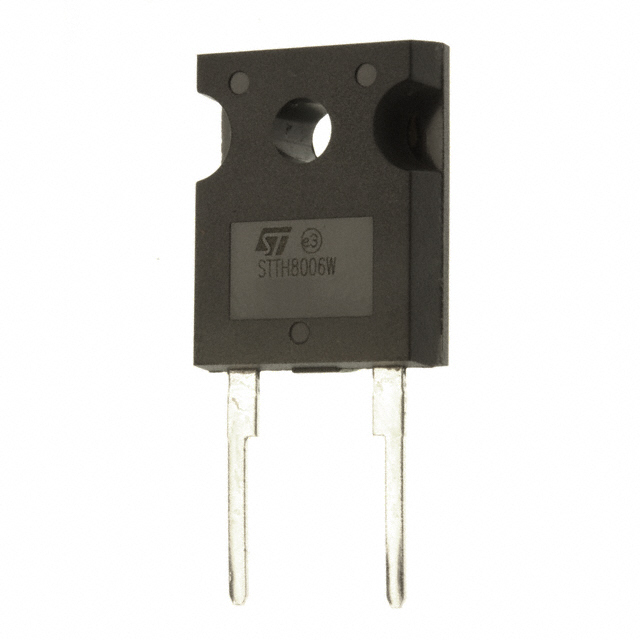
The STTH3010WY is a general-purpose rectifier diode manufactured by STMicroelectronics, rated for 1000 V DC reverse voltage and 30 A average rectified current. This through-hole component is designed for standard rectification applications requiring fast recovery characteristics. The part is actively produced and carries automotive-grade qualification (AEC-Q101), making it suitable for demanding industrial and automotive environments. Substitute parts are identified based on matching electrical performance parameters and compatible through-hole packaging configurations.
Substiute Parts
Key Parameters
| Parameter | Value | Unit |
|---|---|---|
| Voltage - DC Reverse (Vr) (Max) | 1000 | V |
| Current - Average Rectified (Io) | 30 | A |
| Voltage - Forward (Vf) (Max) @ If | 2 | V @ 30 A |
| Reverse Recovery Time (trr) | 100 | ns |
| Current - Reverse Leakage @ Vr | 15 | µA @ 1000 V |
| Speed Classification | Fast Recovery ≤ 500ns, > 200mA (Io) | - |
| Mounting Type | Through Hole | - |
| Package / Case | DO-247-2 (Straight Leads) | - |
| Operating Temperature - Junction | -40 to 175 | °C |
| RoHS Status | ROHS3 Compliant | - |
| Qualification | AEC-Q101 | - |
Substitute Part Grouping Explanation
Substitute parts for the STTH3010WY are identified based on the following critical electrical and mechanical parameters:
Matching Criteria:
- Voltage - DC Reverse (Vr) (Max): 1000 V
- Current - Average Rectified (Io): 30 A
- Speed Classification: Fast Recovery ≤ 500ns, > 200mA (Io)
- Mounting Type: Through Hole
- Package Category: DO-247 or equivalent TO-247 variants
The DSEI30-10A from IXYS meets these core substitution requirements. Both devices operate at identical reverse voltage and current ratings with fast recovery characteristics. Both are through-hole mounted components in compatible TO-247 package families, enabling direct functional substitution in rectification circuits.
Parameter Comparison
| Parameter | STTH3010WY (STMicroelectronics) | DSEI30-10A (IXYS) | Unit |
|---|---|---|---|
| Voltage - DC Reverse (Vr) (Max) | 1000 | 1000 | V |
| Current - Average Rectified (Io) | 30 | 30 | A |
| Voltage - Forward (Vf) (Max) @ If | 2 @ 30 A | 2.4 @ 36 A | V |
| Reverse Recovery Time (trr) | 100 | 50 | ns |
| Current - Reverse Leakage @ Vr | 15 @ 1000 V | 750 @ 1000 V | µA |
| Speed Classification | Fast Recovery ≤ 500ns, > 200mA (Io) | Fast Recovery ≤ 500ns, > 200mA (Io) | - |
| Mounting Type | Through Hole | Through Hole | - |
| Package / Case | DO-247-2 (Straight Leads) | TO-247-2 (TO-247AD) | - |
| Operating Temperature - Junction | -40 to 175 | -40 to 150 | °C |
| RoHS Status | ROHS3 Compliant | ROHS3 Compliant | - |
| Product Status | Active | Active | - |
Engineering Selection Recommendations
STTH3010WY (Primary Selection): The STTH3010WY is the primary component choice for applications requiring automotive-grade qualification. This part carries AEC-Q101 certification and operates across a junction temperature range of -40°C to 175°C, providing extended thermal performance. The lower reverse leakage current (15 µA @ 1000 V) and longer reverse recovery time (100 ns) are suitable for standard rectification circuits where leakage minimization is beneficial. Both the STTH3010WY and DSEI30-10A maintain ROHS3 compliance and REACH unaffected status.
DSEI30-10A (Substitute Selection): The DSEI30-10A from IXYS serves as a functional equivalent for applications where the substitute's electrical characteristics are acceptable. This part features a faster reverse recovery time (50 ns), which may provide advantages in high-frequency switching applications. The higher reverse leakage current (750 µA @ 1000 V) and slightly elevated forward voltage (2.4 V @ 36 A) must be evaluated against circuit design margins. The maximum junction temperature of 150°C is lower than the STTH3010WY, limiting use in high-temperature environments. Both parts are actively produced and maintain equivalent compliance certifications.
Frequently Asked Questions (FAQ)
Q: Can the DSEI30-10A directly replace the STTH3010WY in all applications?
A: The DSEI30-10A is electrically compatible for rectification circuits operating within its specified parameters. Both devices share identical 1000 V reverse voltage and 30 A current ratings with fast recovery characteristics. However, circuit designers must verify that the higher reverse leakage current (750 µA versus 15 µA) and elevated forward voltage (2.4 V versus 2 V) do not exceed design tolerances. The lower maximum junction temperature (150°C versus 175°C) restricts use in high-temperature applications.
Q: Are the DO-247-2 and TO-247-2 packages mechanically compatible?
A: The DO-247-2 (STTH3010WY) and TO-247-2 (DSEI30-10A) packages are through-hole mounted variants within the TO-247 family. Both feature straight leads and identical pin configurations for standard rectifier diodes. Mechanical compatibility exists for PCB mounting; however, component outline drawings should be consulted to confirm lead spacing and hole positioning match the target PCB design.
Q: What is the significance of the reverse recovery time difference?
A: The STTH3010WY exhibits a reverse recovery time of 100 ns, while the DSEI30-10A operates at 50 ns. Faster recovery times reduce switching losses in high-frequency applications but are not required for standard 50/60 Hz rectification. Circuit performance is not degraded by selecting the faster device; however, the slower device may introduce additional switching losses in applications exceeding several kilohertz.
Q: Do both parts meet automotive qualification requirements?
A: The STTH3010WY carries AEC-Q101 automotive qualification. The DSEI30-10A does not list automotive qualification in the provided specifications. Applications requiring automotive-grade components must use the STTH3010WY. Both parts maintain ROHS3 compliance and REACH unaffected status.
Q: What is the impact of reverse leakage current differences on circuit design?
A: The STTH3010WY exhibits 15 µA reverse leakage at 1000 V, while the DSEI30-10A exhibits 750 µA under identical conditions. Higher leakage current increases standby power dissipation and may affect circuit performance in precision applications. Standard rectification circuits typically tolerate both leakage levels; however, low-power or precision applications should account for the 50-fold difference in leakage specifications.
Alternative Parts

SJ6012L2TP
Littelfuse Inc.
6 Alternative Parts

JMK107BBJ476MA-RE
Taiyo Yuden
10 Alternative Parts

GMK107BBJ475MA-T
Taiyo Yuden
5 Alternative Parts
SJ6020N2ARP
Littelfuse Inc.
3 Alternative Parts
SJ6025R2ATP
Littelfuse Inc.
4 Alternative Parts

2474-05L
API Delevan Inc.
1 Alternative Parts

4590R-684K
API Delevan Inc.
1 Alternative Parts

CM6560R-334
API Delevan Inc.
1 Alternative Parts

CM6460-104
API Delevan Inc.
1 Alternative Parts

5526-12
API Delevan Inc.
1 Alternative Parts