




Request Quote
(Ships tomorrow)
SMDA15C/TR13 Equivalent & Substitute Parts
Part Overview
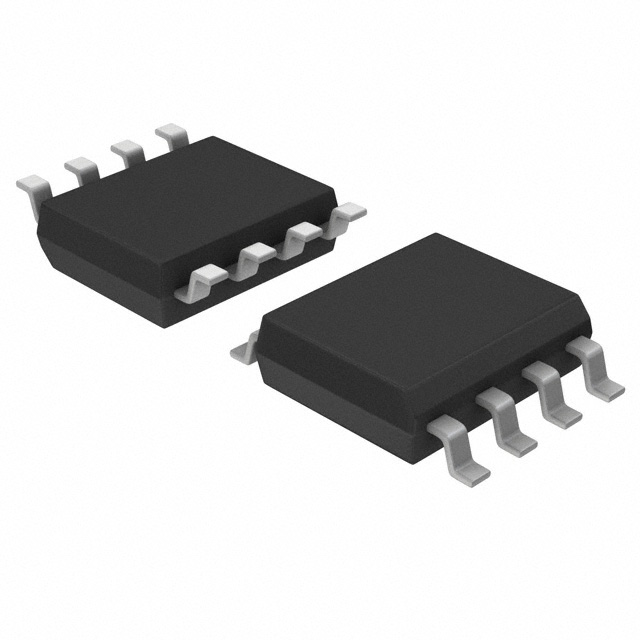
The SMDA15C/TR13 is a bidirectional transient voltage suppressor (TVS) diode manufactured by Microchip Technology, designed for general-purpose overvoltage protection applications. This surface-mount component operates across a temperature range of -55°C to 150°C and is supplied in tape and reel packaging. The device is currently in active production status. Substitute parts are identified to provide alternative sourcing options when the primary part is unavailable or when design requirements necessitate different electrical performance characteristics within the same functional category.
Substiute Parts
Key Parameters
| Parameter | Value | Unit |
|---|---|---|
| Manufacturer Part Number | SMDA15C/TR13 | — |
| Manufacturer | Microchip Technology | — |
| Category | Transient Voltage Suppressors (TVS) | — |
| Package / Case | 8-SOIC (0.154", 3.90mm Width) | — |
| Bidirectional Channels | 4 | — |
| Voltage - Reverse Standoff (Typ) | 15V | V |
| Voltage - Breakdown (Min) | 16.7V | V |
| Voltage - Clamping (Max) @ Ipp | 24V | V |
| Current - Peak Pulse (8/20µs) | 5A | A |
| Power - Peak Pulse | 300W | W |
| Capacitance @ 1MHz | 70pF | pF |
| Operating Temperature Range | -55°C to 150°C | °C |
| Mounting Type | Surface Mount | — |
| Product Status | Active | — |
Substitute Part Grouping Explanation
Substitution of TVS diodes is determined by compatibility across the following critical parameters:
Package Compatibility: All substitute parts must use the 8-SOIC surface-mount package to ensure mechanical and electrical compatibility with existing PCB layouts and assembly processes.
Voltage Ratings: Substitute parts must maintain the same reverse standoff voltage (15V typical) and minimum breakdown voltage (16.7V) to ensure proper circuit protection thresholds. Clamping voltage may vary within acceptable limits based on application requirements.
Bidirectional Channel Configuration: All qualified substitutes must provide 4 bidirectional channels to match the protection architecture of the primary part.
Temperature Operating Range: Substitute parts must support the full operating temperature range of -55°C to 150°C to ensure reliability across all deployment conditions.
Type Classification: All parts must be Zener-type TVS diodes for general-purpose transient suppression applications.
The CDNBS08-T15C and SMDA15C.TBT meet these core substitution criteria while offering variations in peak pulse current handling and clamping voltage characteristics.
Parameter Comparison
| Parameter | SMDA15C/TR13 (Primary) | CDNBS08-T15C (Substitute) | SMDA15C.TBT (Substitute) |
|---|---|---|---|
| Manufacturer | Microchip Technology | Bourns Inc. | Semtech Corporation |
| Package / Case | 8-SOIC | 8-SOIC | 8-SOIC |
| Bidirectional Channels | 4 | 4 | 4 |
| Voltage - Reverse Standoff (Typ) | 15V | 15V | 15V (Max) |
| Voltage - Breakdown (Min) | 16.7V | 16.7V | 16.7V |
| Voltage - Clamping (Max) @ Ipp | 24V | 30V (Typ) | 30V |
| Current - Peak Pulse (8/20µs) | 5A | 17A | 10A |
| Power - Peak Pulse | 300W | 500W | 300W |
| Capacitance @ 1MHz | 70pF | 80pF | 75pF |
| Operating Temperature Range | -55°C to 150°C | -55°C to 150°C | -55°C to 125°C |
| Mounting Type | Surface Mount | Surface Mount | Surface Mount |
| Product Status | Active | Active | Active |
| RoHS Status | RoHS non-compliant | ROHS3 Compliant | ROHS3 Compliant |
Engineering Selection Recommendations
CDNBS08-T15C (Bourns Inc.): This substitute provides enhanced current handling capability at 17A peak pulse compared to the primary part's 5A rating, with increased power dissipation capacity of 500W. The clamping voltage is specified at 30V typical. This part achieves ROHS3 compliance and maintains full temperature range operation from -55°C to 150°C. Selection of this substitute is appropriate for applications requiring higher transient current suppression capacity within the same voltage protection window.
SMDA15C.TBT (Semtech Corporation): This substitute offers intermediate current handling at 10A peak pulse with 30V clamping voltage and maintains 300W peak pulse power rating equivalent to the primary part. ROHS3 compliance is achieved. The operating temperature range extends to 125°C maximum, which is 25°C lower than the primary part's upper limit. Selection of this substitute is appropriate for general-purpose applications where the reduced upper temperature limit does not constrain system operation.
Both substitute parts maintain the critical voltage protection thresholds (15V standoff, 16.7V breakdown minimum) and 4-channel bidirectional configuration required for functional equivalence. All three parts are in active production status, ensuring continued availability.
Frequently Asked Questions (FAQ)
Q: Can CDNBS08-T15C be used as a direct replacement for SMDA15C/TR13?
A: CDNBS08-T15C is mechanically and electrically compatible as a substitute. Both parts use the 8-SOIC package, maintain identical reverse standoff voltage (15V), and provide 4 bidirectional channels. The CDNBS08-T15C provides higher peak pulse current (17A versus 5A) and increased power dissipation (500W versus 300W), making it suitable for applications requiring enhanced transient suppression. The clamping voltage increases from 24V to 30V typical, which must be evaluated against specific circuit requirements.
Q: What is the primary difference between SMDA15C.TBT and SMDA15C/TR13?
A: Both parts share the same base product number (SMDA15) and maintain identical voltage protection characteristics (15V standoff, 16.7V breakdown). The SMDA15C.TBT provides higher peak pulse current (10A versus 5A) and achieves ROHS3 compliance. The maximum operating temperature is reduced to 125°C compared to 150°C for the primary part. Package designation differs slightly (8-SO versus 8-SOIC), though both are mechanically compatible 8-pin surface-mount configurations.
Q: Are all three parts pin-compatible?
A: All three parts use 8-pin surface-mount packages with identical 0.154" (3.90mm) width specifications. Pin configuration for 4-channel bidirectional TVS diodes follows industry-standard layouts. Physical placement on PCBs is interchangeable without layout modification.
Q: Which substitute should be selected for high-temperature applications?
A: SMDA15C/TR13 (primary part) and CDNBS08-T15C both support the full -55°C to 150°C operating range. SMDA15C.TBT is limited to 125°C maximum junction temperature. For applications requiring operation above 125°C, selection must be restricted to the primary part or CDNBS08-T15C.
Q: What is the significance of RoHS compliance differences?
A: SMDA15C/TR13 is RoHS non-compliant, while both CDNBS08-T15C and SMDA15C.TBT achieve ROHS3 compliance. For applications subject to RoHS regulatory requirements, substitute parts provide compliant alternatives. Compliance status does not affect electrical performance or functional equivalence.
Q: How do capacitance specifications affect substitution?
A: Capacitance values (70pF for primary, 80pF for CDNBS08-T15C, 75pF for SMDA15C.TBT) are measured at 1MHz and represent parasitic junction capacitance. Variations within this range do not affect TVS diode protection function but may influence high-frequency circuit behavior. Applications with strict capacitance requirements must evaluate these differences against circuit specifications.
Q: Can peak pulse current ratings be used interchangeably?
A: Peak pulse current ratings (5A, 17A, and 10A respectively) define the maximum transient current each device can suppress. Higher-rated devices provide greater transient suppression capacity. Selection must match or exceed the maximum transient current expected in the protected circuit. Lower-rated devices cannot be substituted for higher-current applications.
Alternative Parts

SJ6012L2TP
Littelfuse Inc.
6 Alternative Parts

JMK107BBJ476MA-RE
Taiyo Yuden
10 Alternative Parts

GMK107BBJ475MA-T
Taiyo Yuden
5 Alternative Parts
SJ6020N2ARP
Littelfuse Inc.
3 Alternative Parts
SJ6025R2ATP
Littelfuse Inc.
4 Alternative Parts

2474-05L
API Delevan Inc.
1 Alternative Parts

4590R-684K
API Delevan Inc.
1 Alternative Parts

CM6560R-334
API Delevan Inc.
1 Alternative Parts

CM6460-104
API Delevan Inc.
1 Alternative Parts

5526-12
API Delevan Inc.
1 Alternative Parts