



Request Quote
(Ships tomorrow)
SF12-TP Equivalent & Substitute Parts
Part Overview
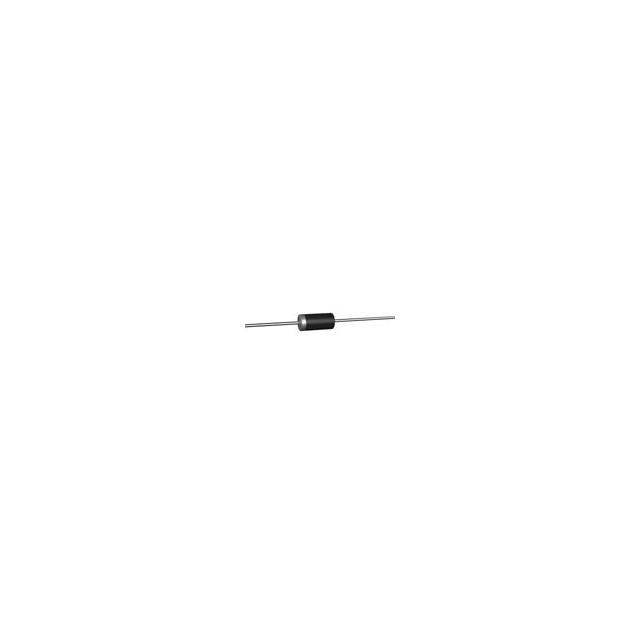
The SF12-TP is a general-purpose rectifier diode rated for 100V DC reverse voltage and 1A average rectified current in a DO-41 through-hole package. Manufactured by Micro Commercial Co, this component is classified as obsolete, necessitating identification of active equivalent parts for ongoing design support and procurement continuity. The part operates across a junction temperature range of -55°C to 125°C and features fast recovery characteristics with a reverse recovery time of 35 nanoseconds.
Substiute Parts
Key Parameters
| Parameter | Value | Unit |
|---|---|---|
| Voltage - DC Reverse (Vr) (Max) | 100 | V |
| Current - Average Rectified (Io) | 1 | A |
| Voltage - Forward (Vf) (Max) @ If | 950 mV @ 1 A | mV |
| Reverse Recovery Time (trr) | 35 | ns |
| Current - Reverse Leakage @ Vr | 5 | µA @ 100 V |
| Package / Case | DO-204AL, DO-41, Axial | — |
| Mounting Type | Through Hole | — |
| Operating Temperature - Junction | -55 to 125 | °C |
| Technology | Standard | — |
| RoHS Status | ROHS3 Compliant | — |
Substitute Part Grouping Explanation
Substitution of the SF12-TP is determined by equivalence across the following critical electrical and mechanical parameters:
Electrical Equivalence Criteria:
- Voltage - DC Reverse (Vr) (Max): 100V minimum
- Current - Average Rectified (Io): 1A minimum
- Technology classification: Standard
- Speed category: Fast Recovery
Mechanical Equivalence Criteria:
- Package / Case: DO-204AL or DO-41 (axial through-hole)
- Mounting Type: Through Hole
Compliance Criteria:
- RoHS3 Compliant status
- ECCN and HTSUS classifications match
The 1N4934-E3/73 manufactured by Vishay General Semiconductor - Diodes Division satisfies all substitution criteria. Both parts share identical reverse voltage and average rectified current ratings, operate within compatible temperature ranges, and utilize the same through-hole axial package configuration. The substitute part maintains active product status, ensuring long-term availability and supply chain continuity.
Parameter Comparison
| Parameter | SF12-TP (Micro Commercial Co) | 1N4934-E3/73 (Vishay) | Compatibility |
|---|---|---|---|
| Voltage - DC Reverse (Vr) (Max) | 100 V | 100 V | Equivalent |
| Current - Average Rectified (Io) | 1 A | 1 A | Equivalent |
| Voltage - Forward (Vf) (Max) @ If | 950 mV @ 1 A | 1.2 V @ 1 A | Compatible |
| Reverse Recovery Time (trr) | 35 ns | 200 ns | Compatible |
| Current - Reverse Leakage @ Vr | 5 µA @ 100 V | 5 µA @ 100 V | Equivalent |
| Capacitance @ Vr, F | 40 pF @ 4V, 1MHz | 12 pF @ 4V, 1MHz | Compatible |
| Package / Case | DO-204AL, DO-41, Axial | DO-204AL, DO-41, Axial | Equivalent |
| Mounting Type | Through Hole | Through Hole | Equivalent |
| Operating Temperature - Junction | -55 to 125°C | -50 to 150°C | Compatible |
| Technology | Standard | Standard | Equivalent |
| RoHS Status | ROHS3 Compliant | ROHS3 Compliant | Equivalent |
| Product Status | Obsolete | Active | Upgrade Path |
Engineering Selection Recommendations
The 1N4934-E3/73 is the direct equivalent substitute for the SF12-TP. Both components meet identical electrical specifications for reverse voltage and average rectified current. The substitute part carries active product status from Vishay General Semiconductor - Diodes Division, providing assured long-term availability compared to the obsolete SF12-TP.
Both parts maintain ROHS3 compliance and share identical ECCN (EAR99) and HTSUS (8541.10.0080) classifications, ensuring regulatory and trade compliance equivalence. The 1N4934-E3/73 operates across an extended junction temperature range (-50 to 150°C) compared to the SF12-TP (-55 to 125°C), providing additional thermal margin in applications requiring elevated operating temperatures.
Forward voltage characteristics differ slightly, with the 1N4934-E3/73 specified at 1.2V versus 950mV for the SF12-TP at 1A. This represents a 250mV increase in forward voltage drop. Reverse recovery time extends from 35ns to 200ns in the substitute part. These parameter variations remain within acceptable tolerances for standard general-purpose rectifier applications and do not preclude direct substitution in circuit designs originally specified for the SF12-TP.
Frequently Asked Questions (FAQ)
Q: Can the 1N4934-E3/73 be used as a direct replacement for the SF12-TP in existing circuit designs?
A: Yes. Both diodes share identical reverse voltage (100V) and average rectified current (1A) ratings, operate in the same DO-41 through-hole package, and maintain equivalent RoHS3 compliance. The electrical characteristics are compatible for general-purpose rectification applications.
Q: What are the differences in forward voltage between these parts?
A: The SF12-TP specifies 950mV maximum forward voltage at 1A, while the 1N4934-E3/73 specifies 1.2V maximum at 1A. This 250mV difference may affect power dissipation calculations in high-current applications but does not prevent functional substitution in standard rectifier circuits.
Q: How do the reverse recovery times compare?
A: The SF12-TP exhibits 35ns reverse recovery time, while the 1N4934-E3/73 specifies 200ns. The longer recovery time in the substitute part may introduce slightly increased switching losses in high-frequency applications but remains acceptable for standard rectification duty.
Q: Are the packages physically identical?
A: Yes. Both parts use the DO-204AL (DO-41) axial through-hole package. Physical dimensions, lead spacing, and mounting characteristics are equivalent, allowing direct board-level substitution without layout modifications.
Q: What is the temperature operating range difference?
A: The SF12-TP operates from -55°C to 125°C junction temperature, while the 1N4934-E3/73 operates from -50°C to 150°C. The substitute part provides extended high-temperature capability, suitable for applications requiring operation above 125°C.
Q: Why is the SF12-TP classified as obsolete?
A: Obsolete status indicates the manufacturer has discontinued production. The 1N4934-E3/73 maintains active product status, ensuring continued availability, technical support, and supply chain reliability for new designs and ongoing production requirements.
Q: Are there any compliance or certification differences?
A: No. Both parts are ROHS3 compliant and share identical ECCN (EAR99) and HTSUS (8541.10.0080) classifications. Regulatory and trade compliance requirements are equivalent.
Alternative Parts

SJ6012L2TP
Littelfuse Inc.
6 Alternative Parts

JMK107BBJ476MA-RE
Taiyo Yuden
10 Alternative Parts

GMK107BBJ475MA-T
Taiyo Yuden
5 Alternative Parts
SJ6020N2ARP
Littelfuse Inc.
3 Alternative Parts
SJ6025R2ATP
Littelfuse Inc.
4 Alternative Parts

2474-05L
API Delevan Inc.
1 Alternative Parts

4590R-684K
API Delevan Inc.
1 Alternative Parts

CM6560R-334
API Delevan Inc.
1 Alternative Parts

CM6460-104
API Delevan Inc.
1 Alternative Parts

5526-12
API Delevan Inc.
1 Alternative Parts