


Request Quote
(Ships tomorrow)
SE5450-014 Infrared Emitter 935nm Equivalent & Substitute Parts
Part Overview
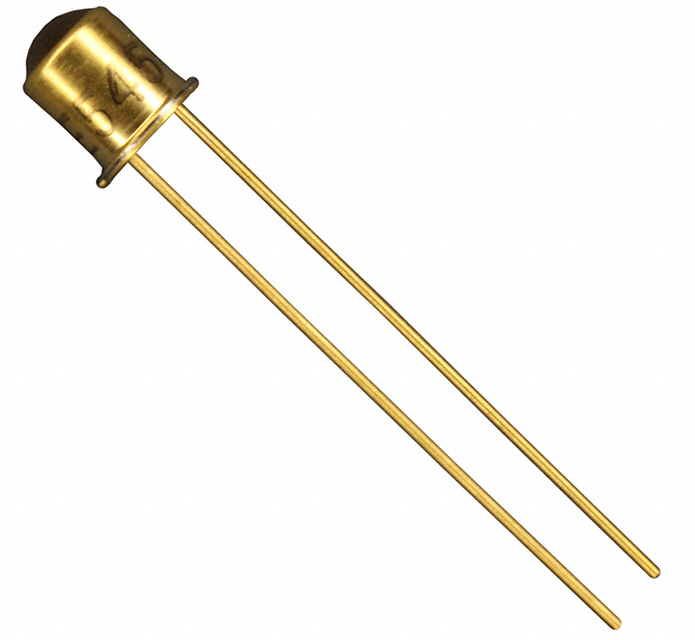
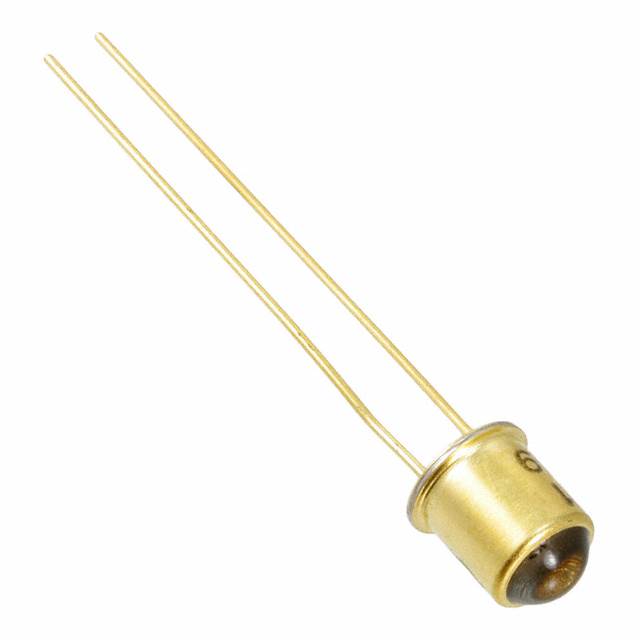
The SE5450-014 is an infrared (IR) emitter manufactured by Honeywell Sensing and Productivity Solutions, operating at 935nm wavelength with a maximum forward current of 100mA. This component is housed in a TO-46-2 metal can package and is designed for through-hole mounting applications requiring near-infrared emission in the 935nm spectrum.
The SE5450-014 is classified as obsolete. Identifying equivalent and substitute parts is necessary to maintain design continuity, ensure supply chain availability, and support ongoing production or maintenance of systems utilizing this component. Active alternatives with compatible electrical and mechanical specifications are available from TT Electronics/Optek Technology.
Substiute Parts
Key Parameters
| Parameter | Value | Unit |
|---|---|---|
| Wavelength | 935 | nm |
| Current - DC Forward (If) Max | 100 | mA |
| Voltage - Forward (Vf) Typical | 1.7 | V |
| Radiant Intensity (Ie) Min @ If | 1.5 | mW/cm² @ 100mA |
| Viewing Angle | 20 | ° |
| Operating Temperature Range | -55 to 125 | °C |
| Package / Case | TO-46-2 Metal Can | — |
| Mounting Type | Through Hole | — |
| RoHS Status | RoHS Compliant | — |
Substitute Part Grouping Explanation
Substitution of the SE5450-014 is determined by the following critical parameters:
Primary Compatibility Criteria:
- Wavelength: 935nm (exact match required)
- Maximum Forward Current: 100mA (exact match required)
- Package / Case: TO-46-2 Metal Can (exact match required)
- Mounting Type: Through Hole (exact match required)
Secondary Compatibility Criteria:
- Forward Voltage (Vf): Tolerance within ±0.15V acceptable for circuit design
- Radiant Intensity (Ie): Functional equivalence within application requirements
- Viewing Angle: Tolerance within ±5° acceptable for optical design
- Operating Temperature Range: Minimum coverage of -55°C to 125°C required
The substitute parts OP130 and OP133 (both from TT Electronics/Optek Technology) satisfy all primary compatibility criteria. Both operate at 935nm wavelength, support 100mA maximum forward current, and are packaged in TO-46-2 metal can configurations with through-hole mounting. Secondary parameters show minor variations within acceptable engineering tolerances for most applications.
Parameter Comparison
| Parameter | SE5450-014 (Honeywell) | OP130 (Optek) | OP133 (Optek) |
|---|---|---|---|
| Manufacturer | Honeywell Sensing and Productivity Solutions | TT Electronics/Optek Technology | TT Electronics/Optek Technology |
| Wavelength | 935nm | 935nm | 935nm |
| Current - DC Forward (If) Max | 100mA | 100mA | 100mA |
| Voltage - Forward (Vf) Typical | 1.7V | 1.75V | 1.75V |
| Radiant Intensity (Ie) Min @ If | 1.5mW/cm² @ 100mA | 1mW/cm² @ 100mA | 5mW/cm² @ 100mA |
| Viewing Angle | 20° | 18° | 18° |
| Operating Temperature Range | -55°C to 125°C | -65°C to 125°C | -65°C to 125°C |
| Package / Case | TO-46-2 Metal Can | TO-46-2 Lens Top Metal Can | TO-46-2 Lens Top Metal Can |
| Mounting Type | Through Hole | Through Hole | Through Hole |
| Product Status | Obsolete | Active | Active |
| RoHS Status | RoHS Compliant | ROHS3 Compliant | ROHS3 Compliant |
| Moisture Sensitivity Level (MSL) | 1 (Unlimited) | 1 (Unlimited) | 1 (Unlimited) |
Engineering Selection Recommendations
SE5450-014 Status: Obsolete. Direct replacement with active alternatives is recommended for new designs and ongoing production support.
OP130 Selection Criteria:
- Active product status ensures long-term availability and supply chain stability
- ROHS3 compliance exceeds RoHS requirements of the original part
- Extended operating temperature range (-65°C to 125°C) provides broader environmental coverage
- Forward voltage increase of 0.05V (1.75V vs. 1.7V) is within typical circuit tolerance
- Radiant intensity reduction to 1mW/cm² requires circuit-level evaluation for applications sensitive to optical output
- Viewing angle reduction from 20° to 18° may impact optical system design in wide-angle applications
OP133 Selection Criteria:
- Active product status ensures long-term availability and supply chain stability
- ROHS3 compliance exceeds RoHS requirements of the original part
- Extended operating temperature range (-65°C to 125°C) provides broader environmental coverage
- Forward voltage increase of 0.05V (1.75V vs. 1.7V) is within typical circuit tolerance
- Radiant intensity increase to 5mW/cm² provides enhanced optical output, suitable for applications requiring higher emission intensity
- Viewing angle reduction from 20° to 18° may impact optical system design in wide-angle applications
Compliance Considerations: Both OP130 and OP133 maintain RoHS3 compliance and unlimited moisture sensitivity rating (MSL 1), ensuring compatibility with modern manufacturing and environmental standards. Both parts carry identical ECCN and HTSUS classifications as the original SE5450-014.
Frequently Asked Questions (FAQ)
Q: Can OP130 and OP133 be used interchangeably with SE5450-014?
A: Both OP130 and OP133 are electrically and mechanically compatible with SE5450-014 based on wavelength, forward current, package type, and mounting configuration. However, differences in radiant intensity (1mW/cm² for OP130 vs. 5mW/cm² for OP133 vs. 1.5mW/cm² for SE5450-014) require application-specific evaluation. Selection between OP130 and OP133 depends on optical output requirements.
Q: What is the difference between OP130 and OP133?
A: OP130 and OP133 are identical in all parameters except radiant intensity. OP130 provides 1mW/cm² @ 100mA, while OP133 provides 5mW/cm² @ 100mA. Both operate at 935nm, support 100mA forward current, and use TO-46-2 metal can packaging. Selection depends on whether the application requires lower or higher infrared emission intensity.
Q: Are there package differences between SE5450-014 and the substitute parts?
A: SE5450-014 uses a TO-46-2 Metal Can package, while OP130 and OP133 use TO-46-2 Lens Top Metal Can packages. Both are through-hole mountable in TO-46-2 footprints. The lens top configuration on the Optek parts may affect optical characteristics in specific applications.
Q: What is the forward voltage difference, and does it affect circuit design?
A: SE5450-014 has a typical forward voltage of 1.7V, while OP130 and OP133 have 1.75V. The 0.05V difference is within standard circuit design tolerance and typically does not require redesign of current-limiting resistor networks in most applications.
Q: Do the substitute parts support the same temperature range?
A: SE5450-014 operates from -55°C to 125°C. OP130 and OP133 extend the lower limit to -65°C, providing 10°C additional cold-temperature capability. Both maintain the 125°C upper limit. Applications requiring operation below -55°C benefit from the extended range of the substitute parts.
Q: Are OP130 and OP133 RoHS compliant?
A: Yes. Both OP130 and OP133 are ROHS3 compliant, which exceeds the RoHS compliance of SE5450-014. Both parts are also REACH unaffected, ensuring compliance with current environmental regulations.
Q: Which substitute part should I select for a new design?
A: Selection between OP130 and OP133 depends on optical output requirements. If the original design operated at the 1.5mW/cm² specification of SE5450-014, OP133 (5mW/cm²) provides higher intensity, while OP130 (1mW/cm²) provides lower intensity. Circuit-level evaluation of optical sensor response is required to determine the appropriate substitute.
Alternative Parts

SJ6012L2TP
Littelfuse Inc.
6 Alternative Parts

JMK107BBJ476MA-RE
Taiyo Yuden
10 Alternative Parts

GMK107BBJ475MA-T
Taiyo Yuden
5 Alternative Parts
SJ6020N2ARP
Littelfuse Inc.
3 Alternative Parts
SJ6025R2ATP
Littelfuse Inc.
4 Alternative Parts

2474-05L
API Delevan Inc.
1 Alternative Parts

4590R-684K
API Delevan Inc.
1 Alternative Parts

CM6560R-334
API Delevan Inc.
1 Alternative Parts

CM6460-104
API Delevan Inc.
1 Alternative Parts

5526-12
API Delevan Inc.
1 Alternative Parts