



Request Quote
(Ships tomorrow)
RESD1CANFHT116 Equivalent & Substitute Parts
Part Overview
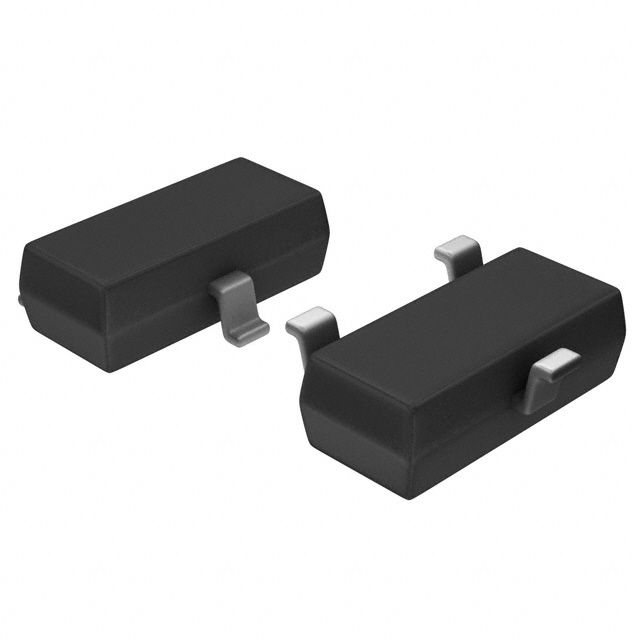
The RESD1CANFHT116 is a bidirectional Transient Voltage Suppressor (TVS) diode manufactured by Rohm Semiconductor, designed for CAN bus protection applications. This automotive-grade component operates with a 24V reverse standoff voltage and provides 44V clamping at peak pulse current. The device is AEC-Q101 qualified and maintains active product status, ensuring continued availability and support for new designs and production requirements.
Substiute Parts
Key Parameters
| Parameter | Value |
|---|---|
| Voltage - Reverse Standoff (Typ) | 24V (Max) |
| Voltage - Breakdown (Min) | 26.2V |
| Voltage - Clamping (Max) @ Ipp | 44V |
| Current - Peak Pulse (10/1000µs) | 8A (8/20µs) |
| Power - Peak Pulse | 350W |
| Bidirectional Channels | 2 |
| Capacitance @ 1MHz | 30pF |
| Operating Temperature | 150°C (TJ) |
| Package / Case | TO-236-3, SC-59, SOT-23-3 |
| Grade | Automotive |
| Qualification | AEC-Q101 |
Substitute Part Grouping Explanation
Substitution eligibility for the RESD1CANFHT116 is determined by the following critical parameters:
Primary Substitution Criteria:
- Voltage - Reverse Standoff: 24V (Max)
- Voltage - Breakdown (Min): 26.2V or higher
- Bidirectional Channels: 2
- Package / Case: TO-236-3, SC-59, SOT-23-3
- Mounting Type: Surface Mount
- Grade: Automotive
- Qualification: AEC-Q101
Secondary Compatibility Factors:
- Current - Peak Pulse (10/1000µs): 8A or higher
- Voltage - Clamping (Max) @ Ipp: 44V or lower
- Operating Temperature: 150°C (TJ) or higher
- RoHS Status: ROHS3 Compliant
The substitute parts listed below meet the primary substitution criteria and maintain compatibility with CAN bus protection applications.
Parameter Comparison
| Parameter | RESD1CANFHT116 | RESD1CANYFHT116 | PJEC24MTA-AU_R1_000A1 |
|---|---|---|---|
| Manufacturer | Rohm Semiconductor | Rohm Semiconductor | Panjit International Inc. |
| Voltage - Reverse Standoff (Typ) | 24V (Max) | 24V (Max) | 24V (Max) |
| Voltage - Breakdown (Min) | 26.2V | 26.2V | 25.4V |
| Voltage - Clamping (Max) @ Ipp | 44V | 44V | 50V |
| Current - Peak Pulse (10/1000µs) | 8A (8/20µs) | 8A (8/20µs) | 4A (8/20µs) |
| Power - Peak Pulse | 350W | 350W | Not specified |
| Bidirectional Channels | 2 | 2 | 2 |
| Capacitance @ 1MHz | 30pF | 30pF (Max) | 11pF |
| Operating Temperature | 150°C (TJ) | 150°C (TJ) | -55°C ~ 150°C (TJ) |
| Package / Case | TO-236-3, SC-59, SOT-23-3 | TO-236-3, SC-59, SOT-23-3 | TO-236-3, SC-59, SOT-23-3 |
| Grade | Automotive | Automotive | Automotive |
| Qualification | AEC-Q101 | AEC-Q101 | AEC-Q101 |
| RoHS Status | ROHS3 Compliant | ROHS3 Compliant | ROHS3 Compliant |
| Moisture Sensitivity Level (MSL) | 1 (Unlimited) | 1 (Unlimited) | 1 (Unlimited) |
Engineering Selection Recommendations
RESD1CANYFHT116 (Rohm Semiconductor)
This part is a direct equivalent to the RESD1CANFHT116, sharing identical electrical specifications including 24V reverse standoff voltage, 26.2V breakdown voltage, 44V clamping voltage, and 8A peak pulse current. Both devices are manufactured by Rohm Semiconductor, carry AEC-Q101 automotive qualification, and are ROHS3 compliant. The RESD1CANYFHT116 differs only in packaging format (SOT-23 supplier device package versus SSD3), maintaining full functional and electrical compatibility. This substitute is suitable for direct replacement in CAN bus protection circuits.
PJEC24MTA-AU_R1_000A1 (Panjit International Inc.)
This part meets the primary substitution criteria with matching 24V reverse standoff voltage, 2-channel bidirectional configuration, and identical package specifications. The device is AEC-Q101 qualified and ROHS3 compliant. However, the PJEC24MTA-AU_R1_000A1 exhibits reduced peak pulse current capability (4A versus 8A) and higher clamping voltage (50V versus 44V). These parameter differences result in lower transient energy dissipation capacity. This substitute is applicable only in applications where the reduced current rating and higher clamping voltage are acceptable within the circuit design margins.
Frequently Asked Questions (FAQ)
Q: Can RESD1CANYFHT116 be used as a direct replacement for RESD1CANFHT116?
A: Yes. Both parts share identical electrical specifications, automotive qualification, and compliance certifications. The difference lies in the supplier device package designation (SOT-23 versus SSD3), which does not affect electrical performance or PCB compatibility.
Q: What are the limitations of using PJEC24MTA-AU_R1_000A1 as a substitute?
A: The PJEC24MTA-AU_R1_000A1 has a reduced peak pulse current rating of 4A compared to the 8A specification of the RESD1CANFHT116. Additionally, its clamping voltage is 50V versus 44V. These differences reduce the device's transient energy handling capability. Use this substitute only when circuit design margins accommodate the lower current rating and higher clamping voltage.
Q: Are all substitute parts automotive-grade and AEC-Q101 qualified?
A: Yes. All listed substitute parts carry automotive-grade classification and AEC-Q101 qualification, meeting the same reliability and qualification standards as the RESD1CANFHT116.
Q: Do all substitute parts have the same package footprint?
A: Yes. All substitute parts use the TO-236-3, SC-59, SOT-23-3 package family, ensuring identical PCB footprint compatibility and mounting characteristics.
Q: What is the significance of the capacitance difference between PJEC24MTA-AU_R1_000A1 and the main part?
A: The PJEC24MTA-AU_R1_000A1 has lower capacitance (11pF versus 30pF at 1MHz). Lower capacitance may reduce signal coupling effects in high-frequency CAN bus applications, but this parameter difference should be evaluated within the specific circuit design context.
Q: Are all parts RoHS3 compliant?
A: Yes. All listed parts, including the main part and substitutes, are ROHS3 compliant and have MSL rating of 1 (Unlimited), meeting environmental and moisture sensitivity requirements.
Alternative Parts

SJ6012L2TP
Littelfuse Inc.
6 Alternative Parts

JMK107BBJ476MA-RE
Taiyo Yuden
10 Alternative Parts

GMK107BBJ475MA-T
Taiyo Yuden
5 Alternative Parts
SJ6020N2ARP
Littelfuse Inc.
3 Alternative Parts
SJ6025R2ATP
Littelfuse Inc.
4 Alternative Parts

2474-05L
API Delevan Inc.
1 Alternative Parts

4590R-684K
API Delevan Inc.
1 Alternative Parts

CM6560R-334
API Delevan Inc.
1 Alternative Parts

CM6460-104
API Delevan Inc.
1 Alternative Parts

5526-12
API Delevan Inc.
1 Alternative Parts