


Request Quote
(Ships tomorrow)
QED523 Infrared Emitter - Equivalent & Substitute Parts
Part Overview
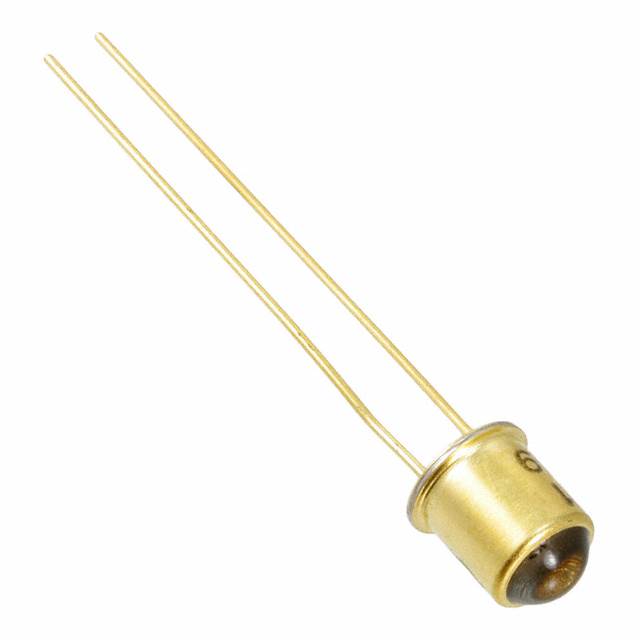
The QED523 is an infrared (IR) emitter operating at 880nm wavelength, designed for through-hole mounting in TO-46-2 package configuration. This component is rated for 100mA DC forward current with 1.8V typical forward voltage and 40mW/sr radiant intensity. The QED523 is classified as obsolete, making identification of functionally equivalent substitute components necessary for ongoing design support and production continuity.
Substiute Parts
Key Parameters
| Parameter | Value |
|---|---|
| Manufacturer Part Number | QED523 |
| Manufacturer | onsemi |
| Type | Infrared (IR) Emitter |
| Wavelength | 880nm |
| Current - DC Forward (If) Max | 100mA |
| Voltage - Forward (Vf) Typical | 1.8V |
| Radiant Intensity (Ie) Min @ If | 40mW/sr @ 100mA |
| Viewing Angle | 20° |
| Package / Case | TO-46-2 |
| Mounting Type | Through Hole |
| Operating Temperature Range | -40°C to 100°C |
| Product Status | Obsolete |
Substitute Part Grouping Explanation
Substitution of the QED523 is evaluated based on the following critical parameters that define functional equivalence for infrared emitter applications:
Primary Matching Criteria:
- Package / Case: TO-46-2 (mechanical and thermal compatibility)
- Mounting Type: Through Hole (PCB integration compatibility)
- Current - DC Forward (If) Max: 100mA (circuit design compatibility)
- Type: Infrared (IR) Emitter (functional category)
Secondary Consideration Parameters:
- Wavelength: 880nm (application-specific, but near-infrared alternatives within detector sensitivity ranges may be acceptable depending on system design)
- Voltage - Forward (Vf): 1.8V (power supply and circuit design impact)
- Viewing Angle: 20° (optical field of view requirements)
- Operating Temperature Range: -40°C to 100°C (environmental operating conditions)
The OP130 substitute part maintains identical package, mounting type, and maximum forward current specifications. Wavelength differs at 935nm, forward voltage is slightly lower at 1.75V, and viewing angle is narrower at 18°. Operating temperature range is extended to -65°C to 125°C. These variations must be evaluated against specific application requirements.
Parameter Comparison
| Parameter | QED523 (Main Part) | OP130 (Substitute) |
|---|---|---|
| Manufacturer | onsemi | TT Electronics/Optek Technology |
| Wavelength | 880nm | 935nm |
| Current - DC Forward (If) Max | 100mA | 100mA |
| Voltage - Forward (Vf) Typical | 1.8V | 1.75V |
| Radiant Intensity (Ie) Min @ If | 40mW/sr @ 100mA | 1mW/cm² @ 100mA |
| Viewing Angle | 20° | 18° |
| Package / Case | TO-46-2 | TO-46-2 Lens Top Metal Can |
| Mounting Type | Through Hole | Through Hole |
| Operating Temperature Range | -40°C to 100°C | -65°C to 125°C |
| Product Status | Obsolete | Active |
| RoHS Status | Not specified | ROHS3 Compliant |
Engineering Selection Recommendations
The OP130 is an active product from TT Electronics/Optek Technology and represents a viable substitute for the obsolete QED523 based on matching package, mounting type, and maximum forward current specifications. The OP130 provides extended operating temperature range (-65°C to 125°C versus -40°C to 100°C) and ROHS3 compliance, supporting modern regulatory requirements.
Wavelength difference (935nm versus 880nm) and radiant intensity measurement units (1mW/cm² versus 40mW/sr) require application-level validation. Systems designed for 880nm detection may require assessment of detector spectral response at 935nm. Viewing angle narrowing from 20° to 18° represents a minor optical field reduction.
Forward voltage reduction from 1.8V to 1.75V is negligible for most circuit designs and may provide marginal power efficiency improvement.
Frequently Asked Questions (FAQ)
Q: Can the OP130 directly replace the QED523 without circuit modification?
A: The OP130 matches critical mechanical and electrical parameters (TO-46-2 package, 100mA maximum forward current, through-hole mounting). However, wavelength difference (935nm versus 880nm) and radiant intensity measurement differences require validation against detector specifications and system optical design. Forward voltage difference (1.75V versus 1.8V) is typically accommodated by standard circuit designs.
Q: What is the significance of the wavelength difference between 880nm and 935nm?
A: Wavelength determines the spectral emission characteristics of the infrared emitter. The 880nm QED523 and 935nm OP130 operate in different regions of the near-infrared spectrum. Substitution is valid only if the receiving detector or sensor has adequate spectral response at 935nm. System-level optical performance testing is required to confirm compatibility.
Q: Why are the radiant intensity values expressed in different units?
A: The QED523 specifies radiant intensity as 40mW/sr (milliwatts per steradian), while the OP130 specifies 1mW/cm² (milliwatts per square centimeter). These are different measurement conventions for optical output. Direct numerical comparison is not valid without conversion based on viewing angle and distance parameters. Application-specific optical performance validation is necessary.
Q: Does the OP130's narrower viewing angle (18° versus 20°) affect compatibility?
A: Viewing angle defines the optical field of view of the emitter. The OP130's 18° angle is slightly narrower than the QED523's 20°. This difference is minor and acceptable for most applications. Compatibility depends on whether the receiving optics or detector field of view accommodates the narrower emission pattern.
Q: What advantage does the OP130's extended operating temperature range provide?
A: The OP130 operates from -65°C to 125°C, compared to the QED523's -40°C to 100°C range. This extended range supports applications requiring operation in extreme temperature environments. For standard industrial applications within -40°C to 100°C, both parts are functionally equivalent in this parameter.
Q: Is the OP130 ROHS3 compliant?
A: Yes, the OP130 is ROHS3 compliant. The QED523 compliance status is not specified in available documentation. For applications requiring ROHS3 compliance, the OP130 provides documented regulatory conformance.
Alternative Parts

SJ6012L2TP
Littelfuse Inc.
6 Alternative Parts

JMK107BBJ476MA-RE
Taiyo Yuden
10 Alternative Parts

GMK107BBJ475MA-T
Taiyo Yuden
5 Alternative Parts
SJ6020N2ARP
Littelfuse Inc.
3 Alternative Parts
SJ6025R2ATP
Littelfuse Inc.
4 Alternative Parts

2474-05L
API Delevan Inc.
1 Alternative Parts

4590R-684K
API Delevan Inc.
1 Alternative Parts

CM6560R-334
API Delevan Inc.
1 Alternative Parts

CM6460-104
API Delevan Inc.
1 Alternative Parts

5526-12
API Delevan Inc.
1 Alternative Parts