





Request Quote
(Ships tomorrow)
QBED8120 Infrared Emitter 940nm Equivalent & Substitute Parts
Part Overview
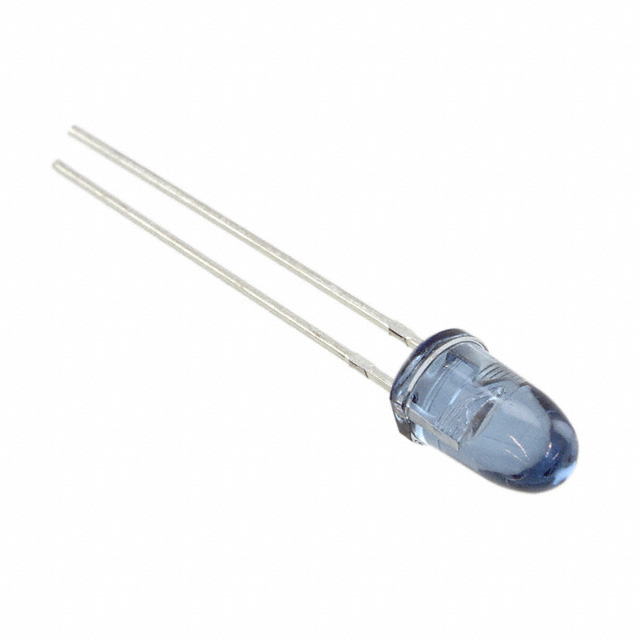
The QBED8120 is an infrared (IR) emitter manufactured by QT Brightek (QTB) operating at 940nm wavelength with a maximum forward current of 50mA and typical forward voltage of 1.3V. This radial through-hole component delivers 30mW/sr radiant intensity at 50mA with a 20° viewing angle and operates across the temperature range of -25°C to 85°C. The part is Active status, RoHS3 compliant, and carries MSL Level 1 (Unlimited) moisture sensitivity rating.
Equivalent and substitute parts are identified when design requirements permit variations in electrical parameters such as forward current, forward voltage, wavelength, or package configuration while maintaining functional compatibility within the application circuit.
Substiute Parts
Key Parameters
| Parameter | Value | Unit |
|---|---|---|
| Wavelength | 940 | nm |
| Current - DC Forward (If) Max | 50 | mA |
| Voltage - Forward (Vf) Typical | 1.3 | V |
| Radiant Intensity (Ie) Min @ If | 30 | mW/sr @ 50mA |
| Viewing Angle | 20 | ° |
| Operating Temperature Range | -25 to 85 | °C |
| Mounting Type | Through Hole | — |
| Package / Case | Radial | — |
| RoHS Status | ROHS3 Compliant | — |
Substitute Part Grouping Explanation
Substitute parts for the QBED8120 are grouped based on the following substitution criteria:
Group 1: Direct Wavelength Match (940nm) with Radial Package Substitutes maintain the 940nm wavelength and radial package configuration. These parts are compatible when forward current and voltage specifications align with circuit design parameters. Forward current tolerance ranges from 50mA to 100mA, and forward voltage ranges from 1.2V to 1.3V.
Group 2: Direct Wavelength Match (940nm) with Alternative Package (T 1 3/4) Substitutes maintain the 940nm wavelength but use T 1 3/4 package configuration instead of radial. These require mechanical redesign of the PCB footprint and mounting structure.
Group 3: Alternative Wavelength (890nm or 875nm) with Different Package Substitutes operate at different infrared wavelengths (890nm or 875nm) and use T 1 3/4 or radial packages. These are applicable only when the application circuit does not require strict wavelength specification and can tolerate the spectral shift.
The following parameters determine substitution eligibility:
- Wavelength (940nm preferred; 890nm or 875nm acceptable only if application permits)
- Package type (Radial or T 1 3/4)
- Forward current rating (50mA or 100mA or 150mA depending on circuit design)
- Forward voltage (1.2V to 4V depending on circuit design)
- Operating temperature range (must meet or exceed application requirements)
- Viewing angle (20° standard across all candidates)
Parameter Comparison
| Part Number | Manufacturer | Wavelength (nm) | If Max (mA) | Vf Typ (V) | Ie Min @ If (mW/sr) | Package | Temp Range (°C) | RoHS Status |
|---|---|---|---|---|---|---|---|---|
| QBED8120 | QT Brightek | 940 | 50 | 1.3 | 30 @ 50mA | Radial | -25 to 85 | ROHS3 |
| IR383 | Everlight Electronics | 940 | 100 | 1.2 | 7.8 @ 20mA | Radial | -25 to 85 | ROHS3 |
| WP7113F3C | Kingbright | 940 | 50 | 1.2 | 15 @ 30mA | Radial | -40 to 85 | ROHS3 |
| LTE-4208 | LITEON | 940 | 50 | 1.2 | 3.31 @ 20mA | T 1 3/4 | -40 to 85 | ROHS3 |
| OP295A | TT Electronics/Optek | 890 | 150 | 4.0 | — | T 1 3/4 | -40 to 100 | ROHS3 |
| OP296B | TT Electronics/Optek | 890 | 150 | 2.0 | — | T 1 3/4 | -40 to 100 | ROHS3 |
| OP297A | TT Electronics/Optek | 890 | 150 | 1.75 | — | T 1 3/4 | -40 to 100 | ROHS3 |
| SIR383C | Everlight Electronics | 875 | 100 | 1.3 | 11 @ 20mA | Radial | -40 to 85 | ROHS3 |
Engineering Selection Recommendations
For Direct Substitution (Same Wavelength, Same Package):
IR383 (Everlight Electronics) and WP7113F3C (Kingbright) are direct substitutes for QBED8120 when the application permits higher maximum forward current ratings (100mA and 50mA respectively) and can tolerate lower radiant intensity values. Both maintain 940nm wavelength and radial package configuration. IR383 operates within the same temperature range as QBED8120 (-25°C to 85°C). WP7113F3C extends the lower operating temperature to -40°C. Both are RoHS3 compliant with MSL Level 1 rating.
For Package Reconfiguration (Same Wavelength, Different Package):
LTE-4208 (LITEON) maintains 940nm wavelength but requires mechanical redesign due to T 1 3/4 package configuration. This substitute is applicable when PCB layout permits through-hole T 1 3/4 mounting. Forward current and voltage specifications (50mA, 1.2V) align closely with QBED8120. Operating temperature range extends to -40°C. RoHS3 compliance and MSL Level 1 rating are maintained.
For Wavelength Variation (Alternative Wavelength, Different Package):
OP295A, OP296B, OP297A (TT Electronics/Optek Technology) operate at 890nm wavelength with T 1 3/4 package configuration. These substitutes are applicable only when the application circuit does not require strict 940nm wavelength specification. Forward voltage options range from 1.75V to 4.0V to accommodate different circuit designs. Maximum forward current is 150mA. Operating temperature range extends to -40°C to 100°C. All are RoHS3 compliant with MSL Level 1 rating.
SIR383C (Everlight Electronics) operates at 875nm wavelength with radial package. This substitute is applicable when wavelength variation is acceptable and radial package is required. Forward current is 100mA at 1.3V typical. Operating temperature range extends to -40°C. RoHS3 compliance and MSL Level 1 rating are maintained.
All substitute parts carry Active product status and are RoHS3 compliant. Selection depends on circuit design constraints regarding wavelength tolerance, package configuration, forward current/voltage requirements, and operating temperature range.
Frequently Asked Questions (FAQ)
Q1: Can IR383 replace QBED8120 directly on the PCB?
IR383 uses the same radial through-hole package as QBED8120, so mechanical compatibility is confirmed. However, IR383 has a maximum forward current rating of 100mA compared to QBED8120's 50mA. If the circuit is designed for 50mA operation, IR383 will operate safely at reduced current. The radiant intensity specification differs (7.8mW/sr @ 20mA for IR383 versus 30mW/sr @ 50mA for QBED8120), so verify that the application can tolerate lower output intensity.
Q2: What is the key difference between QBED8120 and WP7113F3C?
Both parts operate at 940nm wavelength with radial package and 50mA maximum forward current. The primary differences are: QBED8120 has 1.3V typical forward voltage and 30mW/sr radiant intensity @ 50mA; WP7113F3C has 1.2V typical forward voltage and 15mW/sr radiant intensity @ 30mA. WP7113F3C extends the lower operating temperature to -40°C. Select WP7113F3C when lower forward voltage is beneficial for circuit design and lower operating temperature is required.
Q3: Why would I use LTE-4208 instead of QBED8120?
LTE-4208 maintains 940nm wavelength and 50mA forward current specifications but uses T 1 3/4 package instead of radial. This substitution is necessary when the PCB layout or mechanical design requires T 1 3/4 package configuration. Forward voltage is 1.2V (lower than QBED8120's 1.3V). Operating temperature range extends to -40°C. Radiant intensity is significantly lower (3.31mW/sr @ 20mA), so verify application tolerance.
Q4: Can I use OP296B (890nm) in place of QBED8120 (940nm)?
OP296B operates at 890nm wavelength, which differs from QBED8120's 940nm. This substitution is only valid if the application circuit does not require strict wavelength specification. The 50nm wavelength shift may affect receiver sensitivity or filter performance. OP296B uses T 1 3/4 package (not radial), requires 2.0V forward voltage (versus 1.3V), and supports 150mA maximum forward current. Mechanical redesign of the PCB footprint is required.
Q5: What does "RoHS3 Compliant" mean for component substitution?
RoHS3 (Restriction of Hazardous Substances Directive 3) compliance indicates that the component meets EU environmental regulations restricting hazardous materials. All substitute parts listed are RoHS3 compliant, confirming regulatory equivalence. This compliance status does not affect electrical or mechanical substitution criteria but ensures that the substitute part meets the same environmental standards as QBED8120.
Q6: Does MSL Level 1 rating affect substitution decisions?
MSL (Moisture Sensitivity Level) Level 1 indicates unlimited shelf life and no special moisture protection requirements during storage or handling. All substitute parts carry MSL Level 1 rating, confirming that moisture sensitivity is not a differentiating factor in substitution decisions. Standard handling procedures apply to all candidates.
Q7: Which substitute offers the widest operating temperature range?
OP295A, OP296B, and OP297A (TT Electronics/Optek Technology) all support -40°C to 100°C operating temperature range, which is wider than QBED8120's -25°C to 85°C range. Select these substitutes when extended temperature operation is required. Note that these parts operate at 890nm wavelength and use T 1 3/4 package, so verify application compatibility.
Q8: How do I choose between radial and T 1 3/4 package substitutes?
Radial package (QBED8120, IR383, WP7113F3C, SIR383C) uses two leads extending from the component body perpendicular to the mounting surface. T 1 3/4 package (LTE-4208, OP295A, OP296B, OP297A) uses a tubular form factor with leads at the base. Selection depends on PCB layout and mechanical design. Radial packages are more compact; T 1 3/4 packages may offer better heat dissipation in some applications. PCB footprint redesign is required when switching between package types.
Alternative Parts

SJ6012L2TP
Littelfuse Inc.
6 Alternative Parts

JMK107BBJ476MA-RE
Taiyo Yuden
10 Alternative Parts

GMK107BBJ475MA-T
Taiyo Yuden
5 Alternative Parts
SJ6020N2ARP
Littelfuse Inc.
3 Alternative Parts
SJ6025R2ATP
Littelfuse Inc.
4 Alternative Parts

2474-05L
API Delevan Inc.
1 Alternative Parts

4590R-684K
API Delevan Inc.
1 Alternative Parts

CM6560R-334
API Delevan Inc.
1 Alternative Parts

CM6460-104
API Delevan Inc.
1 Alternative Parts

5526-12
API Delevan Inc.
1 Alternative Parts