



Request Quote
(Ships tomorrow)
PUMB17,115 Pre-Biased Dual PNP Transistor Equivalent & Substitute Parts
Part Overview
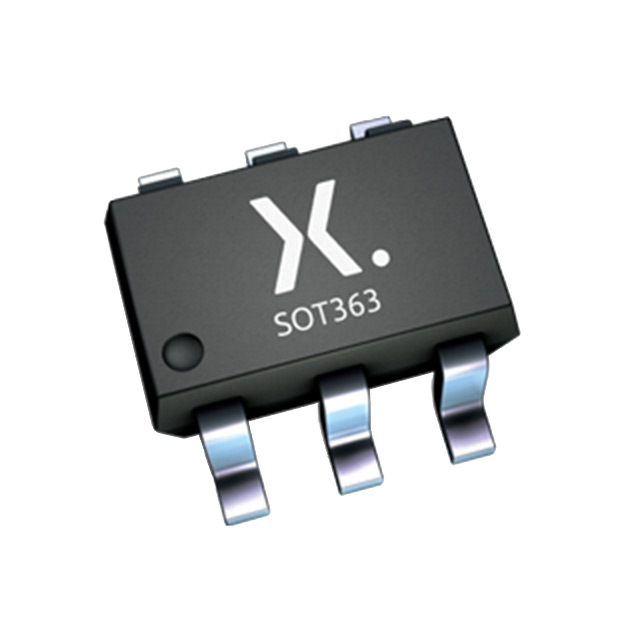
The PUMB17,115 is an active pre-biased dual PNP bipolar junction transistor (BJT) manufactured by Nexperia USA Inc. in a 6-TSSOP surface mount package. This component integrates two PNP transistors with internal biasing resistors, designed for 50V operation at 100mA maximum collector current with 300mW power dissipation. The device is AEC-Q100 qualified for automotive applications and RoHS3 compliant.
Equivalent and substitute parts are necessary when the primary part number becomes unavailable, when alternative packaging formats are required for manufacturing processes, or when design specifications allow for components with different internal biasing resistor configurations while maintaining core electrical performance parameters.
Substiute Parts
Key Parameters
| Parameter | Value | Unit |
|---|---|---|
| Transistor Type | 2 PNP - Pre-Biased (Dual) | — |
| Current - Collector (Ic) (Max) | 100 | mA |
| Voltage - Collector Emitter Breakdown (Max) | 50 | V |
| Resistor - Base (R1) | 47 | kOhms |
| Resistor - Emitter Base (R2) | 22 | kOhms |
| DC Current Gain (hFE) (Min) | 60 @ 5mA, 5V | — |
| Vce Saturation (Max) | 150 @ 500µA, 10mA | mV |
| Current - Collector Cutoff (Max) | 1 | µA |
| Power - Max | 300 | mW |
| Package / Case | 6-TSSOP, SC-88, SOT-363 | — |
| Mounting Type | Surface Mount | — |
| RoHS Status | ROHS3 Compliant | — |
| Grade | Automotive | — |
| Qualification | AEC-Q100 | — |
Substitute Part Grouping Explanation
Substitution of the PUMB17,115 is determined by the following critical parameters:
Mandatory Matching Parameters:
- Transistor Type: 2 PNP - Pre-Biased (Dual)
- Current - Collector (Ic) (Max): 100mA
- Voltage - Collector Emitter Breakdown (Max): 50V
- Mounting Type: Surface Mount
- Package compatibility: 6-TSSOP, SC-88, or SOT-363
Configurable Parameters (Substitution Allowed with Design Verification):
- Resistor - Base (R1): 47kOhms (PUMB17,115 specification)
- Resistor - Emitter Base (R2): 22kOhms (PUMB17,115 specification)
- DC Current Gain (hFE): Minimum 60 @ 5mA, 5V
- Vce Saturation: Maximum 150mV @ 500µA, 10mA
- Power - Max: 300mW
- Current - Collector Cutoff (Max): 1µA
The substitute parts listed below maintain the core electrical specifications (voltage, current, and package) but may differ in internal biasing resistor values, saturation voltage characteristics, cutoff current, power dissipation ratings, and transition frequency. These differences require circuit-level evaluation to confirm functional equivalence in the target application.
Parameter Comparison
| Parameter | PUMB17,115 (Nexperia) | NSVMUN5137DW1T1G (onsemi) | UMB10NTN (Rohm) | UMB11NTN (Rohm) | UMB2NTN (Rohm) |
|---|---|---|---|---|---|
| Manufacturer | Nexperia USA Inc. | onsemi | Rohm Semiconductor | Rohm Semiconductor | Rohm Semiconductor |
| Transistor Type | 2 PNP - Pre-Biased (Dual) | 2 PNP - Pre-Biased (Dual) | 2 PNP - Pre-Biased (Dual) | 2 PNP - Pre-Biased (Dual) | 2 PNP - Pre-Biased (Dual) |
| Current - Collector (Ic) (Max) | 100mA | 100mA | 100mA | 100mA | 100mA |
| Voltage - Collector Emitter Breakdown (Max) | 50V | 50V | 50V | 50V | 50V |
| Resistor - Base (R1) | 47kOhms | 47kOhms | 2.2kOhms | 10kOhms | 47kOhms |
| Resistor - Emitter Base (R2) | 22kOhms | 22kOhms | 47kOhms | 10kOhms | 47kOhms |
| DC Current Gain (hFE) (Min) @ Ic, Vce | 60 @ 5mA, 5V | 80 @ 5mA, 10V | 80 @ 10mA, 5V | 20 @ 5mA, 5V | 68 @ 5mA, 5V |
| Vce Saturation (Max) @ Ib, Ic | 150mV @ 500µA, 10mA | 250mV @ 300µA, 10mA | 300mV @ 250µA, 5mA | 300mV @ 500µA, 10mA | 300mV @ 500µA, 10mA |
| Current - Collector Cutoff (Max) | 1µA | 500nA | 500nA | 500nA | 500nA |
| Frequency - Transition | — | — | 250MHz | 250MHz | 250MHz |
| Power - Max | 300mW | 250mW | 150mW | 150mW | 150mW |
| Package / Case | 6-TSSOP, SC-88, SOT-363 | 6-TSSOP, SC-88, SOT-363 | 6-TSSOP, SC-88, SOT-363 | 6-TSSOP, SC-88, SOT-363 | 6-TSSOP, SC-88, SOT-363 |
| Supplier Device Package | 6-TSSOP | SC-88/SC70-6/SOT-363 | UMT6 | UMT6 | UMT6 |
| Mounting Type | Surface Mount | Surface Mount | Surface Mount | Surface Mount | Surface Mount |
| RoHS Status | ROHS3 Compliant | ROHS3 Compliant | ROHS3 Compliant | ROHS3 Compliant | ROHS3 Compliant |
| Moisture Sensitivity Level (MSL) | 1 (Unlimited) | 1 (Unlimited) | 1 (Unlimited) | 1 (Unlimited) | 1 (Unlimited) |
| REACH Status | REACH Unaffected | REACH Unaffected | REACH Unaffected | REACH Unaffected | REACH Unaffected |
| Product Status | Active | Active | Active | Active | Active |
Engineering Selection Recommendations
NSVMUN5137DW1T1G (onsemi)
This substitute maintains identical base and emitter-base resistor values (47kOhms and 22kOhms respectively) to the PUMB17,115. The primary differences are higher DC current gain (80 vs. 60 minimum), increased saturation voltage (250mV vs. 150mV), and reduced power dissipation (250mW vs. 300mW). The onsemi device is RoHS3 compliant, REACH unaffected, and maintains active product status. This part is suitable for applications where the higher saturation voltage and reduced power budget are acceptable within circuit design margins.
UMB10NTN (Rohm Semiconductor)
This substitute differs significantly in internal biasing resistor configuration (R1: 2.2kOhms, R2: 47kOhms versus R1: 47kOhms, R2: 22kOhms on the PUMB17,115). The UMB10NTN provides 250MHz transition frequency, higher DC current gain (80 minimum), and reduced power dissipation (150mW). The increased saturation voltage (300mV) and different biasing network require circuit-level evaluation. This part is RoHS3 compliant, REACH unaffected, and active. Suitable for high-frequency switching applications where the lower power budget and faster transition frequency provide design advantages.
UMB11NTN (Rohm Semiconductor)
This substitute features symmetric internal biasing resistors (R1: 10kOhms, R2: 10kOhms) and significantly lower DC current gain (20 minimum at 5mA, 5V). The UMB11NTN provides 250MHz transition frequency and 150mW power dissipation. The substantially different gain characteristics and biasing network require application-specific evaluation. This part is RoHS3 compliant, REACH unaffected, and active. Suitable for applications requiring lower gain and symmetric biasing characteristics.
UMB2NTN (Rohm Semiconductor)
This substitute maintains identical base and emitter-base resistor values (47kOhms and 47kOhms) to the PUMB17,115, though the emitter-base resistor differs from the original (47kOhms vs. 22kOhms). The UMB2NTN provides 250MHz transition frequency, DC current gain of 68 minimum, and reduced power dissipation (150mW). The increased saturation voltage (300mV) and different emitter-base resistor value require circuit evaluation. This part is RoHS3 compliant, REACH unaffected, and active. Suitable for applications where the symmetric resistor configuration and transition frequency provide design benefits.
All substitute parts maintain compliance with RoHS3, REACH, and active product status. Selection between substitutes depends on specific circuit requirements regarding biasing resistor values, saturation voltage tolerance, power dissipation limits, and frequency response characteristics.
Frequently Asked Questions (FAQ)
Q: Can NSVMUN5137DW1T1G directly replace PUMB17,115 without circuit modification?
A: NSVMUN5137DW1T1G maintains identical internal biasing resistor values (47kOhms base, 22kOhms emitter-base) and maximum ratings (50V, 100mA). However, the saturation voltage is higher (250mV vs. 150mV), which may affect switching speed and power dissipation in the application. Circuit-level evaluation is required to confirm functional equivalence.
Q: What is the primary difference between UMB10NTN and UMB2NTN?
A: UMB10NTN has internal biasing resistors of 2.2kOhms (base) and 47kOhms (emitter-base), while UMB2NTN has 47kOhms (base) and 47kOhms (emitter-base). This results in different DC current gain characteristics (80 minimum vs. 68 minimum) and different biasing behavior. UMB2NTN more closely matches the emitter-base resistor value of the PUMB17,115 (22kOhms vs. 47kOhms).
Q: Why do the Rohm parts (UMB series) have lower power dissipation ratings than PUMB17,115?
A: The UMB10NTN, UMB11NTN, and UMB2NTN are rated for 150mW maximum power dissipation compared to 300mW for PUMB17,115. This reflects different thermal design specifications. Applications requiring sustained power dissipation above 150mW should not use these Rohm substitutes without thermal analysis.
Q: Are all substitute parts suitable for automotive applications?
A: PUMB17,115 carries AEC-Q100 automotive qualification. The substitute parts (NSVMUN5137DW1T1G, UMB10NTN, UMB11NTN, UMB2NTN) are listed as active products with RoHS3 compliance and REACH unaffected status. However, automotive qualification status for the substitute parts is not provided in the technical specifications. Applications requiring AEC-Q100 qualification should confirm this requirement with the respective manufacturers.
Q: What does the different DC current gain (hFE) mean for circuit operation?
A: DC current gain determines the base current required to achieve a given collector current. PUMB17,115 specifies 60 minimum hFE at 5mA collector current and 5V Vce. NSVMUN5137DW1T1G specifies 80 minimum at 5mA and 10V Vce. UMB11NTN specifies only 20 minimum at 5mA and 5V Vce. Lower gain requires higher base current to achieve saturation; higher gain requires lower base current. Circuit biasing networks must be evaluated for each substitute.
Q: Can UMB11NTN be used in place of PUMB17,115 given its significantly lower gain?
A: UMB11NTN has a minimum DC current gain of 20 compared to PUMB17,115's 60 minimum. This 3:1 difference in gain requires substantially higher base current to achieve the same collector current. Applications designed for PUMB17,115 biasing may not function correctly with UMB11NTN without redesign of the base biasing network.
Q: What is the significance of the 250MHz transition frequency in the Rohm parts?
A: Transition frequency (fT) indicates the frequency at which current gain drops to unity. The Rohm UMB series parts specify 250MHz fT, while PUMB17,115 does not specify this parameter. Higher transition frequency indicates faster switching capability, which may be beneficial for high-frequency applications but is not a requirement for low-frequency switching circuits.
Q: Are the package designations (6-TSSOP, SC-88, SOT-363) interchangeable?
A: All listed parts support 6-TSSOP, SC-88, and SOT-363 package designations, which are equivalent package formats for dual transistor devices. However, the supplier device package may differ (PUMB17,115 supplied as 6-TSSOP, NSVMUN5137DW1T1G as SC-88/SC70-6/SOT-363, Rohm parts as UMT6). Physical footprint compatibility should be confirmed with PCB layout requirements.
Q: What does MSL 1 (Unlimited) mean for moisture sensitivity?
A: Moisture Sensitivity Level 1 (Unlimited) indicates the component has no moisture sensitivity restrictions. These parts can be stored and handled without special moisture control measures, simplifying supply chain and manufacturing processes compared to higher MSL ratings.
Alternative Parts

SJ6012L2TP
Littelfuse Inc.
6 Alternative Parts

JMK107BBJ476MA-RE
Taiyo Yuden
10 Alternative Parts

GMK107BBJ475MA-T
Taiyo Yuden
5 Alternative Parts
SJ6020N2ARP
Littelfuse Inc.
3 Alternative Parts
SJ6025R2ATP
Littelfuse Inc.
4 Alternative Parts

2474-05L
API Delevan Inc.
1 Alternative Parts

4590R-684K
API Delevan Inc.
1 Alternative Parts

CM6560R-334
API Delevan Inc.
1 Alternative Parts

CM6460-104
API Delevan Inc.
1 Alternative Parts

5526-12
API Delevan Inc.
1 Alternative Parts