


Request Quote
(Ships tomorrow)
PDB-C207 Equivalent & Substitute Parts
Part Overview
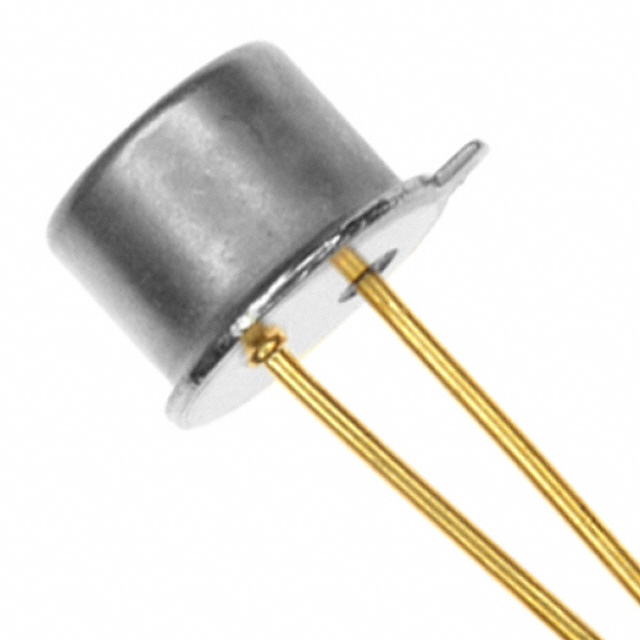
The PDB-C207 is a 950nm photodiode sensor in TO-46-2 metal can packaging, designed for optical sensing applications requiring near-infrared detection. This component features a 100ns response time and 49° viewing angle with a 0.33mm² active area. The product is currently obsolete, making identification of functionally compatible alternatives essential for ongoing system support and new design implementations.
Substiute Parts
Key Parameters
| Parameter | Value |
|---|---|
| Wavelength | 950nm |
| Diode Type | PIN |
| Response Time | 100ns |
| Voltage - DC Reverse (Max) | 100V |
| Current - Dark (Typ) | 1nA |
| Active Area | 0.33mm² |
| Viewing Angle | 49° |
| Operating Temperature | -20°C ~ 80°C |
| Package / Case | TO-46-2 Metal Can |
| Mounting Type | Through Hole |
| RoHS Status | RoHS non-compliant |
Substitute Part Grouping Explanation
The PDB-V104 qualifies as a substitute for the PDB-C207 based on the following alignment of critical parameters:
Matching Parameters:
- Wavelength: Both operate at 950nm for identical spectral response
- Diode Type: Both are PIN photodiodes
- Package / Case: Both use TO-46-2 Metal Can
- Mounting Type: Both are Through Hole
- Spectral Range: Both cover 350nm ~ 1100nm
- Manufacturer: Both are Advanced Photonix products
Substitution Validity: The PDB-V104 maintains the same optical wavelength, diode architecture, and physical package, enabling direct mechanical and electrical compatibility in circuit designs originally specified for the PDB-C207.
Parameter Comparison
| Parameter | PDB-C207 | PDB-V104 |
|---|---|---|
| Wavelength | 950nm | 950nm |
| Diode Type | PIN | PIN |
| Response Time | 100ns | 13ns |
| Voltage - DC Reverse (Max) | 100V | 75V |
| Current - Dark (Typ) | 1nA | 150pA |
| Active Area | 0.33mm² | 3.09mm² |
| Viewing Angle | 49° | 65° |
| Operating Temperature | -20°C ~ 80°C | -40°C ~ 125°C |
| Package / Case | TO-46-2 Metal Can | TO-46-2 Metal Can |
| Mounting Type | Through Hole | Through Hole |
| RoHS Status | RoHS non-compliant | RoHS Compliant |
| Product Status | Obsolete | Active |
Engineering Selection Recommendations
The PDB-V104 is the manufacturer-recommended substitute for the obsolete PDB-C207. Selection of the PDB-V104 provides the following advantages:
Product Availability: The PDB-V104 is in active production status with 692 units in stock, whereas the PDB-C207 is obsolete with limited remaining inventory.
Regulatory Compliance: The PDB-V104 is RoHS Compliant, meeting current environmental and regulatory requirements for new designs and procurement. The PDB-C207 is RoHS non-compliant.
Operating Range: The PDB-V104 extends the operating temperature range to -40°C ~ 125°C, providing broader environmental compatibility compared to the PDB-C207 range of -20°C ~ 80°C.
Performance Characteristics: The PDB-V104 delivers improved response time (13ns versus 100ns) and lower dark current (150pA versus 1nA), resulting in enhanced signal-to-noise performance in optical sensing applications.
Frequently Asked Questions (FAQ)
Q: Can the PDB-V104 be used as a direct replacement for the PDB-C207 in existing designs?
A: Yes. Both components share identical wavelength (950nm), diode type (PIN), and package format (TO-46-2 Metal Can). The PDB-V104 maintains mechanical and electrical compatibility for direct substitution in through-hole mounting applications.
Q: What are the key differences between these two photodiodes?
A: The PDB-V104 offers faster response time (13ns versus 100ns), lower dark current (150pA versus 1nA), larger active area (3.09mm² versus 0.33mm²), and wider viewing angle (65° versus 49°). The PDB-V104 also supports a broader operating temperature range (-40°C ~ 125°C versus -20°C ~ 80°C) and is RoHS Compliant.
Q: Are there any circuit design considerations when switching from PDB-C207 to PDB-V104?
A: The maximum reverse voltage rating differs: PDB-C207 is rated at 100V while PDB-V104 is rated at 75V. Designs operating near the 100V limit require verification that the 75V maximum of the PDB-V104 remains within acceptable operating margins. The improved response time and lower dark current of the PDB-V104 may allow optimization of transimpedance amplifier designs.
Q: Why is the PDB-C207 obsolete?
A: The PDB-C207 is listed as obsolete by the manufacturer. The PDB-V104 represents the current active product offering for 950nm PIN photodiode applications in TO-46-2 packaging.
Q: What is the active area difference and does it affect substitution?
A: The PDB-V104 has a larger active area (3.09mm²) compared to the PDB-C207 (0.33mm²). This larger collection area improves light gathering capability and signal strength. Applications requiring the smaller active area of the original part should evaluate whether the increased active area affects optical coupling or system performance.
Alternative Parts

SJ6012L2TP
Littelfuse Inc.
6 Alternative Parts

JMK107BBJ476MA-RE
Taiyo Yuden
10 Alternative Parts

GMK107BBJ475MA-T
Taiyo Yuden
5 Alternative Parts
SJ6020N2ARP
Littelfuse Inc.
3 Alternative Parts
SJ6025R2ATP
Littelfuse Inc.
4 Alternative Parts

2474-05L
API Delevan Inc.
1 Alternative Parts

4590R-684K
API Delevan Inc.
1 Alternative Parts

CM6560R-334
API Delevan Inc.
1 Alternative Parts

CM6460-104
API Delevan Inc.
1 Alternative Parts

5526-12
API Delevan Inc.
1 Alternative Parts