


Request Quote
(Ships tomorrow)
PCA9626BS,518 LED Driver IC - Equivalent & Substitute Parts
Part Overview
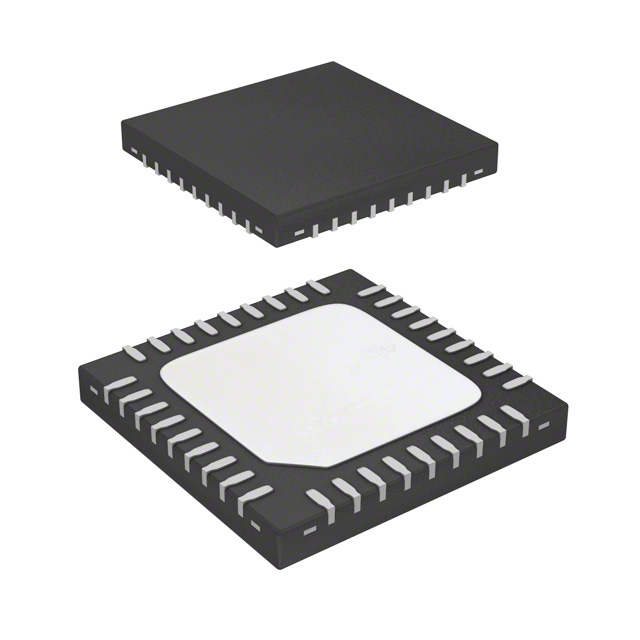
The PCA9626BS,518 is a 24-output linear PWM LED driver IC manufactured by NXP Semiconductors, designed for backlight applications requiring precise dimming control. This device operates across a 2.3V to 5.5V supply range with 100mA per-channel output capability and supports PWM dimming at frequencies between 100kHz and 1MHz. The component is classified as obsolete, making identification of functionally equivalent alternatives essential for ongoing design support and production continuity.
Substiute Parts
Key Parameters
| Parameter | Value |
|---|---|
| Manufacturer Part Number | PCA9626BS,518 |
| Manufacturer | NXP Semiconductors |
| Category | Power Management (PMIC) |
| Number of Outputs | 24 |
| Voltage - Supply (Min) | 2.3V |
| Voltage - Supply (Max) | 5.5V |
| Voltage - Output | 40V |
| Current - Output / Channel | 100mA |
| Frequency | 100kHz ~ 1MHz |
| Dimming | PWM |
| Operating Temperature | -40°C ~ 85°C (TA) |
| Package / Case | 48-VFQFN Exposed Pad |
| Product Status | Obsolete |
| RoHS Status | ROHS3 Compliant |
Substitute Part Grouping Explanation
Substitution eligibility for the PCA9626BS,518 is determined by the following critical parameters:
- Output Configuration: 24-output LED driver topology
- Supply Voltage Range: Compatibility within 2.3V to 5.5V operating window
- Output Voltage Capability: Minimum 40V output voltage support
- Per-Channel Current: 100mA output current per channel
- Dimming Control: PWM-based dimming functionality
- Temperature Range: -40°C to 85°C operating specification
- Package Type: Surface mount VFQFN or equivalent form factor
- Compliance: ROHS3 compliance requirement
The TB62D612FTG,EL qualifies as a substitute based on shared 24-output architecture, overlapping supply voltage range (3V to 5.5V), PWM dimming capability, and identical operating temperature specification. However, critical differences in output voltage (4V vs. 40V) and per-channel current (40mA vs. 100mA) must be evaluated against specific application requirements.
Parameter Comparison
| Parameter | PCA9626BS,518 (Main) | TB62D612FTG,EL (Substitute) |
|---|---|---|
| Manufacturer | NXP Semiconductors | Toshiba Semiconductor and Storage |
| Number of Outputs | 24 | 24 |
| Voltage - Supply (Min) | 2.3V | 3V |
| Voltage - Supply (Max) | 5.5V | 5.5V |
| Voltage - Output | 40V | 4V |
| Current - Output / Channel | 100mA | 40mA |
| Dimming | PWM | Analog, I2C, PWM |
| Operating Temperature | -40°C ~ 85°C (TA) | -40°C ~ 85°C (TA) |
| Package / Case | 48-VFQFN Exposed Pad | 36-WFQFN Exposed Pad |
| Product Status | Obsolete | Active |
| RoHS Status | ROHS3 Compliant | ROHS3 Compliant |
Engineering Selection Recommendations
The TB62D612FTG,EL is an active product with current manufacturing support, whereas the PCA9626BS,518 is obsolete. Both devices maintain ROHS3 compliance and identical operating temperature specifications, supporting long-term supply chain stability and regulatory consistency.
Selection between these components must account for application-specific output voltage and current requirements. The PCA9626BS,518 supports 40V output with 100mA per-channel capability, while the TB62D612FTG,EL is limited to 4V output with 40mA per-channel. The TB62D612FTG,EL offers expanded dimming control options through Analog and I2C interfaces in addition to PWM, providing greater flexibility in control architecture.
Package differences (48-pin vs. 36-pin VFQFN/WQFN) require PCB layout redesign and may impact board space allocation. The minimum supply voltage floor differs by 0.7V (2.3V vs. 3V), which may affect low-voltage application compatibility.
Frequently Asked Questions (FAQ)
Q: Can the TB62D612FTG,EL directly replace the PCA9626BS,518 without circuit modification?
A: Direct replacement is not possible without circuit redesign. The TB62D612FTG,EL has lower output voltage (4V vs. 40V) and reduced per-channel current (40mA vs. 100mA). Applications requiring the full 40V output or 100mA per-channel capability cannot use this substitute. PCB layout changes are also required due to package pin count differences (48 vs. 36 pins).
Q: What are the key compatibility criteria for LED driver substitution?
A: Substitution eligibility is determined by: matching output channel count (24 outputs), overlapping supply voltage range, sufficient output voltage capability, adequate per-channel current rating, compatible dimming control method (PWM), and identical or superior operating temperature range. All parameters must meet or exceed application requirements.
Q: Why does the TB62D612FTG,EL have a lower minimum supply voltage?
A: The TB62D612FTG,EL specifies a 3V minimum supply voltage compared to the PCA9626BS,518's 2.3V minimum. This represents a design difference between manufacturers and may limit applicability in ultra-low-voltage systems. Applications operating below 3V cannot use the Toshiba device.
Q: Are there compliance or certification differences between these parts?
A: Both devices are ROHS3 compliant and REACH unaffected, with identical ECCN and HTSUS classifications. Compliance profiles are equivalent for regulatory purposes.
Q: What is the significance of the package change from 48-VFQFN to 36-WQFN?
A: The package change involves both pin count reduction (48 to 36 pins) and physical dimensions. This requires complete PCB redesign, including trace routing, via placement, and thermal management considerations. The 36-pin package may offer improved thermal characteristics but reduces design flexibility for future modifications.
Alternative Parts

SJ6012L2TP
Littelfuse Inc.
6 Alternative Parts

JMK107BBJ476MA-RE
Taiyo Yuden
10 Alternative Parts

GMK107BBJ475MA-T
Taiyo Yuden
5 Alternative Parts
SJ6020N2ARP
Littelfuse Inc.
3 Alternative Parts
SJ6025R2ATP
Littelfuse Inc.
4 Alternative Parts

2474-05L
API Delevan Inc.
1 Alternative Parts

4590R-684K
API Delevan Inc.
1 Alternative Parts

CM6560R-334
API Delevan Inc.
1 Alternative Parts

CM6460-104
API Delevan Inc.
1 Alternative Parts

5526-12
API Delevan Inc.
1 Alternative Parts