



Request Quote
(Ships tomorrow)
OP470EY Equivalent & Substitute Parts
Part Overview
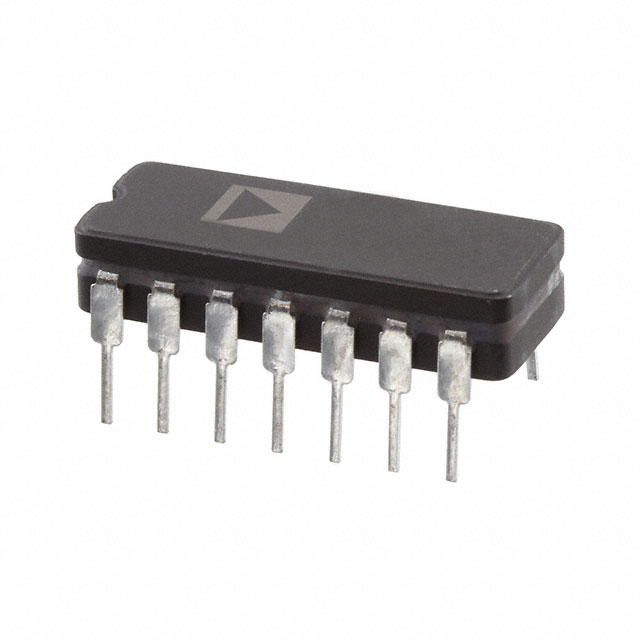
The OP470EY is a general-purpose operational amplifier manufactured by Analog Devices Inc., configured as a 4-circuit integrated circuit in a 14-CERDIP package. This device is classified as Active product status and is designed for linear amplification applications requiring moderate bandwidth and low input bias current characteristics. The OP470EY operates across a wide supply voltage range of 9V to 36V and maintains performance across the industrial temperature range of -55°C to 125°C. Identification of equivalent and substitute parts becomes necessary when managing inventory constraints, addressing component obsolescence concerns, or optimizing procurement across multiple suppliers while maintaining circuit performance specifications.
Substiute Parts
Key Parameters
| Parameter | Value | Unit |
|---|---|---|
| Amplifier Type | General Purpose | — |
| Number of Circuits | 4 | — |
| Slew Rate | 3 | V/µs |
| Gain Bandwidth Product | 6 | MHz |
| Current - Input Bias | 25 | nA |
| Voltage - Input Offset | 400 | µV |
| Current - Supply | 9 | mA |
| Voltage - Supply Span (Min) | 9 | V |
| Voltage - Supply Span (Max) | 36 | V |
| Operating Temperature | -55 to 125 | °C |
| Mounting Type | Through Hole | — |
| Package / Case | 14-CDIP (0.300", 7.62mm) | — |
| Product Status | Active | — |
| RoHS Status | ROHS3 Compliant | — |
Substitute Part Grouping Explanation
Substitution of the OP470EY with the LF147J is determined by the following critical parameters that must align for functional equivalence:
Package Compatibility: Both devices utilize the 14-CDIP (0.300", 7.62mm) through-hole package, enabling direct physical interchange on printed circuit boards without layout modifications.
Circuit Configuration: Both parts contain 4 operational amplifier circuits within a single integrated circuit, maintaining identical channel count and pinout compatibility.
Operating Temperature Range: Both devices support the industrial temperature range of -55°C to 125°C, ensuring equivalent thermal performance across specified operating conditions.
Supply Voltage Compatibility: The OP470EY operates from 9V to 36V, while the LF147J operates from 10V to 44V. The overlap range of 10V to 36V permits substitution in applications operating within this common window.
RoHS and Regulatory Compliance: Both devices maintain ROHS3 compliance and EAR99 classification, satisfying equivalent regulatory requirements.
Amplifier Architecture Difference: The OP470EY is a general-purpose amplifier, while the LF147J is a J-FET input amplifier. This architectural difference results in distinct electrical performance characteristics that must be evaluated against specific application requirements.
Parameter Comparison
| Parameter | OP470EY (Analog Devices) | LF147J (Texas Instruments) | Unit |
|---|---|---|---|
| Amplifier Type | General Purpose | J-FET | — |
| Number of Circuits | 4 | 4 | — |
| Slew Rate | 3 | 13 | V/µs |
| Gain Bandwidth Product | 6 | 4 | MHz |
| Current - Input Bias | 25 | 50 | nA |
| Voltage - Input Offset | 400 | 1000 | µV |
| Current - Supply | 9 | 7.2 (x4 Channels) | mA |
| Voltage - Supply Span (Min) | 9 | 10 | V |
| Voltage - Supply Span (Max) | 36 | 44 | V |
| Operating Temperature | -55 to 125 | -55 to 125 | °C |
| Mounting Type | Through Hole | Through Hole | — |
| Package / Case | 14-CDIP (0.300", 7.62mm) | 14-CDIP (0.300", 7.62mm) | — |
| RoHS Status | ROHS3 Compliant | ROHS3 Compliant | — |
| Product Status | Active | Active | — |
Engineering Selection Recommendations
Compliance and Regulatory Status: Both the OP470EY and LF147J maintain Active product status with ROHS3 compliance and EAR99 classification. The OP470EY carries REACH Unaffected status, while the LF147J carries REACH Affected status. Selection between these devices must account for supply chain and regulatory requirements specific to the end application and geographic market.
Electrical Performance Trade-offs: The LF147J exhibits superior slew rate performance at 13V/µs compared to the OP470EY at 3V/µs, enabling faster signal transitions in high-speed applications. Conversely, the OP470EY provides higher gain bandwidth product at 6MHz versus 4MHz for the LF147J. The OP470EY demonstrates lower input bias current at 25nA and lower input offset voltage at 400µV, compared to the LF147J at 50nA and 1mV respectively.
Supply Current Considerations: The OP470EY draws 9mA total supply current, while the LF147J draws 7.2mA across four channels, resulting in lower power consumption with the LF147J in multi-channel applications.
Minimum Supply Voltage: Applications operating below 10V require the OP470EY, as the LF147J minimum supply voltage is 10V. The OP470EY supports operation down to 9V.
Packaging and Mounting: Both devices utilize identical 14-CDIP through-hole packages, permitting direct physical substitution without circuit board redesign.
Frequently Asked Questions (FAQ)
Q: Can the LF147J directly replace the OP470EY in all applications?
A: Direct replacement is possible only when the application operates within the common supply voltage range of 10V to 36V and when the electrical performance differences between general-purpose and J-FET amplifier architectures are compatible with circuit requirements. Applications requiring operation below 10V supply voltage cannot use the LF147J.
Q: What are the primary electrical differences between these devices?
A: The OP470EY is a general-purpose amplifier with 6MHz gain bandwidth product and 3V/µs slew rate. The LF147J is a J-FET input amplifier with 4MHz gain bandwidth product and 13V/µs slew rate. The LF147J provides superior slew rate performance but lower bandwidth. Input bias current and offset voltage differ significantly, with the OP470EY providing superior precision characteristics.
Q: Are both devices available in the same package?
A: Yes. Both the OP470EY and LF147J are available in the 14-CDIP (0.300", 7.62mm) through-hole package, enabling direct physical interchange on printed circuit boards.
Q: What is the impact of REACH status on component selection?
A: The OP470EY carries REACH Unaffected status, while the LF147J carries REACH Affected status. Applications subject to REACH compliance requirements must evaluate whether the LF147J's REACH Affected classification presents constraints for the intended market or application.
Q: How do the supply current specifications compare?
A: The OP470EY draws 9mA total supply current. The LF147J draws 7.2mA across four channels, resulting in lower power consumption. This difference becomes significant in battery-powered or power-constrained applications.
Q: What minimum supply voltage is required for each device?
A: The OP470EY operates from a minimum of 9V supply voltage. The LF147J requires a minimum of 10V supply voltage. Applications operating below 10V must use the OP470EY.
Q: Are both devices RoHS compliant?
A: Yes. Both the OP470EY and LF147J maintain ROHS3 compliance status.
Q: What is the operating temperature range for both devices?
A: Both devices operate across the industrial temperature range of -55°C to 125°C, providing equivalent thermal performance specifications.
Alternative Parts

SJ6012L2TP
Littelfuse Inc.
6 Alternative Parts

JMK107BBJ476MA-RE
Taiyo Yuden
10 Alternative Parts

GMK107BBJ475MA-T
Taiyo Yuden
5 Alternative Parts
SJ6020N2ARP
Littelfuse Inc.
3 Alternative Parts
SJ6025R2ATP
Littelfuse Inc.
4 Alternative Parts

2474-05L
API Delevan Inc.
1 Alternative Parts

4590R-684K
API Delevan Inc.
1 Alternative Parts

CM6560R-334
API Delevan Inc.
1 Alternative Parts

CM6460-104
API Delevan Inc.
1 Alternative Parts

5526-12
API Delevan Inc.
1 Alternative Parts