


Request Quote
(Ships tomorrow)
OP169C Infrared Emitter - Equivalent & Substitute Parts
Part Overview
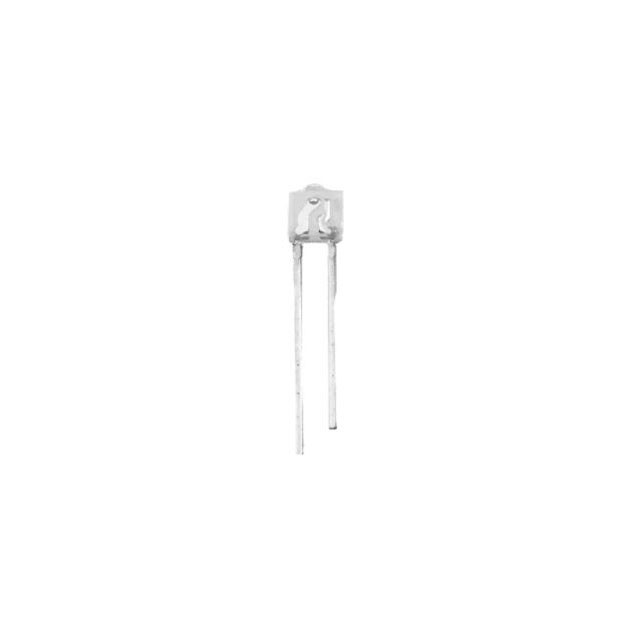
The OP169C is an infrared (IR) emitter manufactured by TT Electronics/Optek Technology, designed for applications requiring 935nm wavelength emission at 50mA forward current. This component features a 1.4V typical forward voltage, 0.03mW/cm² radiant intensity at 20mA, and an 18° viewing angle in a radial through-hole package.
The OP169C is classified as obsolete. Identifying suitable substitute components is necessary to maintain design continuity and ensure component availability for new production runs, repairs, and system upgrades where this wavelength and performance profile are required.
Substiute Parts
Key Parameters
| Parameter | Value | Unit |
|---|---|---|
| Type | Infrared (IR) Emitter | — |
| Wavelength | 935nm | nm |
| Current - DC Forward (If) Max | 50mA | mA |
| Voltage - Forward (Vf) Typical | 1.4V | V |
| Radiant Intensity (Ie) Min @ If | 0.03mW/cm² @ 20mA | mW/cm² |
| Viewing Angle | 18° | degrees |
| Mounting Type | Through Hole | — |
| Package / Case | Radial | — |
| Operating Temperature Range | -40°C to 100°C | °C |
| RoHS Status | ROHS3 Compliant | — |
| Moisture Sensitivity Level | 1 (Unlimited) | — |
Substitute Part Grouping Explanation
Substitution of the OP169C is determined by the following critical parameters:
- Wavelength compatibility: The substitute must operate within the infrared spectrum at a wavelength suitable for the application's optical receiver or sensor
- Current rating: Maximum DC forward current must be 50mA or greater to ensure safe operation within design specifications
- Forward voltage: Typical forward voltage must be compatible with existing circuit bias networks
- Radiant intensity: Output power must meet or exceed the minimum radiant intensity requirement for the application
- Viewing angle: The 18° viewing angle defines the spatial emission pattern; substitutes must maintain this characteristic
- Mounting type and package: Through-hole radial package ensures mechanical and electrical compatibility with existing PCB layouts
- Operating temperature range: The -40°C to 100°C range must be maintained for environmental compliance
- Compliance certifications: RoHS3 compliance and MSL rating must be preserved
The OP269A is identified as a manufacturer-recommended substitute. While it operates at a different wavelength (890nm versus 935nm), it maintains electrical and mechanical compatibility across all other critical parameters.
Parameter Comparison
| Parameter | OP169C (Main Part) | OP269A (Substitute) | Compatibility Notes |
|---|---|---|---|
| Type | Infrared (IR) Emitter | Infrared (IR) Emitter | Identical |
| Wavelength | 935nm | 890nm | Different wavelength band |
| Current - DC Forward (If) Max | 50mA | 50mA | Identical |
| Voltage - Forward (Vf) Typical | 1.4V | 1.5V | 0.1V difference |
| Radiant Intensity (Ie) Min @ If | 0.03mW/cm² @ 20mA | 0.58mW/cm² @ 20mA | OP269A provides higher output |
| Viewing Angle | 18° | 18° | Identical |
| Mounting Type | Through Hole | Through Hole | Identical |
| Package / Case | Radial | Radial | Identical |
| Operating Temperature Range | -40°C to 100°C | -40°C to 100°C | Identical |
| RoHS Status | ROHS3 Compliant | ROHS3 Compliant | Identical |
| Moisture Sensitivity Level | 1 (Unlimited) | 1 (Unlimited) | Identical |
| Product Status | Obsolete | Active | OP269A actively manufactured |
Engineering Selection Recommendations
The OP269A is the manufacturer-recommended substitute for the obsolete OP169C. Both components maintain identical electrical current ratings, viewing angles, mounting configurations, and operating temperature ranges. Both are ROHS3 compliant with MSL rating 1 (Unlimited), ensuring regulatory and environmental compatibility.
The primary difference is wavelength: OP269A operates at 890nm compared to OP169C's 935nm. This wavelength shift must be evaluated against the optical receiver or sensor specifications in the target application. The OP269A also provides significantly higher radiant intensity (0.58mW/cm² versus 0.03mW/cm²), which may require circuit-level adjustments to current-limiting resistors to prevent over-driving the receiver.
Forward voltage differs by 0.1V (1.5V for OP269A versus 1.4V for OP169C), a variance that is typically accommodated within standard circuit bias tolerances.
The OP269A's active product status ensures ongoing availability and manufacturing support, eliminating supply chain risk associated with the obsolete OP169C.
Frequently Asked Questions (FAQ)
Q: Can the OP269A directly replace the OP169C without circuit modifications?
A: Mechanical and electrical compatibility is maintained for current rating, voltage tolerance, mounting type, and package configuration. However, the wavelength difference (890nm versus 935nm) requires verification that the optical receiver or sensor in the application is responsive to 890nm emission. The higher radiant intensity of the OP269A may necessitate adjustment of current-limiting resistors to prevent receiver saturation.
Q: What is the significance of the wavelength difference between these parts?
A: Wavelength determines the spectral response of the receiving photodiode or sensor. If the application's receiver is optimized for 935nm, substitution with an 890nm emitter may result in reduced optical coupling efficiency. Receiver datasheets must be consulted to confirm 890nm responsivity.
Q: Are both parts RoHS compliant?
A: Yes. Both the OP169C and OP269A are ROHS3 compliant and carry MSL rating 1 (Unlimited), meeting current environmental and regulatory requirements.
Q: Why is the OP269A recommended if the wavelength differs?
A: The OP269A is the manufacturer-recommended substitute because it is the closest active equivalent from TT Electronics/Optek Technology that maintains all mechanical and electrical parameters except wavelength. The manufacturer designation indicates this substitution has been evaluated for compatibility within the product family.
Q: What is the impact of the 0.1V forward voltage difference?
A: The 0.1V difference (1.4V to 1.5V) is within typical circuit design tolerances and does not require redesign of bias networks in most applications. Standard resistor tolerances and power supply regulation accommodate this variance.
Q: Is the OP269A's higher radiant intensity a concern?
A: The OP269A's radiant intensity is approximately 19 times higher than the OP169C. This increased output may require reduction of the forward current through resistor adjustment to prevent receiver saturation or false triggering. Circuit-level testing is necessary to establish appropriate operating current.
Q: Can I use both parts interchangeably in inventory?
A: Mechanical interchangeability is confirmed. However, optical and electrical performance differences require that substitution be evaluated on a per-application basis. Mixed inventory use is not recommended without explicit design verification.
Alternative Parts

SJ6012L2TP
Littelfuse Inc.
6 Alternative Parts

JMK107BBJ476MA-RE
Taiyo Yuden
10 Alternative Parts

GMK107BBJ475MA-T
Taiyo Yuden
5 Alternative Parts
SJ6020N2ARP
Littelfuse Inc.
3 Alternative Parts
SJ6025R2ATP
Littelfuse Inc.
4 Alternative Parts

2474-05L
API Delevan Inc.
1 Alternative Parts

4590R-684K
API Delevan Inc.
1 Alternative Parts

CM6560R-334
API Delevan Inc.
1 Alternative Parts

CM6460-104
API Delevan Inc.
1 Alternative Parts

5526-12
API Delevan Inc.
1 Alternative Parts