



Request Quote
(Ships tomorrow)
OED-CL-1L2 Infrared Emitter 880nm Equivalent & Substitute Parts
Part Overview
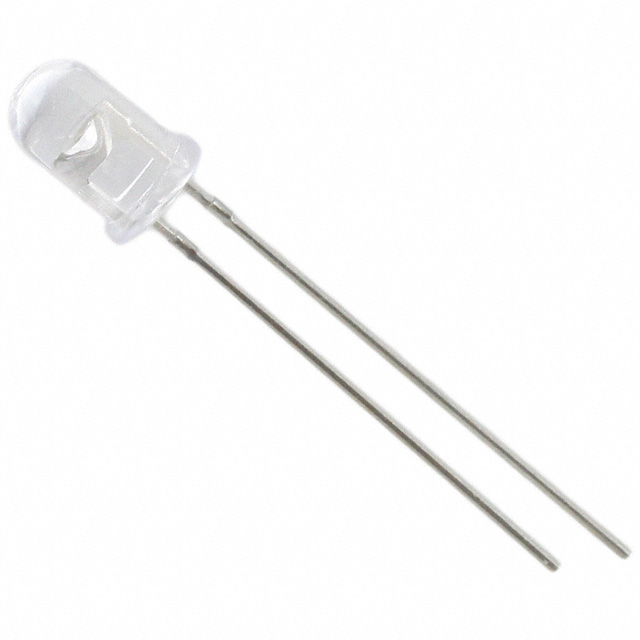
The OED-CL-1L2 is an infrared (IR) emitter manufactured by Lumex Opto/Components Inc., designed for applications requiring 880nm wavelength emission at 100mA maximum forward current. This component operates at a typical forward voltage of 1.9V with a radiant intensity of 15mW/sr at 50mA and a 60° viewing angle in radial through-hole configuration.
The OED-CL-1L2 is classified as obsolete. Identifying equivalent and substitute parts is necessary to maintain design continuity, ensure supply chain availability, and support ongoing production or repair requirements for systems utilizing this component.
Substiute Parts
Key Parameters
| Parameter | Value |
|---|---|
| Manufacturer Part Number | OED-CL-1L2 |
| Manufacturer | Lumex Opto/Components Inc. |
| Type | Infrared (IR) Emitter |
| Wavelength | 880nm |
| Current - DC Forward (If) Max | 100mA |
| Voltage - Forward (Vf) Typical | 1.9V |
| Radiant Intensity (Ie) Min @ If | 15mW/sr @ 50mA |
| Viewing Angle | 60° |
| Mounting Type | Through Hole |
| Package / Case | Radial |
| Operating Temperature Range | -25°C ~ 85°C (TA) |
| Product Status | Obsolete |
| RoHS Status | ROHS3 Compliant |
Substitute Part Grouping Explanation
Substitution eligibility for the OED-CL-1L2 is determined by the following critical parameters:
Primary Compatibility Criteria:
- Mounting Type: Through Hole (radial orientation)
- Package / Case: Radial
- Current - DC Forward (If) Max: 100mA
- Type: Infrared (IR) Emitter
Secondary Compatibility Criteria:
- Wavelength: 880nm (primary) or 940nm (alternative IR spectrum)
- Viewing Angle: 60° (primary) or compatible narrow-angle alternatives
- Operating Temperature Range: Minimum -25°C, Maximum 85°C
- RoHS Compliance: ROHS3 Compliant
Two substitute parts meet the core mechanical and electrical compatibility requirements:
-
LTE-5238A (Lite-On Inc.): Matches wavelength (880nm), forward current (100mA), and radial through-hole configuration. Differs in forward voltage (1.3V vs. 1.9V), radiant intensity measurement conditions (20mA vs. 50mA), and viewing angle (40° vs. 60°).
-
IR7393C (Everlight Electronics Co Ltd): Matches forward current (100mA) and radial through-hole configuration. Operates at alternative IR wavelength (940nm), lower forward voltage (1.2V), and identical 60° viewing angle.
Parameter Comparison
| Parameter | OED-CL-1L2 (Main) | LTE-5238A | IR7393C |
|---|---|---|---|
| Manufacturer | Lumex Opto/Components Inc. | Lite-On Inc. | Everlight Electronics Co Ltd |
| Wavelength | 880nm | 880nm | 940nm |
| Current - DC Forward (If) Max | 100mA | 100mA | 100mA |
| Voltage - Forward (Vf) Typical | 1.9V | 1.3V | 1.2V |
| Radiant Intensity (Ie) Min @ If | 15mW/sr @ 50mA | 4.81mW/sr @ 20mA | 4mW/sr @ 20mA |
| Viewing Angle | 60° | 40° | 60° |
| Mounting Type | Through Hole | Through Hole | Through Hole |
| Package / Case | Radial | Radial | Radial |
| Operating Temperature Range | -25°C ~ 85°C | -40°C ~ 85°C | -40°C ~ 85°C |
| Product Status | Obsolete | Active | Active |
| RoHS Status | ROHS3 Compliant | ROHS3 Compliant | ROHS3 Compliant |
Engineering Selection Recommendations
LTE-5238A Selection Criteria:
The LTE-5238A is suitable for applications where 880nm wavelength emission is a functional requirement. This substitute maintains wavelength compatibility with the OED-CL-1L2. The LTE-5238A is classified as Active product status, ensuring ongoing availability and supply chain support. Both components are ROHS3 Compliant and carry identical ECCN and HTSUS classifications.
Design considerations: The LTE-5238A operates at lower forward voltage (1.3V vs. 1.9V) and exhibits reduced radiant intensity (4.81mW/sr @ 20mA vs. 15mW/sr @ 50mA). The viewing angle is narrower (40° vs. 60°), which may affect optical coupling efficiency in wide-angle applications. The extended operating temperature range (-40°C vs. -25°C minimum) provides additional thermal margin.
IR7393C Selection Criteria:
The IR7393C is suitable for applications where IR emission in the 940nm spectrum is acceptable as an alternative to 880nm. This substitute maintains identical forward current rating (100mA) and viewing angle (60°) with the OED-CL-1L2. The IR7393C is classified as Active product status with ROHS3 Compliance.
Design considerations: The IR7393C operates at significantly lower forward voltage (1.2V vs. 1.9V) and exhibits reduced radiant intensity (4mW/sr @ 20mA vs. 15mW/sr @ 50mA). The 940nm wavelength shift may require receiver photodiode compatibility verification in spectral-sensitive applications. The extended operating temperature range (-40°C vs. -25°C minimum) provides additional thermal margin.
Compliance and Regulatory Status:
All three components (OED-CL-1L2, LTE-5238A, IR7393C) are ROHS3 Compliant, REACH Unaffected, and classified under ECCN EAR99 with identical HTSUS code 8541.41.0000. Substitution does not introduce regulatory compliance risk.
Frequently Asked Questions (FAQ)
Q: Can the LTE-5238A directly replace the OED-CL-1L2 in all applications?
A: The LTE-5238A shares the same 880nm wavelength and 100mA forward current rating, enabling direct mechanical and electrical substitution in through-hole radial configurations. However, the narrower 40° viewing angle (vs. 60°) may reduce optical coupling efficiency in applications requiring wide-angle emission. Forward voltage difference (1.3V vs. 1.9V) requires circuit verification to ensure proper current limiting and power dissipation characteristics.
Q: Is the IR7393C suitable for applications originally designed for 880nm emission?
A: The IR7393C operates at 940nm wavelength, which differs from the OED-CL-1L2 specification of 880nm. Substitution is only appropriate if the receiver photodiode or detector is specified to accept the 940nm spectrum. Wavelength-sensitive applications (such as those with narrow-band optical filters or specific photodiode peak response curves) require compatibility verification before substitution.
Q: What are the mechanical compatibility requirements for substitution?
A: All three components utilize through-hole radial package configuration, ensuring identical PCB footprint and mounting orientation. No mechanical redesign is required for substitution. Radial lead spacing and component body dimensions are compatible across all three parts.
Q: How do the radiant intensity differences affect circuit design?
A: The OED-CL-1L2 specifies 15mW/sr @ 50mA, while both substitutes specify lower radiant intensity (LTE-5238A: 4.81mW/sr @ 20mA; IR7393C: 4mW/sr @ 20mA). Applications requiring specific optical power output may need increased forward current or optical system redesign to compensate for reduced radiant intensity. Measurement conditions differ between parts, requiring direct comparison at equivalent current levels.
Q: Are there temperature range implications for substitution?
A: The OED-CL-1L2 operates from -25°C to 85°C, while both substitutes extend the minimum operating temperature to -40°C. This provides additional thermal margin for cold-environment applications. Maximum operating temperature (85°C) is identical across all three components. No thermal redesign is required for standard operating conditions.
Q: What is the inventory and supply status for each component?
A: The OED-CL-1L2 (obsolete) has 941 pcs in stock. The LTE-5238A (active) has 932 pcs in stock. The IR7393C (active) has 40,663 pcs in stock. Active product status for both substitutes indicates ongoing manufacturing and supply chain availability, supporting long-term design continuity.
Alternative Parts

SJ6012L2TP
Littelfuse Inc.
6 Alternative Parts

JMK107BBJ476MA-RE
Taiyo Yuden
10 Alternative Parts

GMK107BBJ475MA-T
Taiyo Yuden
5 Alternative Parts
SJ6020N2ARP
Littelfuse Inc.
3 Alternative Parts
SJ6025R2ATP
Littelfuse Inc.
4 Alternative Parts

2474-05L
API Delevan Inc.
1 Alternative Parts

4590R-684K
API Delevan Inc.
1 Alternative Parts

CM6560R-334
API Delevan Inc.
1 Alternative Parts

CM6460-104
API Delevan Inc.
1 Alternative Parts

5526-12
API Delevan Inc.
1 Alternative Parts