


Request Quote
(Ships tomorrow)
OD-880F Infrared Emitter - Equivalent & Substitute Parts
Part Overview
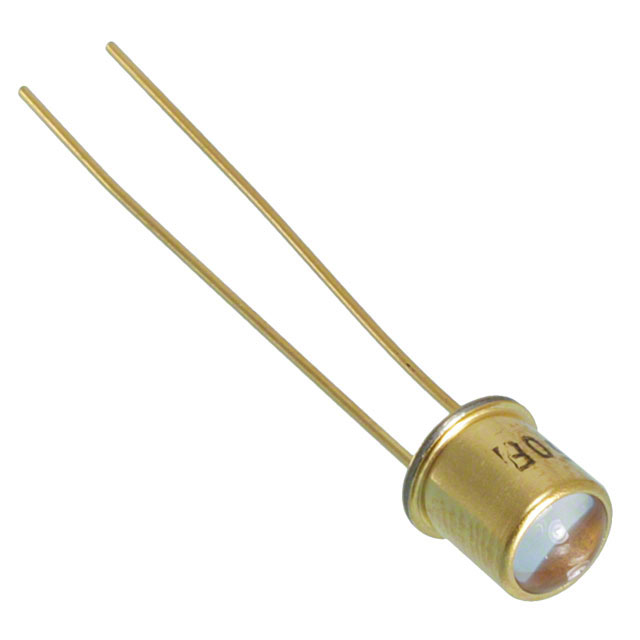
The OD-880F is an infrared (IR) emitter manufactured by Opto Diode Corp, designed for applications requiring 880nm wavelength emission at 100mA forward current. This component operates at a typical forward voltage of 1.55V and delivers 120mW/sr radiant intensity in a TO-46-2 lens top metal can package with an 8° viewing angle.
The OD-880F is classified as obsolete. Locating equivalent or substitute components is necessary for ongoing system support, maintenance, and new production runs where 880nm IR emitters are specified.
Substiute Parts
Key Parameters
| Parameter | Value | Unit |
|---|---|---|
| Manufacturer Part Number | OD-880F | — |
| Manufacturer | Opto Diode Corp | — |
| Type | Infrared (IR) Emitter | — |
| Wavelength | 880nm | nm |
| Current - DC Forward (If) Max | 100mA | mA |
| Voltage - Forward (Vf) Typical | 1.55V | V |
| Radiant Intensity (Ie) Min @ If | 120mW/sr @ 100mA | mW/sr |
| Viewing Angle | 8° | degrees |
| Operating Temperature Range | -55°C to +100°C | °C |
| Package / Case | TO-46-2 Lens Top Metal Can | — |
| Mounting Type | Through Hole | — |
| Product Status | Obsolete | — |
Substitute Part Grouping Explanation
Substitution of the OD-880F is determined by the following critical parameters:
Mandatory Compatibility Parameters:
- Package / Case: TO-46-2 Lens Top Metal Can (physical and electrical interface)
- Mounting Type: Through Hole (PCB assembly compatibility)
- Current - DC Forward (If) Max: 100mA (circuit design constraint)
- Viewing Angle: 8° (optical beam pattern)
Wavelength Consideration: The OD-880F operates at 880nm. Substitute parts may operate at alternative near-infrared wavelengths (such as 850nm) if the application permits wavelength variation. Wavelength selection depends on the specific photodetector or receiver used in the system.
Electrical Parameters: Forward voltage (Vf) and radiant intensity specifications must be evaluated against circuit design requirements and optical performance targets.
Environmental Compliance: Product status (active vs. obsolete), RoHS compliance, and regulatory certifications (REACH, ECCN, HTSUS) are relevant for procurement and supply chain continuity.
Parameter Comparison
| Parameter | OD-880F (Main Part) | OD-850F (Substitute) | Notes |
|---|---|---|---|
| Manufacturer | Opto Diode Corp | Opto Diode Corp | Same manufacturer |
| Type | Infrared (IR) Emitter | Infrared (IR) Emitter | Same component type |
| Wavelength | 880nm | 850nm | 30nm difference; application-dependent compatibility |
| Current - DC Forward (If) Max | 100mA | 100mA | Identical |
| Voltage - Forward (Vf) Typical | 1.55V | 1.6V | 0.05V difference; negligible for most circuits |
| Viewing Angle | 8° | 8° | Identical |
| Operating Temperature Range | -55°C to +100°C | -40°C to +100°C | OD-880F has wider low-temperature range |
| Package / Case | TO-46-2 Lens Top Metal Can | TO-46-2 Lens Top Metal Can | Identical; direct physical compatibility |
| Mounting Type | Through Hole | Through Hole | Identical |
| Product Status | Obsolete | Active | OD-850F is currently in production |
| RoHS Status | Not specified | RoHS Compliant | OD-850F meets RoHS requirements |
Engineering Selection Recommendations
OD-850F as Substitute for OD-880F:
The OD-850F is a viable substitute for the obsolete OD-880F based on the following factors:
-
Package Compatibility: Both components use the TO-46-2 Lens Top Metal Can package with identical through-hole mounting, ensuring direct PCB compatibility without layout modifications.
-
Electrical Compatibility: Both parts operate at 100mA maximum forward current. The forward voltage difference (1.55V vs. 1.6V) is 0.05V, which is negligible for standard circuit designs and does not require recalculation of series resistors in typical applications.
-
Optical Compatibility: Both components feature an 8° viewing angle, maintaining identical beam geometry.
-
Wavelength Difference: The OD-850F operates at 850nm versus the OD-880F's 880nm. This 30nm difference is application-dependent. Substitution is valid only if the system's photodetector or receiver is compatible with 850nm wavelength or if the application permits wavelength variation within the near-infrared spectrum.
-
Product Status and Compliance: The OD-850F is active (in production) and RoHS compliant, providing supply chain continuity and regulatory compliance advantages over the obsolete OD-880F.
-
Temperature Range: The OD-880F supports -55°C to +100°C operation, while the OD-850F supports -40°C to +100°C. For applications requiring operation below -40°C, the OD-880F's extended low-temperature range may be necessary if available from inventory.
Selection Criteria:
- Use OD-850F for new designs and ongoing production where 850nm wavelength is acceptable.
- Verify receiver/detector compatibility with 850nm wavelength before substitution.
- Confirm operating temperature requirements; if below -40°C is required, evaluate OD-880F inventory availability.
Frequently Asked Questions (FAQ)
Q1: Can the OD-850F directly replace the OD-880F without circuit modifications?
A: Yes, for most applications. Both components share identical package (TO-46-2), mounting type (through-hole), maximum forward current (100mA), and viewing angle (8°). The forward voltage difference of 0.05V does not require circuit recalculation in standard designs. However, wavelength compatibility with the system's photodetector must be verified.
Q2: What is the significance of the 880nm vs. 850nm wavelength difference?
A: The 30nm wavelength difference affects optical system performance. The OD-850F's 850nm emission may have different absorption characteristics in the target medium and different spectral response from the receiving photodetector. Substitution is valid only if the system's optical receiver is designed to accept 850nm wavelength or if the application permits wavelength variation.
Q3: Are there any compliance or regulatory differences between OD-880F and OD-850F?
A: The OD-850F is RoHS compliant, while RoHS status for the OD-880F is not specified. Both components share identical ECCN (EAR99) and HTSUS (8541.41.0000) classifications. For new production, the OD-850F's RoHS compliance is advantageous.
Q4: What is the impact of the operating temperature range difference?
A: The OD-880F supports -55°C to +100°C, while the OD-850F supports -40°C to +100°C. For applications requiring operation below -40°C, the OD-880F's extended low-temperature specification is necessary. For standard industrial and commercial temperature ranges (-40°C and above), both components are equivalent.
Q5: Is the OD-850F available in the same packaging as the OD-880F?
A: Yes. Both components use the TO-46-2 Lens Top Metal Can package with through-hole mounting. Physical and electrical interfaces are identical, allowing direct PCB substitution without layout changes.
Q6: Why is the OD-880F obsolete, and what does this mean for supply?
A: The OD-880F is classified as obsolete, indicating it is no longer in production. The OD-850F, as an active product from the same manufacturer, provides supply chain continuity. Existing OD-880F inventory may be available from distributors, but long-term availability is not guaranteed.
Q7: What parameters must be verified before substituting OD-850F for OD-880F?
A: Verify the following before substitution: (1) Photodetector or receiver compatibility with 850nm wavelength; (2) Operating temperature requirements (confirm if below -40°C operation is needed); (3) Radiant intensity requirements (OD-850F radiant intensity data was not provided; confirm if 120mW/sr minimum is required).
Alternative Parts

SJ6012L2TP
Littelfuse Inc.
6 Alternative Parts

JMK107BBJ476MA-RE
Taiyo Yuden
10 Alternative Parts

GMK107BBJ475MA-T
Taiyo Yuden
5 Alternative Parts
SJ6020N2ARP
Littelfuse Inc.
3 Alternative Parts
SJ6025R2ATP
Littelfuse Inc.
4 Alternative Parts

2474-05L
API Delevan Inc.
1 Alternative Parts

4590R-684K
API Delevan Inc.
1 Alternative Parts

CM6560R-334
API Delevan Inc.
1 Alternative Parts

CM6460-104
API Delevan Inc.
1 Alternative Parts

5526-12
API Delevan Inc.
1 Alternative Parts