


Request Quote
(Ships tomorrow)
OD-50W Infrared Emitter 880nm Equivalent & Substitute Parts
Part Overview
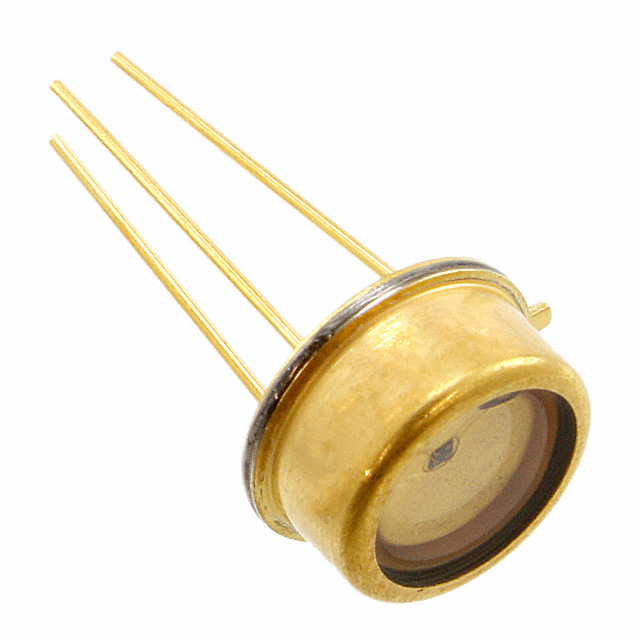
The OD-50W is an infrared (IR) emitter operating at 880nm wavelength, designed for through-hole mounting in TO-39 metal can packages. This component delivers 500mA forward current with 60mW/sr radiant intensity and operates across a temperature range of -55°C to 100°C. The OD-50W is classified as obsolete, making identification of compatible substitute parts essential for ongoing system support and new design implementations where 880nm IR emission is required.
Substiute Parts
Key Parameters
| Parameter | Value |
|---|---|
| Wavelength | 880nm |
| Current - DC Forward (If) Max | 500mA |
| Voltage - Forward (Vf) Typical | 1.65V |
| Radiant Intensity (Ie) Min @ If | 60mW/sr @ 500mA |
| Viewing Angle | 110° |
| Operating Temperature Range | -55°C to 100°C |
| Package / Case | TO-205AD, TO-39-3 Metal Can |
| Mounting Type | Through Hole |
| Product Status | Obsolete |
Substitute Part Grouping Explanation
Substitution eligibility for the OD-50W is determined by the following critical parameters:
Mandatory Matching Parameters:
- Package / Case: TO-205AD, TO-39-3 Metal Can (physical and electrical interface compatibility)
- Mounting Type: Through Hole (board assembly compatibility)
- Current - DC Forward (If) Max: 500mA (circuit design compatibility)
- Viewing Angle: 110° (optical performance compatibility)
Allowable Variation Parameters:
- Wavelength: Near-infrared spectrum (850nm to 880nm range acceptable for most applications)
- Voltage - Forward (Vf): Minor variations within typical operating margins
- Operating Temperature Range: Substitute may have narrower range if application requirements are met
- Radiant Intensity: Specification may vary based on wavelength shift
The OD-110W qualifies as a substitute based on matching package, mounting type, forward current, and viewing angle specifications. The wavelength difference (850nm vs. 880nm) and forward voltage variation (1.7V vs. 1.65V) represent acceptable deviations within the near-infrared emitter category.
Parameter Comparison
| Parameter | OD-50W (Main Part) | OD-110W (Substitute) | Compatibility Notes |
|---|---|---|---|
| Wavelength | 880nm | 850nm | 30nm difference within near-IR spectrum |
| Current - DC Forward (If) Max | 500mA | 500mA | Identical |
| Voltage - Forward (Vf) Typical | 1.65V | 1.7V | 0.05V difference |
| Viewing Angle | 110° | 110° | Identical |
| Operating Temperature Range | -55°C to 100°C | -40°C to 100°C | Substitute has narrower lower limit |
| Package / Case | TO-205AD, TO-39-3 Metal Can | TO-205AD, TO-39-3 Metal Can | Identical |
| Mounting Type | Through Hole | Through Hole | Identical |
| Product Status | Obsolete | Active | Substitute is currently in production |
Engineering Selection Recommendations
OD-110W Substitution Criteria:
The OD-110W is suitable as a substitute for the OD-50W based on the following engineering factors:
-
Package Compatibility: Both components use identical TO-205AD, TO-39-3 metal can packages, ensuring direct physical and electrical interface compatibility without PCB redesign.
-
Electrical Interface: Matching 500mA forward current rating and 110° viewing angle ensure circuit-level compatibility. The 0.05V forward voltage difference (1.65V to 1.7V) falls within standard design margins for IR emitter applications.
-
Wavelength Consideration: The 850nm wavelength of the OD-110W represents a 30nm shift from the OD-50W's 880nm specification. This difference is within the near-infrared spectrum and acceptable for applications not requiring wavelength-specific filtering or detection.
-
Product Status: The OD-110W holds Active product status with RoHS Compliance certification, providing long-term availability and regulatory alignment compared to the obsolete OD-50W.
-
Temperature Range Limitation: The OD-110W operates from -40°C to 100°C, compared to the OD-50W's -55°C to 100°C range. Substitution is valid only for applications where the lower operating temperature does not fall below -40°C.
-
Compliance: Both components carry identical ECCN (EAR99) and HTSUS (8541.41.0000) classifications, maintaining regulatory consistency.
Frequently Asked Questions (FAQ)
Q: Can the OD-110W directly replace the OD-50W in existing designs?
A: Direct replacement is possible if the application does not require operation below -40°C and if the 850nm wavelength is compatible with the system's optical detection or filtering requirements. The identical package, mounting type, and forward current rating ensure physical and electrical compatibility.
Q: What is the significance of the 30nm wavelength difference between 880nm and 850nm?
A: The 30nm difference places both emitters within the near-infrared spectrum. Applications using broadband IR detection or non-wavelength-specific sensors will not be affected. Applications requiring narrow-band wavelength filtering or wavelength-specific photodiodes should evaluate whether 850nm falls within the detector's response curve.
Q: Does the 0.05V forward voltage difference affect circuit design?
A: The 0.05V difference (1.65V to 1.7V) is negligible for most current-limiting circuit designs. Standard series resistor calculations and power supply margins accommodate this variation without modification.
Q: Why is the OD-50W obsolete while the OD-110W remains active?
A: The OD-110W's Active status indicates continued manufacturing and availability. The OD-50W's obsolescence reflects market transition toward the OD-110W specification, likely driven by improved performance, compliance certifications, or manufacturing efficiency.
Q: Are there packaging differences between the OD-50W and OD-110W?
A: Both components use identical TO-205AD, TO-39-3 metal can packages. The OD-110W is supplied in Tray packaging, while the OD-50W specification does not specify packaging format. This does not affect component functionality or board-level compatibility.
Q: What should be verified before substituting the OD-110W for the OD-50W?
A: Verify that the application's minimum operating temperature requirement does not exceed -40°C, and confirm that the 850nm wavelength is compatible with the system's optical detection components. No circuit redesign is required for electrical or mechanical compatibility.
Alternative Parts

SJ6012L2TP
Littelfuse Inc.
6 Alternative Parts

JMK107BBJ476MA-RE
Taiyo Yuden
10 Alternative Parts

GMK107BBJ475MA-T
Taiyo Yuden
5 Alternative Parts
SJ6020N2ARP
Littelfuse Inc.
3 Alternative Parts
SJ6025R2ATP
Littelfuse Inc.
4 Alternative Parts

2474-05L
API Delevan Inc.
1 Alternative Parts

4590R-684K
API Delevan Inc.
1 Alternative Parts

CM6560R-334
API Delevan Inc.
1 Alternative Parts

CM6460-104
API Delevan Inc.
1 Alternative Parts

5526-12
API Delevan Inc.
1 Alternative Parts