



Request Quote
(Ships tomorrow)
OAC15 AC Output Module Equivalent & Substitute Parts
Part Overview
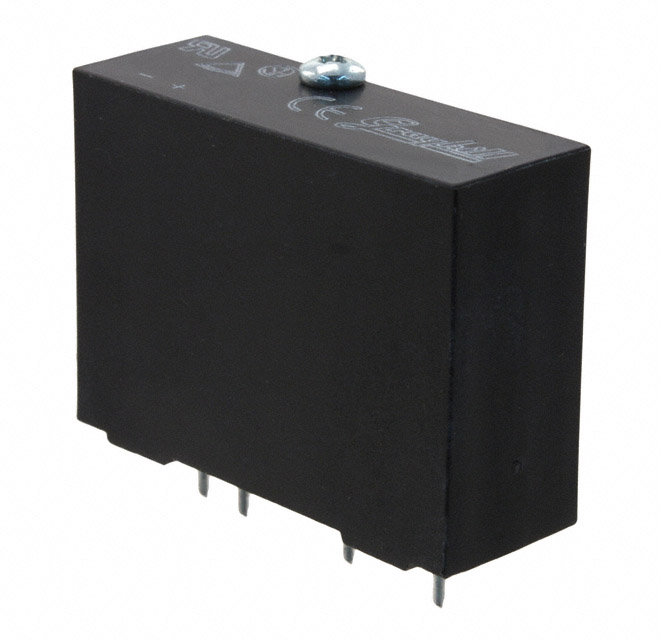
The OAC15 is an AC output module manufactured by Sensata-Crydom, designed to switch AC loads with a 3A output capacity. This module accepts a 15VDC supply and outputs 12–140VAC, making it suitable for industrial control applications requiring solid-state AC switching. The OAC15 carries a "Not For New Designs" status, necessitating evaluation of active alternative components for new applications or when inventory becomes unavailable.
Substiute Parts
Key Parameters
| Parameter | Value |
|---|---|
| Voltage - Input | 15VDC |
| Current - Input | 20 mA |
| Voltage - Output | 12 ~ 140VAC |
| Current - Output | 3A |
| Turn On Time | 1/2 Cycle |
| Turn Off Time | 1/2 Cycle |
| Type | AC Output Module |
| Features | Hold Down Screw |
| RoHS Status | RoHS Compliant |
Substitute Part Grouping Explanation
Substitution eligibility for the OAC15 is determined by the following critical parameters:
- Input voltage specification (15VDC)
- Output voltage range compatibility (minimum 12VAC, maximum 140VAC)
- Output current capacity (3A or greater)
- Switching time performance (1/2 cycle or faster)
- Physical form factor and mounting features (Hold Down Screw)
The substitute parts listed below meet these core electrical and mechanical requirements, though variations in input current draw, output voltage range limits, switching speed, and regulatory compliance exist.
Parameter Comparison
| Parameter | OAC15 (Sensata-Crydom) | 70-OAC15 (Grayhill Inc.) | OAC-15 (TE Connectivity) |
|---|---|---|---|
| Voltage - Input | 15VDC | 15VDC | 15VDC |
| Current - Input | 20 mA | 9 mA | 16 mA |
| Voltage - Output | 12 ~ 140VAC | 24 ~ 140VAC | 12 ~ 120VAC |
| Current - Output | 3A | 4.6A | 3A |
| Turn On Time | 1/2 Cycle | 8.33ms | 8.33ms |
| Turn Off Time | 1/2 Cycle | 8.33ms | 8.33ms |
| Type | AC Output Module | AC Output Module | AC Output Module |
| Features | Hold Down Screw | Hold Down Screw | Hold Down Screw |
| RoHS Status | RoHS Compliant | RoHS non-compliant | ROHS3 Compliant |
| Product Status | Not For New Designs | Active | Active |
Engineering Selection Recommendations
70-OAC15 (Grayhill Inc.): This substitute offers higher output current capacity (4.6A) and lower input current draw (9 mA). However, the output voltage range begins at 24VAC rather than 12VAC, which may limit compatibility in applications requiring lower AC output voltages. Additionally, this part carries RoHS non-compliant status, which may conflict with regulatory requirements in certain markets or applications. Switching times are faster (8.33ms) compared to the OAC15 specification.
OAC-15 (TE Connectivity Potter & Brumfield Relays): This substitute maintains electrical compatibility with the OAC15 across input voltage, output current, and output voltage range (12–120VAC). Input current draw is 16 mA, which is lower than the OAC15. This part is actively manufactured and carries ROHS3 compliance, making it suitable for new designs and applications with environmental or regulatory compliance requirements. Output voltage range is limited to 120VAC maximum, which may not accommodate applications requiring operation above 120VAC.
Frequently Asked Questions (FAQ)
Q: Can the 70-OAC15 replace the OAC15 in all applications?
A: The 70-OAC15 is electrically compatible for applications where the AC output voltage requirement does not fall below 24VAC. Applications requiring 12–23VAC output will not function with this substitute. Additionally, RoHS non-compliance status must be evaluated against project requirements.
Q: Is the OAC-15 suitable for new product designs?
A: Yes. The OAC-15 carries Active product status and ROHS3 compliance, making it appropriate for new designs. However, applications requiring AC output above 120VAC cannot use this substitute.
Q: What is the primary difference in switching performance between these parts?
A: The OAC15 specifies 1/2 cycle switching time, while both substitute parts specify 8.33ms. At 50Hz AC frequency, 1/2 cycle equals 10ms; at 60Hz, it equals 8.33ms. The substitute parts provide consistent 8.33ms performance independent of line frequency.
Q: How do input current requirements affect circuit design?
A: The OAC15 requires 20 mA input current, while the 70-OAC15 requires 9 mA and the OAC-15 requires 16 mA. Lower input current reduces control circuit power dissipation and may simplify driver circuit design.
Q: Are packaging differences significant for board-level integration?
A: The OAC15 and OAC-15 are supplied in Tray packaging, while the 70-OAC15 is supplied in Bulk packaging. This affects handling, storage, and assembly processes but does not impact electrical or mechanical compatibility.
Alternative Parts

SJ6012L2TP
Littelfuse Inc.
6 Alternative Parts

JMK107BBJ476MA-RE
Taiyo Yuden
10 Alternative Parts

GMK107BBJ475MA-T
Taiyo Yuden
5 Alternative Parts
SJ6020N2ARP
Littelfuse Inc.
3 Alternative Parts
SJ6025R2ATP
Littelfuse Inc.
4 Alternative Parts

2474-05L
API Delevan Inc.
1 Alternative Parts

4590R-684K
API Delevan Inc.
1 Alternative Parts

CM6560R-334
API Delevan Inc.
1 Alternative Parts

CM6460-104
API Delevan Inc.
1 Alternative Parts

5526-12
API Delevan Inc.
1 Alternative Parts