


Request Quote
(Ships tomorrow)
MPX12D Equivalent & Substitute Parts
Part Overview
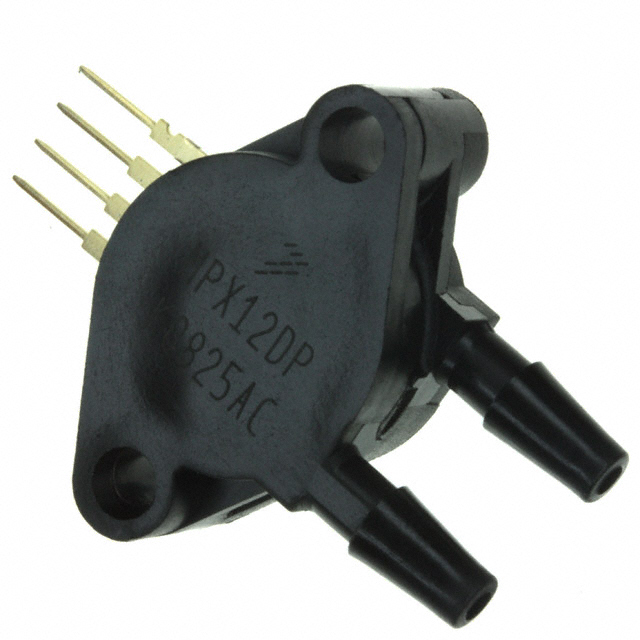
The MPX12D is a differential pressure sensor manufactured by NXP USA Inc., designed for board mount applications with a nominal pressure range of 1.45 PSI (10 kPa). The sensor outputs a Wheatstone Bridge signal of 0 mV to 55 mV at 3V supply voltage, with ±5% accuracy across an operating temperature range of -40°C to 125°C. The MPX12D is classified as obsolete, making identification of functionally equivalent alternatives necessary for ongoing system support and new design implementations.
Substiute Parts
Key Parameters
| Parameter | Value |
|---|---|
| Manufacturer Part Number | MPX12D |
| Manufacturer | NXP USA Inc. |
| Product Status | Obsolete |
| Pressure Type | Differential |
| Operating Pressure | 1.45 PSI (10 kPa) |
| Output Type | Wheatstone Bridge |
| Output Range | 0 mV ~ 55 mV (3V) |
| Accuracy | ±5% |
| Supply Voltage | 3V ~ 6V |
| Maximum Pressure | 10.88 PSI (75 kPa) |
| Operating Temperature | -40°C ~ 125°C |
| Mounting Type | Through Hole |
| Package / Case | 4-SIP Module |
| Termination Style | PC Pin |
| RoHS Status | ROHS3 Compliant |
Substitute Part Grouping Explanation
Substitution of the MPX12D is determined by the following critical parameters:
- Pressure Type & Range: Differential pressure sensor with 1.45 PSI (10 kPa) nominal operating pressure and 10.88 PSI (75 kPa) maximum pressure rating
- Output Characteristics: Wheatstone Bridge output with supply voltage range of 3V to 6V
- Electrical Interface: PC Pin termination compatible with through-hole mounting
- Environmental Specifications: Operating temperature range of -40°C to 125°C
- Package Form Factor: 4-SIP Module configuration
The MPX10DP meets these core substitution criteria while maintaining compatibility with the electrical and mechanical interfaces of the original MPX12D design.
Parameter Comparison
| Parameter | MPX12D | MPX10DP | Compatibility |
|---|---|---|---|
| Manufacturer | NXP USA Inc. | NXP USA Inc. | Match |
| Pressure Type | Differential | Differential | Match |
| Operating Pressure | 1.45 PSI (10 kPa) | 1.45 PSI (10 kPa) | Match |
| Output Type | Wheatstone Bridge | Wheatstone Bridge | Match |
| Supply Voltage | 3V ~ 6V | 3V ~ 6V | Match |
| Maximum Pressure | 10.88 PSI (75 kPa) | 10.88 PSI (75 kPa) | Match |
| Operating Temperature | -40°C ~ 125°C | -40°C ~ 125°C | Match |
| Mounting Type | Through Hole | Through Hole | Match |
| Package / Case | 4-SIP Module | 4-SIP Module | Match |
| Termination Style | PC Pin | PC Pin | Match |
| Output Range (3V) | 0 mV ~ 55 mV | 0 mV ~ 35 mV | Different |
| Accuracy | ±5% | ±1% | Improved |
| Port Style | No Port | Barbed (Male - 0.19" Tube, Dual) | Different |
| Product Status | Obsolete | Active | Active Alternative |
Engineering Selection Recommendations
The MPX10DP is the manufacturer-recommended substitute for the obsolete MPX12D. Both sensors share identical core electrical and mechanical specifications: differential pressure measurement at 1.45 PSI (10 kPa), Wheatstone Bridge output topology, 3V to 6V supply voltage compatibility, and 4-SIP through-hole package configuration.
Key differences between the parts are:
- Output Sensitivity: The MPX10DP produces 0 mV to 35 mV output at 3V supply, compared to the MPX12D's 0 mV to 55 mV. Circuit gain adjustment may be required to maintain equivalent signal levels in existing designs.
- Accuracy: The MPX10DP offers improved accuracy of ±1% versus the MPX12D's ±5%, providing better measurement precision without design modification.
- Port Configuration: The MPX10DP includes a barbed male port (0.19" / 4.93 mm tube, dual) for direct fluid connection, whereas the MPX12D has no integrated port. System integration requirements will determine whether this feature is beneficial or requires adaptation.
- Product Status: The MPX10DP is actively manufactured and supported, ensuring long-term availability and supply chain continuity.
Both parts maintain ROHS3 compliance and REACH unaffected status, meeting current regulatory requirements.
Frequently Asked Questions (FAQ)
Q: Can the MPX10DP be used as a direct pin-for-pin replacement for the MPX12D?
A: The MPX10DP and MPX12D share identical PC Pin termination and 4-SIP module packaging, enabling direct physical installation. However, the output sensitivity difference (35 mV versus 55 mV at 3V) requires signal conditioning circuit adjustment to maintain equivalent signal levels. Barbed port presence on the MPX10DP may also require mechanical integration changes depending on system design.
Q: What is the impact of the different output ranges on circuit design?
A: The MPX10DP's lower output range (0 mV to 35 mV) compared to the MPX12D (0 mV to 55 mV) necessitates increased amplifier gain in the signal conditioning stage. The ratio of output ranges is approximately 0.636:1, requiring proportional gain adjustment to achieve equivalent signal levels at the analog-to-digital converter input.
Q: Are there any compliance or certification differences between these parts?
A: Both the MPX12D and MPX10DP maintain identical ROHS3 compliance and REACH unaffected status. No additional certification or compliance modifications are required when substituting between these parts.
Q: What is the significance of the barbed port on the MPX10DP?
A: The MPX10DP includes a barbed male port (0.19" / 4.93 mm tube, dual configuration) for direct fluid connection, whereas the MPX12D has no integrated port. System designs using the MPX12D without external porting will require mechanical adaptation to accommodate or bypass the MPX10DP's integrated port feature.
Q: Does the improved accuracy of the MPX10DP affect system compatibility?
A: The MPX10DP's ±1% accuracy specification is superior to the MPX12D's ±5% accuracy. This improvement does not create compatibility issues; systems designed for ±5% accuracy will operate within specification with the more accurate MPX10DP, potentially improving overall system measurement precision.
Q: What is the recommended approach for transitioning from MPX12D to MPX10DP in production?
A: Substitution requires validation of signal conditioning circuit performance with the MPX10DP's lower output sensitivity and evaluation of mechanical integration with the barbed port configuration. Both electrical and mechanical aspects must be verified before full production transition.
Alternative Parts

SJ6012L2TP
Littelfuse Inc.
6 Alternative Parts

JMK107BBJ476MA-RE
Taiyo Yuden
10 Alternative Parts

GMK107BBJ475MA-T
Taiyo Yuden
5 Alternative Parts
SJ6020N2ARP
Littelfuse Inc.
3 Alternative Parts
SJ6025R2ATP
Littelfuse Inc.
4 Alternative Parts

2474-05L
API Delevan Inc.
1 Alternative Parts

4590R-684K
API Delevan Inc.
1 Alternative Parts

CM6560R-334
API Delevan Inc.
1 Alternative Parts

CM6460-104
API Delevan Inc.
1 Alternative Parts

5526-12
API Delevan Inc.
1 Alternative Parts