



Request Quote
(Ships tomorrow)
MOC70P3 Equivalent & Substitute Parts
Part Overview
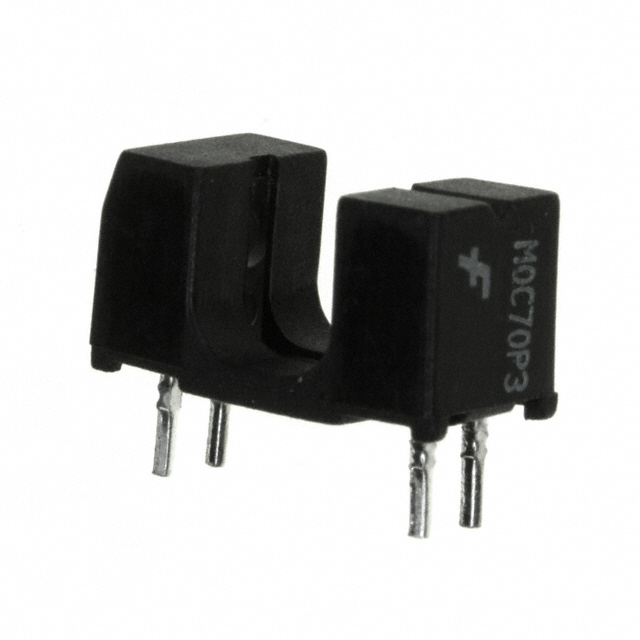
The MOC70P3 is an optical sensor manufactured by onsemi, designed as a through-beam phototransistor with slotted configuration and PC pin mounting. This component operates with a 0.200" (5.08mm) sensing distance and is classified as an unamplified optical sensor. The MOC70P3 is currently listed as obsolete, making identification of functionally equivalent alternatives essential for ongoing system support and new design implementations where through-beam optical sensing is required.
Substiute Parts
Key Parameters
| Parameter | MOC70P3 Specification |
|---|---|
| Manufacturer | onsemi |
| Category | Optical Sensors |
| Sensing Method | Through-Beam |
| Output Configuration | Phototransistor |
| Sensing Distance | 0.200" (5.08mm) |
| Current - DC Forward (If) (Max) | 50 mA |
| Current - Collector (Ic) (Max) | 20 mA |
| Voltage - Collector Emitter Breakdown (Max) | 30 V |
| Response Time | 20µs, 80µs |
| Operating Temperature Range | -55°C ~ 100°C |
| Mounting Type | Through Hole, Flange |
| Package / Case | Slotted, PC Pins |
| Type | Unamplified |
| Product Status | Obsolete |
| Moisture Sensitivity Level (MSL) | 1 (Unlimited) |
Substitute Part Grouping Explanation
Substitution of the MOC70P3 is determined by the following critical parameters:
- Sensing Method: Must be through-beam optical sensing to maintain functional equivalence
- Output Configuration: Phototransistor output is the primary detection mechanism
- Sensing Distance: Tolerance range of ±0.005" (0.127mm) from 0.200" (5.08mm) is acceptable for slot-type optical sensors
- Voltage Rating: Collector-Emitter breakdown voltage must meet or exceed 30 V
- Mounting Interface: Through-hole mounting with PC pin configuration required for PCB compatibility
- Package Type: Slotted configuration with PC pins maintains mechanical and electrical compatibility
- Operating Temperature: Must support the application's thermal requirements within the specified range
- Unamplified Type: Direct phototransistor output without integrated amplification
The LTH-301A from Lite-On Inc. qualifies as a substitute based on these parameters: it maintains through-beam sensing methodology, operates with a compatible sensing distance of 0.205" (5.2mm), provides 30 V collector-emitter breakdown voltage, uses through-hole PC pin mounting, and retains the slotted module configuration.
Parameter Comparison
| Parameter | MOC70P3 (onsemi) | LTH-301A (Lite-On Inc.) | Compatibility Notes |
|---|---|---|---|
| Sensing Method | Through-Beam | Through-Beam | Functionally equivalent |
| Sensing Distance | 0.200" (5.08mm) | 0.205" (5.2mm) | Within acceptable tolerance for slot-type sensors |
| Voltage - Collector Emitter Breakdown (Max) | 30 V | 30 V | Identical rating |
| Mounting Type | Through Hole, Flange | Through Hole | Both support through-hole PCB mounting |
| Package / Case | Slotted, PC Pins | Module, PC Pins, Slot Type | Both use PC pin interface with slot configuration |
| Type | Unamplified | Unamplified | Functionally equivalent |
| Moisture Sensitivity Level (MSL) | 1 (Unlimited) | 1 (Unlimited) | Identical moisture handling |
Engineering Selection Recommendations
The LTH-301A serves as a direct substitute for the obsolete MOC70P3 based on the following engineering criteria:
- Product Status Alignment: The LTH-301A maintains active product status, ensuring ongoing availability and manufacturer support, whereas the MOC70P3 is obsolete
- Compliance and Certifications: The LTH-301A is RoHS3 compliant, meeting current regulatory requirements for electronic components in restricted substance directives
- Electrical Compatibility: Both components share identical 30 V collector-emitter breakdown voltage ratings and maintain through-beam sensing methodology
- Mechanical Compatibility: PC pin configuration and slotted package design ensure direct PCB mounting compatibility without redesign
- Sensing Distance Tolerance: The 0.005" (0.127mm) difference in sensing distance falls within acceptable operational tolerance for through-beam slot-type optical sensors
Selection of the LTH-301A eliminates obsolescence risk while maintaining electrical and mechanical compatibility with existing MOC70P3 circuit implementations.
Frequently Asked Questions (FAQ)
Q: Can the LTH-301A be used as a direct replacement for MOC70P3 without PCB modifications?
A: Yes. Both components use through-hole PC pin mounting with slotted package configuration. The sensing distance difference of 0.005" (5.2mm vs 5.08mm) is within acceptable tolerance for through-beam slot-type optical sensors and does not require PCB layout changes.
Q: What is the primary reason for substituting the MOC70P3?
A: The MOC70P3 is classified as obsolete. The LTH-301A is an active product with ongoing manufacturer support and availability, making it the appropriate choice for new designs and system maintenance.
Q: Are there electrical parameter differences between these components?
A: Both components maintain identical 30 V collector-emitter breakdown voltage ratings. The LTH-301A has lower maximum collector current (500 µA vs 20 mA) and forward current (20 mA vs 50 mA), which may affect circuit design if the original MOC70P3 design relied on higher current specifications. Verify circuit requirements before substitution.
Q: What compliance certifications apply to the LTH-301A?
A: The LTH-301A is RoHS3 compliant and carries MSL 1 (Unlimited) moisture sensitivity rating, meeting current regulatory standards for electronic component procurement.
Q: Does the sensing distance difference affect optical performance?
A: The LTH-301A sensing distance of 0.205" (5.2mm) versus the MOC70P3 at 0.200" (5.08mm) represents a 0.005" variance. For through-beam slot-type optical sensors, this tolerance is within normal operational parameters and does not compromise detection reliability in standard applications.
Q: Are there temperature range considerations for substitution?
A: The MOC70P3 operates from -55°C to 100°C, while the LTH-301A operates from -25°C to 85°C. If the application requires operation below -25°C or above 85°C, the LTH-301A may not be suitable. Verify application temperature requirements before selection.
Alternative Parts

SJ6012L2TP
Littelfuse Inc.
6 Alternative Parts

JMK107BBJ476MA-RE
Taiyo Yuden
10 Alternative Parts

GMK107BBJ475MA-T
Taiyo Yuden
5 Alternative Parts
SJ6020N2ARP
Littelfuse Inc.
3 Alternative Parts
SJ6025R2ATP
Littelfuse Inc.
4 Alternative Parts

2474-05L
API Delevan Inc.
1 Alternative Parts

4590R-684K
API Delevan Inc.
1 Alternative Parts

CM6560R-334
API Delevan Inc.
1 Alternative Parts

CM6460-104
API Delevan Inc.
1 Alternative Parts

5526-12
API Delevan Inc.
1 Alternative Parts