


Request Quote
(Ships tomorrow)
MJD127T4 Equivalent & Substitute Parts
Part Overview
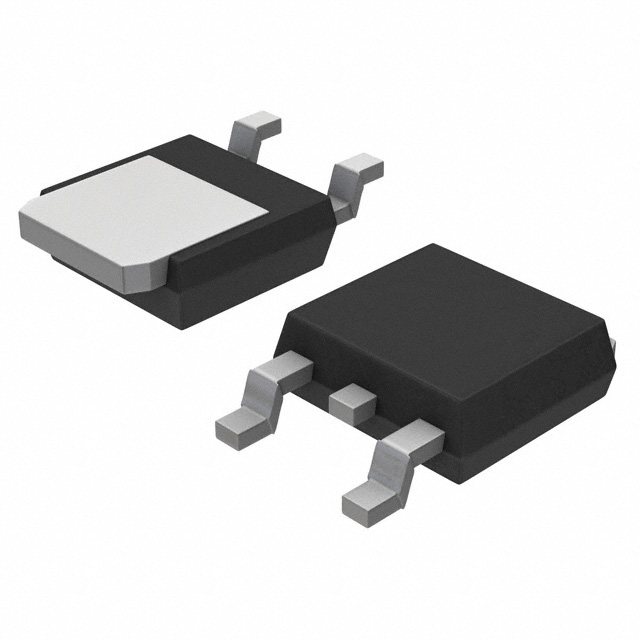
The MJD127T4 is an active-status PNP Darlington bipolar junction transistor manufactured by STMicroelectronics, rated for 100 V collector-emitter breakdown voltage and 8 A maximum collector current. The device is packaged in a Surface Mount DPAK (TO-252-3) configuration with a maximum power dissipation of 20 W. This component is commonly used in switching and amplification applications requiring high current gain and moderate power handling in compact form factors. Substitute parts are identified when equivalent electrical specifications and mechanical compatibility are maintained across the same package type and functional classification.
Substiute Parts
Key Parameters
| Parameter | Value | Unit |
|---|---|---|
| Transistor Type | PNP - Darlington | — |
| Current - Collector (Ic) (Max) | 8 | A |
| Voltage - Collector Emitter Breakdown (Max) | 100 | V |
| Vce Saturation (Max) @ Ib, Ic | 4V @ 80mA, 8A | — |
| Current - Collector Cutoff (Max) | 10 | µA |
| DC Current Gain (hFE) (Min) @ Ic, Vce | 1000 @ 4A, 4V | — |
| Power - Max | 20 | W |
| Package / Case | TO-252-3, DPAK (2 Leads + Tab), SC-63 | — |
| Mounting Type | Surface Mount | — |
| RoHS Status | ROHS3 Compliant | — |
| Moisture Sensitivity Level (MSL) | 1 (Unlimited) | — |
Substitute Part Grouping Explanation
Substitute parts for the MJD127T4 are qualified based on the following criteria:
Electrical Equivalence Requirements:
- Transistor Type: PNP - Darlington configuration
- Current - Collector (Ic) (Max): 8 A
- Voltage - Collector Emitter Breakdown (Max): 100 V
- Vce Saturation (Max) @ Ib, Ic: 4V @ 80mA, 8A
- Current - Collector Cutoff (Max): 10 µA
- DC Current Gain (hFE) (Min) @ Ic, Vce: 1000 @ 4A, 4V
Mechanical Compatibility Requirements:
- Package / Case: TO-252-3, DPAK (2 Leads + Tab), SC-63
- Mounting Type: Surface Mount
- Supplier Device Package: DPAK
Compliance Requirements:
- RoHS Status: ROHS3 Compliant
- Moisture Sensitivity Level (MSL): 1 (Unlimited)
- Product Status: Active
The substitute parts identified maintain all critical electrical parameters and mechanical compatibility. Variations in maximum power dissipation and frequency characteristics do not disqualify substitution when the primary functional parameters remain equivalent.
Parameter Comparison
| Parameter | MJD127T4 (STMicroelectronics) | MJD127G (onsemi) | MJD127T4G (onsemi) | NJVMJD127T4G (onsemi) |
|---|---|---|---|---|
| Manufacturer | STMicroelectronics | onsemi | onsemi | onsemi |
| Transistor Type | PNP - Darlington | PNP - Darlington | PNP - Darlington | PNP - Darlington |
| Current - Collector (Ic) (Max) | 8 A | 8 A | 8 A | 8 A |
| Voltage - Collector Emitter Breakdown (Max) | 100 V | 100 V | 100 V | 100 V |
| Vce Saturation (Max) @ Ib, Ic | 4V @ 80mA, 8A | 4V @ 80mA, 8A | 4V @ 80mA, 8A | 4V @ 80mA, 8A |
| Current - Collector Cutoff (Max) | 10 µA | 10 µA | 10 µA | 10 µA |
| DC Current Gain (hFE) (Min) @ Ic, Vce | 1000 @ 4A, 4V | 1000 @ 4A, 4V | 1000 @ 4A, 4V | 1000 @ 4A, 4V |
| Power - Max | 20 W | 1.75 W | 1.75 W | 20 W |
| Frequency - Transition | — | 4 MHz | 4 MHz | — |
| Operating Temperature | 150°C (TJ) | -65°C ~ 150°C (TJ) | -65°C ~ 150°C (TJ) | -65°C ~ 150°C (TJ) |
| Package / Case | TO-252-3, DPAK (2 Leads + Tab), SC-63 | TO-252-3, DPAK (2 Leads + Tab), SC-63 | TO-252-3, DPAK (2 Leads + Tab), SC-63 | TO-252-3, DPAK (2 Leads + Tab), SC-63 |
| Mounting Type | Surface Mount | Surface Mount | Surface Mount | Surface Mount |
| RoHS Status | ROHS3 Compliant | ROHS3 Compliant | ROHS3 Compliant | ROHS3 Compliant |
| Moisture Sensitivity Level (MSL) | 1 (Unlimited) | 1 (Unlimited) | 1 (Unlimited) | 1 (Unlimited) |
| Product Status | Active | Active | Active | Active |
Engineering Selection Recommendations
All identified substitute parts maintain active product status and ROHS3 compliance, ensuring continued availability and regulatory conformance. The MJD127T4 (STMicroelectronics) and NJVMJD127T4G (onsemi) are functionally equivalent across all critical electrical parameters, including maximum power dissipation of 20 W. Both parts support the full operating temperature range specification when required.
The MJD127G and MJD127T4G (both onsemi) are electrically equivalent in core switching characteristics but specify reduced maximum power dissipation of 1.75 W and include transition frequency specification of 4 MHz. These parts are suitable for applications where power dissipation remains below 1.75 W and where frequency response is not a limiting factor.
Selection between substitute parts should be based on:
- Packaging Format: MJD127T4 and NJVMJD127T4G are supplied in Cut Tape (CT) & Digi-Reel® format; MJD127G is supplied in Tube format.
- Power Dissipation Requirements: Applications requiring full 20 W capability should use MJD127T4 or NJVMJD127T4G; applications with lower power requirements may use MJD127G or MJD127T4G.
- Temperature Range: All substitute parts support extended operating temperature range (-65°C ~ 150°C) compared to the main part specification (150°C maximum).
- Manufacturer Preference: STMicroelectronics (MJD127T4) or onsemi (MJD127G, MJD127T4G, NJVMJD127T4G) based on supply chain requirements.
Frequently Asked Questions (FAQ)
Q: Can MJD127G be used as a direct replacement for MJD127T4?
A: MJD127G is electrically equivalent in switching characteristics and maintains identical collector current, breakdown voltage, and current gain specifications. However, MJD127G specifies maximum power dissipation of 1.75 W compared to 20 W for MJD127T4. Substitution is valid only when circuit power dissipation remains below 1.75 W. MJD127G is supplied in Tube packaging, while MJD127T4 is supplied in Cut Tape & Digi-Reel® format.
Q: What is the difference between MJD127T4G and NJVMJD127T4G?
A: Both parts are manufactured by onsemi and maintain identical electrical specifications, including 8 A collector current, 100 V breakdown voltage, and 20 W maximum power dissipation. Both are supplied in Cut Tape & Digi-Reel® packaging. The primary difference is the base product number designation (MJD127 versus NJVMJD127), which reflects different product lines within onsemi's portfolio. Electrical and mechanical compatibility is equivalent.
Q: Are all substitute parts compatible with the DPAK package footprint?
A: Yes. All identified substitute parts use the TO-252-3 DPAK (2 Leads + Tab) package configuration, designated as SC-63 by suppliers. PCB footprints and thermal characteristics are mechanically compatible across all parts.
Q: Do substitute parts meet the same compliance requirements as MJD127T4?
A: Yes. All substitute parts are ROHS3 compliant, REACH unaffected, and classified under ECCN EAR99. Moisture sensitivity level is 1 (Unlimited) for all parts, indicating no special handling requirements during storage or assembly.
Q: What is the significance of the transition frequency specification in MJD127G and MJD127T4G?
A: Transition frequency of 4 MHz indicates the frequency at which current gain begins to decrease. This specification is provided for MJD127G and MJD127T4G but is not specified for MJD127T4 or NJVMJD127T4G. For DC and low-frequency switching applications, this parameter does not affect substitution validity. For applications operating near or above 4 MHz, the specified transition frequency should be evaluated against circuit requirements.
Q: Can MJD127T4 be substituted with MJD127T4G based on part number similarity?
A: Yes. MJD127T4 (STMicroelectronics) and MJD127T4G (onsemi) share identical electrical specifications for collector current, breakdown voltage, saturation voltage, and current gain. Both are supplied in Cut Tape & Digi-Reel® packaging. The primary difference is maximum power dissipation: MJD127T4 specifies 20 W while MJD127T4G specifies 1.75 W. Substitution is valid when power dissipation requirements do not exceed 1.75 W.
Q: Is inventory availability a factor in substitution selection?
A: Inventory levels are provided for reference but do not determine substitution validity. All identified parts maintain active product status. Substitution decisions should be based on electrical equivalence, mechanical compatibility, and compliance requirements. Inventory availability should be evaluated separately through supply chain channels.
Alternative Parts

SJ6012L2TP
Littelfuse Inc.
6 Alternative Parts

JMK107BBJ476MA-RE
Taiyo Yuden
10 Alternative Parts

GMK107BBJ475MA-T
Taiyo Yuden
5 Alternative Parts
SJ6020N2ARP
Littelfuse Inc.
3 Alternative Parts
SJ6025R2ATP
Littelfuse Inc.
4 Alternative Parts

2474-05L
API Delevan Inc.
1 Alternative Parts

4590R-684K
API Delevan Inc.
1 Alternative Parts

CM6560R-334
API Delevan Inc.
1 Alternative Parts

CM6460-104
API Delevan Inc.
1 Alternative Parts

5526-12
API Delevan Inc.
1 Alternative Parts