



Request Quote
(Ships tomorrow)
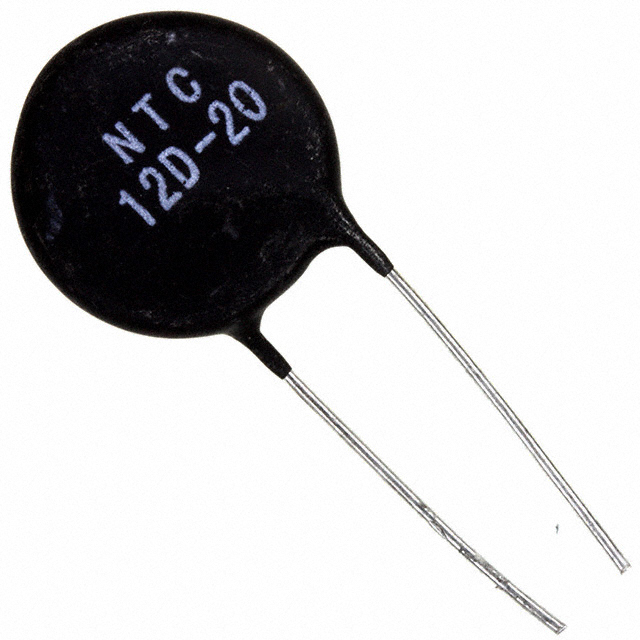
MF72-012D20 Inrush Current Limiter
Part Overview
The MF72-012D20 is an inrush current limiter manufactured by Cantherm, featuring 12 ohms resistance at 25°C with ±20% tolerance and a maximum steady-state current rating of 5 amperes. The component measures 0.886" (22.50mm) in diameter with 0.394" (10.00mm) lead spacing. Product status is Active, with ROHS3 compliance and REACH unaffected designation. This component type is essential in power supply circuits and soft-start applications where controlled current limiting during initial energization prevents damage to downstream components and reduces inrush surge effects.
Substiute Parts
Key Parameters
| Parameter | Value |
|---|---|
| Resistance @ 25°C | 12 Ohms |
| Tolerance | ±20% |
| Current - Steady State Max | 5 A |
| Resistance @ Operating Current | 195 mOhms |
| Diameter | 0.886" (22.50mm) |
| Lead Spacing | 0.394" (10.00mm) |
| Series | MF72 |
| RoHS Status | ROHS3 Compliant |
Substitute Part Grouping Explanation
Substitute relationships for inrush current limiters are determined by matching functional performance boundaries within the steady-state current rating and acceptable thermal operating ranges. The MS22 30005 manufactured by Ametherm qualifies as a substitute based on the following critical parameters:
- Steady-State Current Rating: Both components are rated for 5 A maximum
- Operating Resistance Profile: The MS22 30005 exhibits 230 mOhms at operating current versus 195 mOhms for the MF72-012D20, remaining within acceptable thermal limits for inrush current limiting applications
- Physical Envelope: Both components utilize radial lead configurations with similar mounting footprints (22.50mm versus 23.00mm diameter, representing acceptable tolerance in PCB spacing)
- Regulatory Compliance: Both components maintain ROHS3 compliance and REACH unaffected status, meeting equivalent environmental standards
The primary difference in cold resistance (30 Ohms versus 12 Ohms) and tolerance (±15% versus ±20%) must be evaluated within specific circuit design parameters, as these affect initial current limiting behavior at power-on.
Parameter Comparison
| Parameter | MF72-012D20 (Cantherm) | MS22 30005 (Ametherm) |
|---|---|---|
| Resistance @ 25°C | 12 Ohms | 30 Ohms |
| Tolerance | ±20% | ±15% |
| Current - Steady State Max | 5 A | 5 A |
| Resistance @ Operating Current | 195 mOhms | 230 mOhms |
| Diameter | 0.886" (22.50mm) | 0.906" (23.00mm) |
| Lead Spacing | 0.394" (10.00mm) | 0.307" (7.80mm) |
| Series | MF72 | MegaSurge™ |
| RoHS Status | ROHS3 Compliant | ROHS3 Compliant |
| Approval Agency | Not specified | UL |
| Moisture Sensitivity Level | Not Applicable | 1 (Unlimited) |
Engineering Selection Recommendations
Selection between the MF72-012D20 and MS22 30005 is determined by circuit-specific requirements and compliance certifications. The MS22 30005 carries explicit UL approval, which may be required for applications subject to specific safety standards. Both components maintain ROHS3 compliance and REACH unaffected status, satisfying equivalent environmental regulatory requirements.
The lead spacing difference (10.00mm versus 7.80mm) must be verified for PCB layout compatibility. The cold resistance differential (12 Ohms versus 30 Ohms) directly affects inrush current limiting characteristics and must be evaluated against target peak current values and thermal time constants specified in the circuit design.
Frequently Asked Questions (FAQ)
Q: What is an inrush current limiter and why is substitution necessary? A: Inrush current limiters are thermistors designed to limit surge current during power-on transients. They present high initial resistance that decreases as current flow generates self-heating. Substitution becomes necessary due to inventory availability, manufacturing discontinuation, or supply chain constraints.
Q: Can MS22 30005 directly replace MF72-012D20 in any application? A: Direct substitution requires verification of circuit design parameters. The higher cold resistance (30 Ohms versus 12 Ohms) produces different initial current limiting behavior. Thermal time constants and peak current targets must align with the MS22 30005 specifications.
Q: What is the significance of lead spacing differences (10.00mm versus 7.80mm)? A: Lead spacing affects PCB layout and mounting compatibility. Both configurations use radial lead geometry, but the 2.20mm spacing difference requires confirmation that the component footprint accommodates the substitute part without redesign.
Q: Does the tolerance difference (±20% versus ±15%) affect substitution? A: Tighter tolerance (±15% on MS22 30005) may provide improved design margin in applications sensitive to resistance variation. However, the wider tolerance (±20% on MF72-012D20) does not preclude substitution if the circuit design accommodates this range.
Q: Are both components suitable for the same environmental conditions? A: Both components carry ROHS3 compliance and REACH unaffected status. The MS22 30005 specifies Moisture Sensitivity Level 1 (Unlimited), while MF72-012D20 is listed as Not Applicable, indicating equivalent or superior moisture resistance characteristics.
Q: What does "R @ Current" represent? A: Resistance @ Operating Current represents the thermal stabilized resistance value after self-heating from steady-state current flow. The MS22 30005 exhibits 230 mOhms versus 195 mOhms for the MF72-012D20, a 35 mOhm difference that influences steady-state voltage drop and power dissipation.
Alternative Parts

SJ6012L2TP
Littelfuse Inc.
6 Alternative Parts

JMK107BBJ476MA-RE
Taiyo Yuden
10 Alternative Parts

GMK107BBJ475MA-T
Taiyo Yuden
5 Alternative Parts
SJ6020N2ARP
Littelfuse Inc.
3 Alternative Parts
SJ6025R2ATP
Littelfuse Inc.
4 Alternative Parts

2474-05L
API Delevan Inc.
1 Alternative Parts

4590R-684K
API Delevan Inc.
1 Alternative Parts

CM6560R-334
API Delevan Inc.
1 Alternative Parts

CM6460-104
API Delevan Inc.
1 Alternative Parts

5526-12
API Delevan Inc.
1 Alternative Parts