




Request Quote
(Ships tomorrow)
MBR1050CTHC0G Equivalent & Substitute Parts
Part Overview
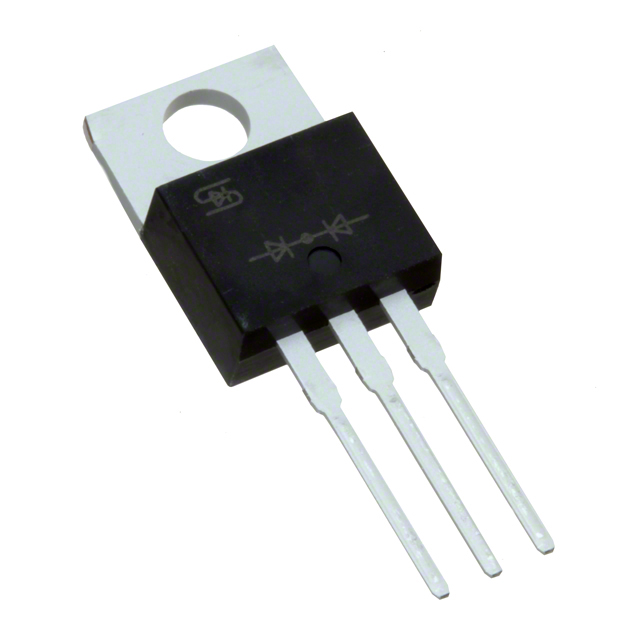
The MBR1050CTHC0G is a Schottky diode array manufactured by Taiwan Semiconductor Corporation, configured as a 1 Pair Common Cathode arrangement. This component is rated for 50 V DC reverse voltage with 10 A average rectified current per diode and is housed in a TO-220-3 through-hole package. The device is classified as Active product status and carries AEC-Q101 automotive qualification.
Substitute parts are identified when equivalent electrical performance can be achieved within the allowed parameter ranges for this diode category, accounting for variations in voltage rating, current capacity, and forward voltage characteristics while maintaining compatible package and mounting specifications.
Substiute Parts
Key Parameters
| Parameter | Value | Unit |
|---|---|---|
| Diode Configuration | 1 Pair Common Cathode | — |
| Technology | Schottky | — |
| Voltage - DC Reverse (Vr) (Max) | 50 | V |
| Current - Average Rectified (Io) (per Diode) | 10 | A |
| Voltage - Forward (Vf) (Max) @ If | 900 mV @ 10 A | — |
| Speed | Fast Recovery ≤ 500ns, > 200mA (Io) | — |
| Current - Reverse Leakage @ Vr | 100 µA @ 50 V | — |
| Operating Temperature - Junction | -55 to 150 | °C |
| Package / Case | TO-220-3 | — |
| Mounting Type | Through Hole | — |
| Grade | Automotive | — |
| Qualification | AEC-Q101 | — |
| RoHS Status | ROHS3 Compliant | — |
Substitute Part Grouping Explanation
Substitution eligibility for the MBR1050CTHC0G is determined by the following criteria:
Configuration Match: All substitute parts must maintain the 1 Pair Common Cathode diode configuration and Schottky technology classification.
Package Compatibility: All substitute parts must use the TO-220-3 through-hole package to ensure mechanical and thermal compatibility with existing PCB layouts and mounting infrastructure.
Electrical Parameter Tolerance: Substitute parts are acceptable when the following conditions are met:
- DC Reverse Voltage (Vr): Rated voltage must be equal to or greater than the main part specification (50 V minimum). Lower voltage ratings are not acceptable for direct substitution.
- Average Rectified Current (Io): Rated current must be equal to or greater than 10 A per diode. Higher current ratings provide design margin and are acceptable.
- Forward Voltage (Vf): Variations in forward voltage are acceptable provided the part operates within the same thermal and current envelope.
- Reverse Leakage Current: Higher leakage values are acceptable within the Schottky diode technology class.
- Operating Temperature Range: Must support the -55°C to 150°C junction temperature range.
Compliance Requirements: All substitute parts must maintain ROHS3 compliance and be suitable for through-hole mounting applications.
The identified substitute parts MBR20L45CTG and STPS40L45CT meet the configuration and package requirements but operate at reduced voltage ratings (45 V) compared to the main part (50 V). These substitutes are applicable in circuits where the actual operating voltage does not exceed 45 V.
Parameter Comparison
| Parameter | MBR1050CTHC0G (Main) | MBR20L45CTG (Substitute) | STPS40L45CT (Substitute) |
|---|---|---|---|
| Manufacturer | Taiwan Semiconductor Corporation | onsemi | STMicroelectronics |
| Diode Configuration | 1 Pair Common Cathode | 1 Pair Common Cathode | 1 Pair Common Cathode |
| Technology | Schottky | Schottky | Schottky |
| Voltage - DC Reverse (Vr) (Max) | 50 V | 45 V | 45 V |
| Current - Average Rectified (Io) (per Diode) | 10 A | 10 A | 20 A |
| Voltage - Forward (Vf) (Max) @ If | 900 mV @ 10 A | 500 mV @ 10 A | 530 mV @ 20 A |
| Speed | Fast Recovery ≤ 500ns, > 200mA (Io) | Fast Recovery ≤ 500ns, > 200mA (Io) | Fast Recovery ≤ 500ns, > 200mA (Io) |
| Current - Reverse Leakage @ Vr | 100 µA @ 50 V | 500 µA @ 45 V | 600 µA @ 45 V |
| Operating Temperature - Junction | -55°C to 150°C | -55°C to 150°C | Max 150°C |
| Package / Case | TO-220-3 | TO-220-3 | TO-220-3 |
| Mounting Type | Through Hole | Through Hole | Through Hole |
| Product Status | Active | Obsolete | Active |
| RoHS Status | ROHS3 Compliant | ROHS3 Compliant | ROHS3 Compliant |
Engineering Selection Recommendations
Primary Selection: The MBR1050CTHC0G remains the preferred component choice due to its Active product status, automotive-grade qualification (AEC-Q101), and 50 V voltage rating that provides margin for applications requiring higher reverse voltage tolerance.
Substitute Selection - STPS40L45CT: This STMicroelectronics component is suitable for applications where the circuit operating voltage does not exceed 45 V. The STPS40L45CT offers Active product status and higher current capacity (20 A per diode), providing thermal margin in high-current applications. This substitute is appropriate for new designs and production environments where 45 V operation is confirmed.
Substitute Selection - MBR20L45CTG: This onsemi component is electrically compatible at 45 V operation but carries Obsolete product status. The MBR20L45CTG should be selected only when existing inventory constraints or legacy system requirements necessitate its use. New designs should avoid this component due to its discontinued status and potential supply chain limitations.
Compliance Consideration: Both substitute parts maintain ROHS3 compliance and are suitable for through-hole mounting. The selection between active and obsolete substitutes depends on production timeline and supply chain strategy.
Frequently Asked Questions (FAQ)
Q: Can the MBR20L45CTG be used as a direct replacement for the MBR1050CTHC0G?
A: The MBR20L45CTG is electrically compatible in circuits operating at 45 V or below. However, it carries Obsolete product status, making it unsuitable for new production. The reduced voltage rating (45 V versus 50 V) requires circuit verification to confirm operating voltage does not exceed the substitute's specification.
Q: What is the primary difference between the MBR1050CTHC0G and STPS40L45CT?
A: The main differences are voltage rating (50 V versus 45 V) and current capacity (10 A versus 20 A per diode). The STPS40L45CT provides higher current handling capability and Active product status. Selection depends on whether the application requires 50 V operation or can operate within the 45 V limit.
Q: Are all substitute parts available in the same TO-220-3 package?
A: Yes. All listed substitute parts use the TO-220-3 through-hole package, ensuring mechanical and thermal compatibility with existing PCB designs and mounting infrastructure.
Q: What does the "1 Pair Common Cathode" configuration mean?
A: This configuration contains two diodes within a single package with a shared cathode connection. All substitute parts maintain this same internal configuration, ensuring pin-compatible operation.
Q: Why does the MBR20L45CTG show higher reverse leakage current than the main part?
A: Reverse leakage current variation is a normal characteristic within the Schottky diode technology class. The MBR20L45CTG exhibits 500 µA at 45 V compared to 100 µA at 50 V for the main part. This difference is acceptable for Schottky devices and does not prevent substitution in applications where 45 V operation is confirmed.
Q: Can the STPS40L45CT be used in automotive applications?
A: The STPS40L45CT is not listed with automotive qualification (AEC-Q101). The MBR1050CTHC0G carries automotive-grade qualification. For automotive applications, the MBR1050CTHC0G is the specified component. The STPS40L45CT is suitable for industrial and commercial applications operating at 45 V.
Q: What is the significance of "Fast Recovery ≤ 500ns" specification?
A: This specification indicates the diode's switching speed capability. All listed parts meet this fast recovery requirement, ensuring compatibility in high-frequency switching applications. This parameter is consistent across the main part and all substitutes.
Q: How does forward voltage affect component selection?
A: Forward voltage determines power dissipation and thermal performance. The MBR1050CTHC0G specifies 900 mV at 10 A, while substitutes show lower values (500 mV and 530 mV). Lower forward voltage reduces heat generation, which is beneficial for thermal management but does not prevent substitution if the circuit design accommodates the main part's higher dissipation.
Alternative Parts

SJ6012L2TP
Littelfuse Inc.
6 Alternative Parts

JMK107BBJ476MA-RE
Taiyo Yuden
10 Alternative Parts

GMK107BBJ475MA-T
Taiyo Yuden
5 Alternative Parts
SJ6020N2ARP
Littelfuse Inc.
3 Alternative Parts
SJ6025R2ATP
Littelfuse Inc.
4 Alternative Parts

2474-05L
API Delevan Inc.
1 Alternative Parts

4590R-684K
API Delevan Inc.
1 Alternative Parts

CM6560R-334
API Delevan Inc.
1 Alternative Parts

CM6460-104
API Delevan Inc.
1 Alternative Parts

5526-12
API Delevan Inc.
1 Alternative Parts