


Request Quote
(Ships tomorrow)
MAX4066EPD Equivalent & Substitute Parts
Part Overview
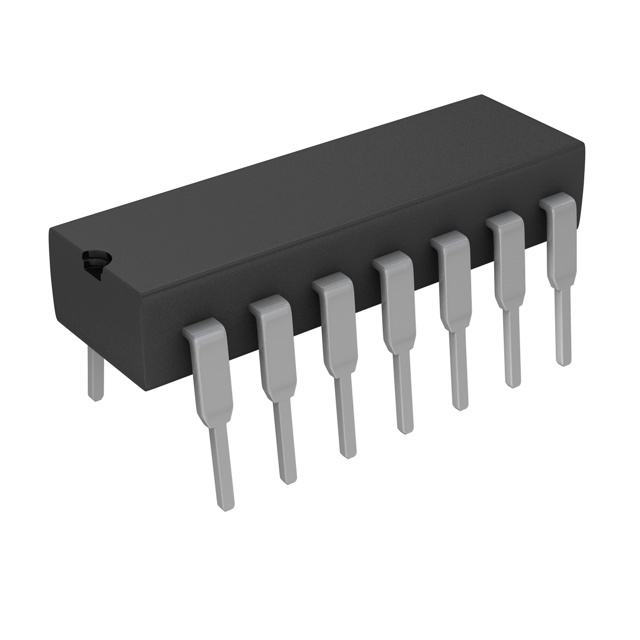
The MAX4066EPD is a 4-circuit SPST-NO (Single Pole Single Throw - Normally Open) analog switch manufactured by Analog Devices Inc./Maxim Integrated. This device functions as a precision electronic switch with 1:1 multiplexing capability, designed for signal routing and switching applications in analog circuits. The part is classified as obsolete, making identification of functionally equivalent alternatives essential for ongoing design support and production continuity.
Substiute Parts
Key Parameters
| Parameter | Value |
|---|---|
| Switch Circuit Type | SPST - NO (Single Pole Single Throw - Normally Open) |
| Number of Circuits | 4 |
| Multiplexer/Demultiplexer Configuration | 1:1 |
| On-State Resistance (Max) | 45Ω |
| Channel-to-Channel Matching (ΔRon) | 500mΩ |
| Supply Voltage Range (Single) | 2V ~ 16V |
| Switch Time (Ton/Toff Max) | 100ns / 75ns |
| -3dB Bandwidth | 100MHz |
| Charge Injection | 1pC |
| Channel Capacitance (CS(off) / CD(off)) | 9pF / 9pF |
| Leakage Current (IS(off) Max) | 1nA |
| Crosstalk | -86dB @ 1MHz |
| Operating Temperature Range | -40°C ~ 85°C |
| Package Type | 14-DIP (0.300", 7.62mm) |
| Mounting Type | Through Hole |
| Product Status | Obsolete |
Substitute Part Grouping Explanation
Substitution eligibility for the MAX4066EPD is determined by strict adherence to the following core parameters:
Mandatory Matching Criteria:
- Switch circuit type: SPST - NO
- Number of circuits: 4
- Multiplexer configuration: 1:1
- Package type: 14-DIP (0.300", 7.62mm)
- Mounting type: Through Hole
Allowable Parameter Variations: Substitute parts may differ in the following parameters within acceptable engineering tolerances:
- On-State Resistance (Max): Substitutes with higher resistance values remain functionally equivalent if circuit design accommodates the increased resistance
- Supply voltage range: Substitutes with narrower or different voltage ranges are acceptable if the operating voltage of the application falls within the substitute's specified range
- Switch time, bandwidth, charge injection, and leakage current: Variations in these parameters do not preclude substitution if the application requirements are met
- Operating temperature range: Substitutes with different temperature ranges are acceptable if the application operates within the substitute's specified range
- RoHS and compliance status: Substitutes with improved compliance (e.g., RoHS3 compliant vs. non-compliant) are preferred for new designs
The CD74HC4066E meets all mandatory matching criteria and is identified as a direct functional substitute for the MAX4066EPD.
Parameter Comparison
| Parameter | MAX4066EPD (Main Part) | CD74HC4066E (Substitute) |
|---|---|---|
| Manufacturer | Analog Devices Inc./Maxim Integrated | Texas Instruments |
| Switch Circuit Type | SPST - NO | SPST - NO |
| Number of Circuits | 4 | 4 |
| Multiplexer Configuration | 1:1 | 1:1 |
| On-State Resistance (Max) | 45Ω | 70Ω |
| Channel-to-Channel Matching (ΔRon) | 500mΩ | 500mΩ |
| Supply Voltage Range (Single) | 2V ~ 16V | 2V ~ 10V |
| -3dB Bandwidth | 100MHz | 200MHz |
| Channel Capacitance (CS(off) / CD(off)) | 9pF / 9pF | 5pF |
| Leakage Current (IS(off) Max) | 1nA | 100nA |
| Crosstalk | -86dB @ 1MHz | -72dB @ 1MHz |
| Operating Temperature Range | -40°C ~ 85°C | -55°C ~ 125°C |
| Package Type | 14-DIP (0.300", 7.62mm) | 14-DIP (0.300", 7.62mm) |
| Mounting Type | Through Hole | Through Hole |
| Product Status | Obsolete | Last Time Buy |
| RoHS Status | RoHS non-compliant | ROHS3 Compliant |
Engineering Selection Recommendations
The CD74HC4066E is a direct functional substitute for the MAX4066EPD based on matching switch topology, circuit count, and package configuration. Selection between these parts should be based on the following engineering considerations:
For Existing Designs (MAX4066EPD Replacement): The CD74HC4066E accommodates the MAX4066EPD's obsolete status. Circuit designs operating within the CD74HC4066E's supply voltage range (2V ~ 10V) and temperature range (-55°C ~ 125°C) will function without modification. The increased on-state resistance (70Ω vs. 45Ω) and leakage current (100nA vs. 1nA) must be evaluated against circuit-specific signal integrity and power consumption requirements.
For New Designs: The CD74HC4066E is preferred due to ROHS3 compliance and extended operating temperature range. The higher bandwidth (200MHz vs. 100MHz) and lower channel capacitance (5pF vs. 9pF) provide improved high-frequency performance characteristics.
Supply Voltage Constraint: Applications requiring supply voltages above 10V cannot use the CD74HC4066E. The MAX4066EPD's 2V ~ 16V range is not matched by the substitute. Designs operating at voltages exceeding 10V require alternative component selection outside the provided substitute list.
Frequently Asked Questions (FAQ)
Q: Can the CD74HC4066E directly replace the MAX4066EPD in all applications?
A: Direct replacement is possible only if the application operates within the CD74HC4066E's supply voltage range (2V ~ 10V) and temperature range (-55°C ~ 125°C). The increased on-state resistance (70Ω vs. 45Ω) and leakage current (100nA vs. 1nA) must be verified against circuit requirements. Applications requiring supply voltages above 10V cannot use this substitute.
Q: What are the key differences between these parts?
A: Both parts share identical switch topology (SPST-NO), circuit count (4), and package configuration (14-DIP). Primary differences include on-state resistance (45Ω vs. 70Ω), supply voltage range (2V~16V vs. 2V~10V), leakage current (1nA vs. 100nA), and RoHS compliance status (non-compliant vs. ROHS3 compliant).
Q: Is the CD74HC4066E suitable for high-frequency applications?
A: The CD74HC4066E exhibits superior high-frequency characteristics compared to the MAX4066EPD, with -3dB bandwidth of 200MHz versus 100MHz and lower channel capacitance (5pF vs. 9pF). These parameters make the CD74HC4066E suitable for applications requiring higher bandwidth performance.
Q: What is the impact of the 25Ω increase in on-state resistance?
A: The CD74HC4066E's on-state resistance of 70Ω versus the MAX4066EPD's 45Ω represents a 56% increase. This affects signal attenuation, power dissipation, and impedance matching in analog signal paths. Circuit designs must verify that this resistance increase does not degrade signal integrity or exceed power budget constraints.
Q: Are there packaging or mounting differences?
A: Both parts use identical 14-DIP (0.300", 7.62mm) through-hole packages. No PCB layout modifications are required for physical substitution.
Q: What is the significance of the product status difference?
A: The MAX4066EPD is classified as obsolete, indicating end-of-life status and unavailability from the manufacturer. The CD74HC4066E is classified as Last Time Buy, indicating limited remaining inventory. For production continuity, the CD74HC4066E should be qualified and adopted in designs where supply voltage constraints permit.
Alternative Parts

SJ6012L2TP
Littelfuse Inc.
6 Alternative Parts

JMK107BBJ476MA-RE
Taiyo Yuden
10 Alternative Parts

GMK107BBJ475MA-T
Taiyo Yuden
5 Alternative Parts
SJ6020N2ARP
Littelfuse Inc.
3 Alternative Parts
SJ6025R2ATP
Littelfuse Inc.
4 Alternative Parts

2474-05L
API Delevan Inc.
1 Alternative Parts

4590R-684K
API Delevan Inc.
1 Alternative Parts

CM6560R-334
API Delevan Inc.
1 Alternative Parts

CM6460-104
API Delevan Inc.
1 Alternative Parts

5526-12
API Delevan Inc.
1 Alternative Parts