



Request Quote
(Ships tomorrow)
LM709H Equivalent & Substitute Parts
Part Overview
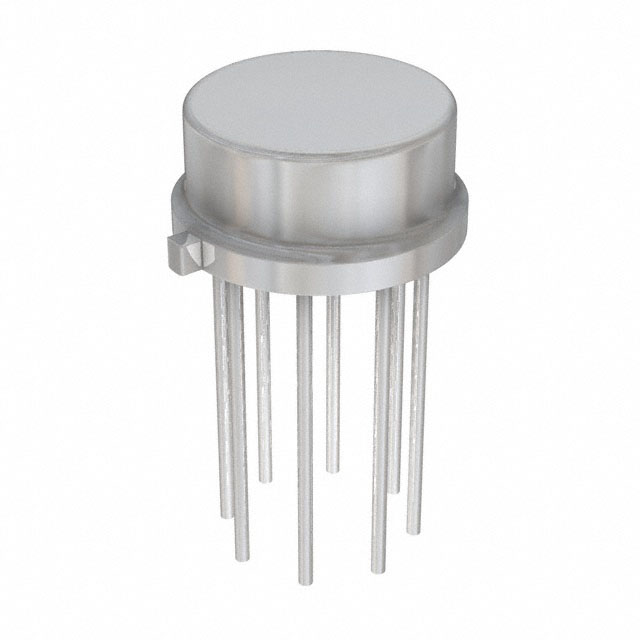
The LM709H is a general-purpose operational amplifier manufactured by Texas Instruments in a TO-99-8 metal can package. This device is classified as obsolete, indicating it has been discontinued and is no longer in active production. The LM709H was designed for general-purpose amplification applications requiring a single operational amplifier circuit with basic performance characteristics suitable for legacy systems and designs.
Due to its obsolete status, sourcing new units from primary manufacturers is no longer possible through standard distribution channels. Organizations maintaining or repairing equipment utilizing the LM709H must identify functionally equivalent alternatives that meet the original design specifications while accommodating any performance improvements or operational differences inherent in modern replacement devices.
Substiute Parts
Key Parameters
| Parameter | LM709H | Unit |
|---|---|---|
| Amplifier Type | General Purpose | — |
| Number of Circuits | 1 | — |
| Slew Rate | 0.25 | V/µs |
| Current - Input Bias | 200 | nA |
| Voltage - Input Offset | 1 | mV |
| Current - Supply | 2.6 | mA |
| Voltage - Supply Span (Min) | 18 | V |
| Voltage - Supply Span (Max) | 30 | V |
| Operating Temperature | -55 to 125 | °C |
| Package / Case | TO-99-8 Metal Can | — |
| Mounting Type | Through Hole | — |
| Product Status | Obsolete | — |
| RoHS Status | RoHS non-compliant | — |
Substitute Part Grouping Explanation
Substitution of the LM709H is determined by strict alignment of electrical and mechanical parameters within the constraints of general-purpose operational amplifier functionality. The primary substitution criteria are:
Mechanical Compatibility:
- Package type: TO-99-8 Metal Can (through-hole mounting)
- Pin configuration and footprint compatibility
Electrical Compatibility:
- Single operational amplifier circuit configuration
- Supply voltage range encompassing the original 18 V to 30 V specification
- Input bias current and input offset voltage within acceptable operational margins
- Slew rate sufficient for the intended application bandwidth
Regulatory and Compliance Considerations:
- RoHS compliance status for modern manufacturing environments
- REACH compliance status for material restrictions
The AD549JHZ from Analog Devices Inc. satisfies these substitution criteria through identical package specification (TO-99-8 Metal Can), compatible supply voltage range (10 V to 36 V, which encompasses the original 18 V to 30 V requirement), and active product status enabling continued availability.
Parameter Comparison
| Parameter | LM709H | AD549JHZ | Unit |
|---|---|---|---|
| Manufacturer | Texas Instruments | Analog Devices Inc. | — |
| Amplifier Type | General Purpose | General Purpose | — |
| Number of Circuits | 1 | 1 | — |
| Slew Rate | 0.25 | 3 | V/µs |
| Current - Input Bias | 200 | 0.15 | nA |
| Voltage - Input Offset | 1 | 0.5 | mV |
| Current - Supply | 2.6 | 0.6 | mA |
| Voltage - Supply Span (Min) | 18 | 10 | V |
| Voltage - Supply Span (Max) | 30 | 36 | V |
| Operating Temperature | -55 to 125 | 0 to 70 | °C |
| Package / Case | TO-99-8 Metal Can | TO-99-8 Metal Can | — |
| Mounting Type | Through Hole | Through Hole | — |
| Product Status | Obsolete | Active | — |
| RoHS Status | RoHS non-compliant | ROHS3 Compliant | — |
Engineering Selection Recommendations
The AD549JHZ is the manufacturer-recommended substitute for the LM709H based on package compatibility and electrical parameter alignment. The following factors support this substitution:
Product Availability: The AD549JHZ maintains active product status with documented inventory availability, addressing the sourcing limitation imposed by the LM709H's obsolete classification.
Regulatory Compliance: The AD549JHZ achieves ROHS3 compliance, meeting modern manufacturing and procurement requirements. Organizations subject to RoHS regulations must account for the LM709H's non-compliant status when planning component transitions.
Electrical Performance: The AD549JHZ demonstrates superior electrical characteristics across multiple parameters. Input bias current is reduced from 200 nA to 0.15 pA, input offset voltage is reduced from 1 mV to 0.5 mV, and slew rate is increased from 0.25 V/µs to 3 V/µs. These improvements enhance circuit performance without requiring design modifications.
Supply Voltage Compatibility: The AD549JHZ supply voltage range (10 V to 36 V) encompasses the original LM709H specification (18 V to 30 V), ensuring compatibility with existing power supply designs.
Operating Temperature Consideration: The AD549JHZ operating temperature range (0°C to 70°C) is narrower than the LM709H range (-55°C to 125°C). Applications requiring extended temperature operation below 0°C or above 70°C must evaluate alternative substitutes or implement thermal management strategies.
Frequently Asked Questions (FAQ)
Q: Can the AD549JHZ directly replace the LM709H without circuit modifications?
A: The AD549JHZ is pin-compatible with the LM709H in the TO-99-8 package and operates within the original supply voltage specification. Direct substitution is mechanically and electrically feasible for applications operating within the AD549JHZ temperature range (0°C to 70°C). Applications requiring the full -55°C to 125°C temperature range of the original LM709H require alternative solutions.
Q: What are the key performance differences between these devices?
A: The AD549JHZ provides superior performance in slew rate (3 V/µs versus 0.25 V/µs), input bias current (0.15 pA versus 200 nA), and input offset voltage (0.5 mV versus 1 mV). These improvements result in faster signal response, lower input current requirements, and improved precision. Supply current is also reduced (0.6 mA versus 2.6 mA), providing power consumption benefits.
Q: Are there compliance implications for using the AD549JHZ instead of the LM709H?
A: Yes. The AD549JHZ is ROHS3 compliant, while the LM709H is RoHS non-compliant. Organizations operating under RoHS regulations must transition to compliant alternatives. Both devices are REACH Unaffected and carry EAR99 ECCN classification.
Q: What is the package compatibility between these devices?
A: Both the LM709H and AD549JHZ use the TO-99-8 metal can package with through-hole mounting. Pin configuration and footprint are identical, enabling direct socket substitution without PCB modifications.
Q: Should I test the AD549JHZ before full production deployment?
A: Circuit validation is a standard engineering practice for any component substitution. Functional testing within your specific application context ensures performance alignment with design requirements, particularly regarding the narrower operating temperature range of the AD549JHZ.
Alternative Parts

SJ6012L2TP
Littelfuse Inc.
6 Alternative Parts

JMK107BBJ476MA-RE
Taiyo Yuden
10 Alternative Parts

GMK107BBJ475MA-T
Taiyo Yuden
5 Alternative Parts
SJ6020N2ARP
Littelfuse Inc.
3 Alternative Parts
SJ6025R2ATP
Littelfuse Inc.
4 Alternative Parts

2474-05L
API Delevan Inc.
1 Alternative Parts

4590R-684K
API Delevan Inc.
1 Alternative Parts

CM6560R-334
API Delevan Inc.
1 Alternative Parts

CM6460-104
API Delevan Inc.
1 Alternative Parts

5526-12
API Delevan Inc.
1 Alternative Parts