



Request Quote
(Ships tomorrow)
LED55CF Infrared Emitter 940nm Equivalent & Substitute Parts
Part Overview
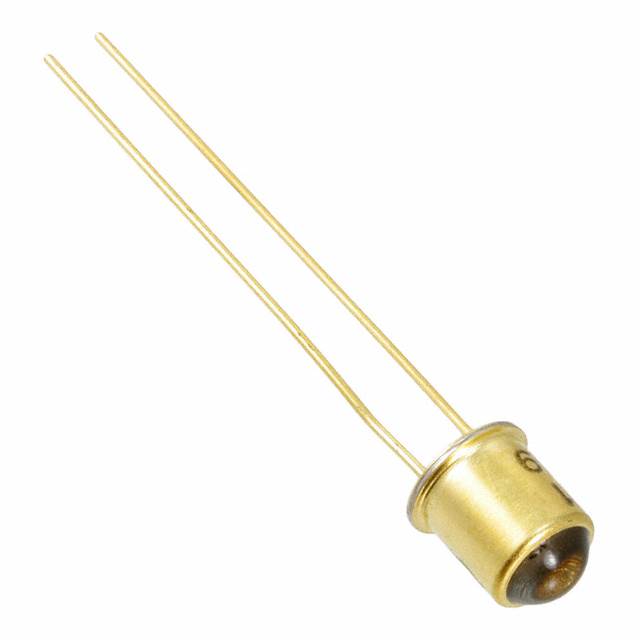
The LED55CF is an infrared (IR) emitter manufactured by onsemi, designed for 940nm wavelength applications requiring 100mA forward current in a TO-46-2 lens top metal can package. This component operates across an extended temperature range of -65°C to 125°C and features an 80° viewing angle for wide-angle IR transmission.
The LED55CF is classified as obsolete. Equivalent and substitute parts are necessary to maintain design continuity and ensure component availability for new production runs and field replacements.
Substiute Parts
Key Parameters
| Parameter | LED55CF (onsemi) |
|---|---|
| Wavelength | 940nm |
| Current - DC Forward (If) Max | 100mA |
| Voltage - Forward (Vf) Typical | 1.7V |
| Viewing Angle | 80° |
| Operating Temperature Range | -65°C to 125°C |
| Mounting Type | Through Hole |
| Package / Case | TO-46-2 Lens Top Metal Can |
| Product Status | Obsolete |
Substitute Part Grouping Explanation
Substitute parts for the LED55CF are qualified based on the following electrical and mechanical parameters:
- Wavelength compatibility: 935nm to 940nm range (near-infrared spectrum for IR applications)
- Forward current rating: 100mA maximum (identical current handling)
- Forward voltage: 1.7V to 1.75V typical (compatible voltage drop)
- Operating temperature range: -65°C to 125°C (identical thermal operating window)
- Mounting type: Through Hole (identical PCB integration method)
- Package type: TO-46-2 Metal Can variants (identical form factor)
The substitute parts OP130, OP130W, and OP133W from TT Electronics/Optek Technology meet these core electrical and mechanical criteria. Differences in viewing angle (18° to 50° versus 80°) and radiant intensity represent design variations within the same component category and do not preclude substitution based on the allowed parameters for this product category.
Parameter Comparison
| Parameter | LED55CF (onsemi) | OP130 (Optek) | OP130W (Optek) | OP133W (Optek) |
|---|---|---|---|---|
| Wavelength | 940nm | 935nm | 935nm | 935nm |
| Current - DC Forward (If) Max | 100mA | 100mA | 100mA | 100mA |
| Voltage - Forward (Vf) Typical | 1.7V | 1.75V | 1.75V | 1.75V |
| Viewing Angle | 80° | 18° | 50° | 50° |
| Radiant Intensity (Ie) Min @ If | Not specified | 1mW/cm² @ 100mA | 1mW/cm² @ 100mA | 5mW/cm² @ 100mA |
| Operating Temperature Range | -65°C to 125°C | -65°C to 125°C | -65°C to 125°C | -65°C to 125°C |
| Mounting Type | Through Hole | Through Hole | Through Hole | Through Hole |
| Package / Case | TO-46-2 Lens Top Metal Can | TO-46-2 Lens Top Metal Can | TO-46-2 Metal Can | TO-46-2 Metal Can |
| Product Status | Obsolete | Active | Active | Active |
| RoHS Status | Not specified | ROHS3 Compliant | ROHS3 Compliant | ROHS3 Compliant |
Engineering Selection Recommendations
All three substitute parts (OP130, OP130W, OP133W) are manufactured by TT Electronics/Optek Technology and carry active product status, ensuring long-term availability and supply chain continuity. All substitutes are ROHS3 compliant, meeting current environmental and regulatory requirements.
Selection among the three substitutes depends on application-specific optical requirements:
- OP130: Narrow viewing angle (18°) for focused IR transmission applications
- OP130W: Medium viewing angle (50°) with standard radiant intensity (1mW/cm²)
- OP133W: Medium viewing angle (50°) with elevated radiant intensity (5mW/cm²) for high-intensity IR applications
All substitutes operate within the same electrical parameters (100mA, 1.75V typical) and thermal range (-65°C to 125°C) as the original LED55CF, ensuring direct PCB-level compatibility in TO-46-2 through-hole mounting configurations.
Frequently Asked Questions (FAQ)
Q: Can OP130, OP130W, and OP133W be used interchangeably with LED55CF?
A: These parts share identical electrical ratings (100mA forward current, 1.75V typical forward voltage) and thermal operating range (-65°C to 125°C). They are housed in compatible TO-46-2 through-hole packages. Substitution is valid when application requirements accommodate the specified viewing angle and radiant intensity of the selected substitute.
Q: What is the difference between OP130, OP130W, and OP133W?
A: The primary differences are viewing angle and radiant intensity. OP130 provides 18° viewing angle with 1mW/cm² intensity. OP130W and OP133W both provide 50° viewing angle; OP130W delivers 1mW/cm² intensity while OP133W delivers 5mW/cm² intensity. All three operate at identical electrical parameters.
Q: Why is the LED55CF obsolete?
A: The LED55CF is classified as obsolete by onsemi. The active substitute parts from TT Electronics/Optek Technology provide equivalent functionality with current product status and regulatory compliance.
Q: Are the substitute parts RoHS compliant?
A: Yes. OP130, OP130W, and OP133W are all ROHS3 compliant. The LED55CF RoHS status was not specified in available documentation.
Q: Do the substitute parts require circuit design changes?
A: No. The substitute parts maintain identical forward current (100mA), forward voltage (1.75V typical), operating temperature range (-65°C to 125°C), and through-hole TO-46-2 mounting configuration. Direct PCB-level substitution is supported without circuit modification.
Q: What is the wavelength difference between 940nm and 935nm?
A: The 5nm difference falls within the near-infrared spectrum and is typical for IR emitter component families. Both wavelengths operate in the same application domain for IR transmission and detection systems.
Alternative Parts

SJ6012L2TP
Littelfuse Inc.
6 Alternative Parts

JMK107BBJ476MA-RE
Taiyo Yuden
10 Alternative Parts

GMK107BBJ475MA-T
Taiyo Yuden
5 Alternative Parts
SJ6020N2ARP
Littelfuse Inc.
3 Alternative Parts
SJ6025R2ATP
Littelfuse Inc.
4 Alternative Parts

2474-05L
API Delevan Inc.
1 Alternative Parts

4590R-684K
API Delevan Inc.
1 Alternative Parts

CM6560R-334
API Delevan Inc.
1 Alternative Parts

CM6460-104
API Delevan Inc.
1 Alternative Parts

5526-12
API Delevan Inc.
1 Alternative Parts