


Request Quote
(Ships tomorrow)
KSC1675OBU Equivalent & Substitute Parts
Part Overview
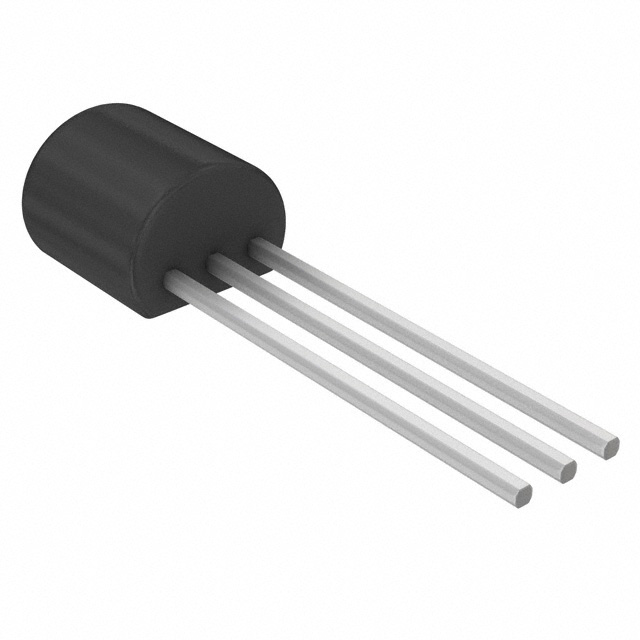
The KSC1675OBU is an NPN bipolar junction transistor manufactured by onsemi, rated for 30V collector-emitter breakdown voltage and 50mA maximum collector current. This device is packaged in a TO-92-3 through-hole configuration and is designed for general-purpose switching and amplification applications with a maximum power dissipation of 250mW.
The KSC1675OBU is classified as obsolete. Locating equivalent or substitute components is necessary to support ongoing maintenance, repair, and new design requirements where this part is specified or where existing inventory requires replenishment from alternative sources.
Substiute Parts
Key Parameters
| Parameter | Value | Unit |
|---|---|---|
| Transistor Type | NPN | — |
| Voltage - Collector Emitter Breakdown (Max) | 30 | V |
| Current - Collector (Ic) (Max) | 50 | mA |
| Power - Max | 250 | mW |
| Vce Saturation (Max) | 300 | mV @ 1mA, 10mA |
| DC Current Gain (hFE) (Min) | 70 | @ 1mA, 6V |
| Frequency - Transition | 300 | MHz |
| Current - Collector Cutoff (Max) | 100 | nA (ICBO) |
| Mounting Type | Through Hole | — |
| Package / Case | TO-92-3 | — |
Substitute Part Grouping Explanation
Substitution of the KSC1675OBU is determined by the following critical electrical and mechanical parameters:
Electrical Compatibility Criteria:
- Transistor type must be NPN
- Voltage - Collector Emitter Breakdown (Max) must be ≥30V
- Current - Collector (Ic) (Max) must be ≥50mA
- Power - Max must be ≥250mW
- Mounting type must be Through Hole
- Package must be physically compatible with TO-92-3 footprint
Substitute Identification: The ZTX849 meets the electrical requirements for substitution. It exceeds the minimum specifications for collector-emitter breakdown voltage (30V), collector current (5A vs. 50mA minimum), and power dissipation (1.2W vs. 250mW minimum). The ZTX849 is packaged in an E-Line configuration that is mechanically compatible with TO-92 footprints. Both devices are NPN transistors with through-hole mounting.
Parameter Comparison
| Parameter | KSC1675OBU | ZTX849 | Unit |
|---|---|---|---|
| Manufacturer | onsemi | Diodes Incorporated | — |
| Product Status | Obsolete | Active | — |
| Transistor Type | NPN | NPN | — |
| Voltage - Collector Emitter Breakdown (Max) | 30 | 30 | V |
| Current - Collector (Ic) (Max) | 50 | 5000 | mA |
| Power - Max | 250 | 1200 | mW |
| Vce Saturation (Max) | 300 @ 1mA, 10mA | 220 @ 200mA, 5A | mV |
| DC Current Gain (hFE) (Min) | 70 @ 1mA, 6V | 100 @ 1A, 1V | — |
| Frequency - Transition | 300 | 100 | MHz |
| Current - Collector Cutoff (Max) | 100 | 50 | nA (ICBO) |
| Mounting Type | Through Hole | Through Hole | — |
| Package / Case | TO-92-3 | E-Line-3 (TO-92 compatible) | — |
| Moisture Sensitivity Level (MSL) | 1 (Unlimited) | 1 (Unlimited) | — |
| REACH Status | REACH Unaffected | REACH Unaffected | — |
| ECCN | EAR99 | EAR99 | — |
Engineering Selection Recommendations
KSC1675OBU Status: The KSC1675OBU is classified as obsolete. New original inventory is available (975 pieces in stock), but long-term availability cannot be assured. For new designs or applications requiring extended component lifecycle support, transition to an active product is recommended.
ZTX849 as Substitute: The ZTX849 is an active product manufactured by Diodes Incorporated with confirmed availability (15,819 pieces in stock). It meets all electrical requirements for substitution and is RoHS3 compliant, providing enhanced environmental and regulatory compliance compared to the obsolete KSC1675OBU. Both devices share identical REACH and ECCN classifications (REACH Unaffected, EAR99).
The ZTX849 provides superior electrical performance in all rated parameters: higher collector current capability (5A vs. 50mA), higher power dissipation rating (1.2W vs. 250mW), and improved DC current gain (100 vs. 70 minimum). The E-Line package is mechanically compatible with TO-92 footprints, enabling direct board-level substitution.
Compliance Considerations: Both devices are MSL Level 1 (Unlimited moisture sensitivity), indicating no moisture-related handling restrictions. Both are REACH Unaffected and classified as EAR99 for export control purposes.
Frequently Asked Questions (FAQ)
Q: Can the ZTX849 be used as a direct replacement for the KSC1675OBU in existing designs?
A: The ZTX849 meets all electrical requirements for substitution. The E-Line package is mechanically compatible with TO-92-3 footprints. Pin configuration and polarity are identical (NPN, three-terminal through-hole). Direct board-level substitution is possible without circuit modification.
Q: What are the key differences between these two transistors?
A: The primary differences are product status and rated performance. The KSC1675OBU is obsolete; the ZTX849 is active. The ZTX849 has higher collector current capability (5A vs. 50mA), higher power dissipation (1.2W vs. 250mW), and higher DC current gain (100 vs. 70 minimum). The ZTX849 has lower transition frequency (100MHz vs. 300MHz) and lower collector cutoff current (50nA vs. 100nA).
Q: Are there any compliance or regulatory differences between these parts?
A: Both devices share identical REACH and ECCN classifications (REACH Unaffected, EAR99). The ZTX849 is RoHS3 compliant, providing enhanced environmental compliance. Both are MSL Level 1 (Unlimited), requiring no special moisture handling.
Q: What is the package compatibility between TO-92-3 and E-Line?
A: The E-Line package is a three-terminal through-hole configuration that is mechanically compatible with TO-92 footprints. Pin spacing and lead diameter are designed for standard TO-92 PCB layouts. Physical substitution on existing boards is supported.
Q: Why does the ZTX849 have lower transition frequency than the KSC1675OBU?
A: Transition frequency is a characteristic of transistor design and manufacturing process. The ZTX849 is optimized for higher current handling and power dissipation, which results in lower transition frequency (100MHz vs. 300MHz). For applications requiring frequencies below 100MHz, this difference is not operationally significant.
Q: Can the ZTX849 be used in high-frequency switching applications originally designed for the KSC1675OBU?
A: Application suitability depends on the specific frequency requirements of the circuit. The KSC1675OBU is rated for 300MHz transition frequency; the ZTX849 is rated for 100MHz. For applications operating above 100MHz, the ZTX849 may not meet performance requirements. Circuit analysis is necessary to determine if the lower transition frequency is acceptable for the intended application.
Alternative Parts

SJ6012L2TP
Littelfuse Inc.
6 Alternative Parts

JMK107BBJ476MA-RE
Taiyo Yuden
10 Alternative Parts

GMK107BBJ475MA-T
Taiyo Yuden
5 Alternative Parts
SJ6020N2ARP
Littelfuse Inc.
3 Alternative Parts
SJ6025R2ATP
Littelfuse Inc.
4 Alternative Parts

2474-05L
API Delevan Inc.
1 Alternative Parts

4590R-684K
API Delevan Inc.
1 Alternative Parts

CM6560R-334
API Delevan Inc.
1 Alternative Parts

CM6460-104
API Delevan Inc.
1 Alternative Parts

5526-12
API Delevan Inc.
1 Alternative Parts