


Request Quote
(Ships tomorrow)
KS503J2 Equivalent & Substitute Parts
Part Overview
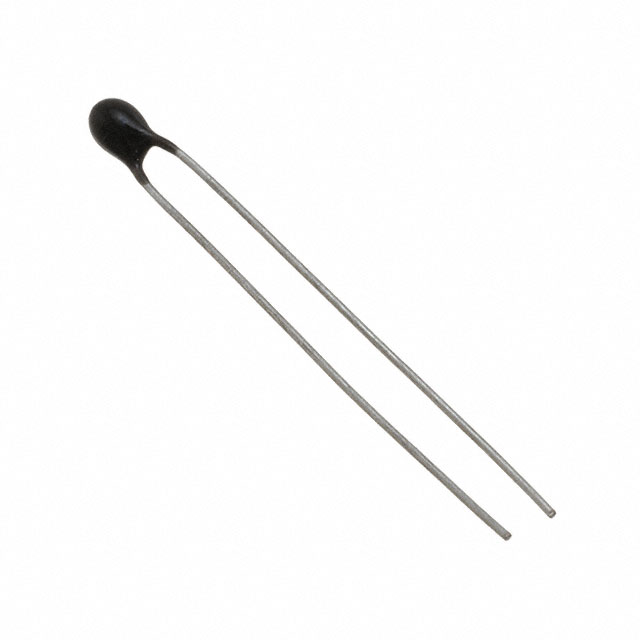
The KS503J2 is an NTC thermistor manufactured by Littelfuse Inc., designed as a 50kΩ bead-type temperature sensor with epoxy packaging. This component is classified as obsolete, making equivalent substitute parts necessary for ongoing applications and new designs. The KS503J2 operates at a maximum temperature of 135°C with a power rating of 30 mW and features free-hanging mounting configuration.
Substiute Parts
Key Parameters
| Parameter | Value |
|---|---|
| Resistance @ 25°C | 50kΩ |
| Resistance Tolerance | ±0.1°C |
| B0/50 Value | 3892K |
| Operating Temperature | Up to 135°C |
| Power - Max | 30 mW |
| Package / Case | Bead, Epoxy |
| Mounting Type | Free Hanging |
| RoHS Status | ROHS3 Compliant |
Substitute Part Grouping Explanation
The TT7-50KC3-3 qualifies as a substitute for the KS503J2 based on the following critical parameters:
- Resistance Match: Both parts maintain 50kΩ nominal resistance at 25°C, ensuring functional equivalence in circuit applications
- Package Type: Both utilize bead epoxy packaging, maintaining mechanical compatibility
- Thermal Characteristics: The B25/50 value of 3950K for the TT7-50KC3-3 is within acceptable range of the KS503J2's B0/50 value of 3892K, providing comparable temperature response
- Compliance: Both parts are ROHS3 compliant and REACH unaffected, meeting regulatory requirements
- Tariff Classification: Identical HTSUS code (8533.40.8070) confirms component category alignment
Parameter Comparison
| Parameter | KS503J2 (Littelfuse) | TT7-50KC3-3 (TEWA Sensors) |
|---|---|---|
| Resistance @ 25°C | 50kΩ | 50kΩ |
| Resistance Tolerance | ±0.1°C | ±1% |
| B Value (Thermal) | B0/50: 3892K | B25/50: 3950K |
| Operating Temperature Range | Up to 135°C | -40°C ~ 125°C |
| Package / Case | Bead, Epoxy | Bead, Epoxy |
| Mounting Type | Free Hanging | Through Hole |
| Product Status | Obsolete | Active |
| RoHS Status | ROHS3 Compliant | ROHS3 Compliant |
Engineering Selection Recommendations
The TT7-50KC3-3 is an active product from TEWA Sensors LLC and represents the primary substitute for the obsolete KS503J2. Both components maintain ROHS3 compliance and REACH unaffected status, satisfying regulatory requirements for new designs and replacements.
The TT7-50KC3-3 operates within a -40°C to 125°C range, which covers the majority of the KS503J2's operating envelope up to 135°C. Applications requiring operation above 125°C may require thermal performance validation. The resistance tolerance specification of ±1% for the TT7-50KC3-3 is broader than the KS503J2's ±0.1°C specification; circuit designs dependent on tighter tolerance margins should account for this difference.
Frequently Asked Questions (FAQ)
Q: Can the TT7-50KC3-3 directly replace the KS503J2 in existing applications?
A: The TT7-50KC3-3 provides functional equivalence based on matching 50kΩ resistance, bead epoxy package type, and comparable thermal characteristics. Mounting configuration differs (through hole versus free hanging), requiring mechanical design review for specific applications.
Q: What is the significance of the B value difference between the two parts?
A: The B0/50 value of 3892K (KS503J2) and B25/50 value of 3950K (TT7-50KC3-3) represent thermal sensitivity coefficients. The 58K difference results in minimal temperature response variation across typical operating ranges and does not preclude substitution for standard temperature sensing applications.
Q: Are there temperature range limitations when substituting?
A: The KS503J2 operates to 135°C while the TT7-50KC3-3 operates to 125°C maximum. Applications requiring sustained operation above 125°C should verify thermal performance requirements before substitution.
Q: Do both parts meet current regulatory standards?
A: Yes. Both the KS503J2 and TT7-50KC3-3 are ROHS3 compliant and REACH unaffected, meeting current regulatory requirements for component procurement and use.
Q: How does the resistance tolerance affect circuit performance?
A: The KS503J2 specifies ±0.1°C tolerance while the TT7-50KC3-3 specifies ±1% tolerance. Circuits with tight tolerance requirements should evaluate whether the broader tolerance of the substitute part affects system accuracy or calibration procedures.
Alternative Parts

SJ6012L2TP
Littelfuse Inc.
6 Alternative Parts

JMK107BBJ476MA-RE
Taiyo Yuden
10 Alternative Parts

GMK107BBJ475MA-T
Taiyo Yuden
5 Alternative Parts
SJ6020N2ARP
Littelfuse Inc.
3 Alternative Parts
SJ6025R2ATP
Littelfuse Inc.
4 Alternative Parts

2474-05L
API Delevan Inc.
1 Alternative Parts

4590R-684K
API Delevan Inc.
1 Alternative Parts

CM6560R-334
API Delevan Inc.
1 Alternative Parts

CM6460-104
API Delevan Inc.
1 Alternative Parts

5526-12
API Delevan Inc.
1 Alternative Parts