


Request Quote
(Ships tomorrow)
KBU407G Bridge Rectifier Equivalent & Substitute Parts
Part Overview
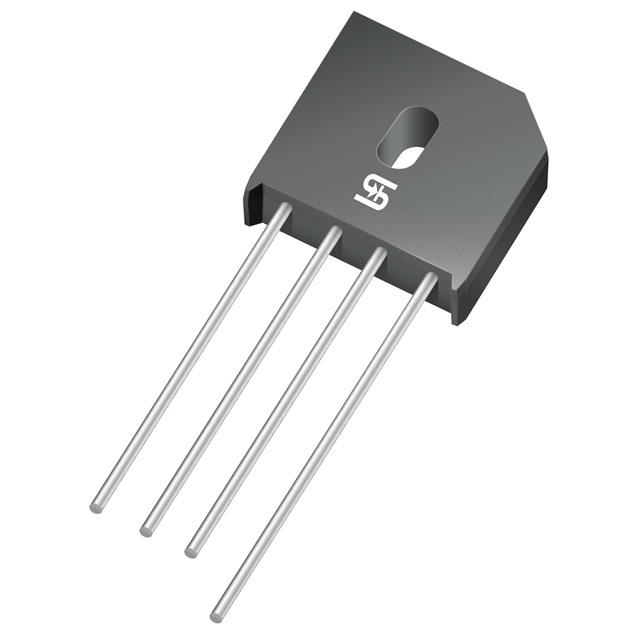
The KBU407G is a single-phase bridge rectifier manufactured by Taiwan Semiconductor Corporation, designed for standard rectification applications requiring 1 kV peak reverse voltage and 4 A average rectified current. This component operates across an industrial temperature range of -55°C to 150°C and is housed in a 4-SIP through-hole package configuration. The part maintains Active product status with full RoHS3 compliance and unlimited moisture sensitivity rating. Alternative equivalent parts are identified based on matching electrical specifications, mechanical packaging, and operational parameters to ensure direct functional interchangeability in circuit applications.
Substiute Parts
Key Parameters
| Parameter | Value | Unit |
|---|---|---|
| Diode Type | Single Phase | — |
| Technology | Standard | — |
| Voltage - Peak Reverse (Max) | 1 | kV |
| Current - Average Rectified (Io) | 4 | A |
| Voltage - Forward (Vf) (Max) @ If | 1.1 | V @ 4 A |
| Current - Reverse Leakage @ Vr | 5 | µA @ 1000 V |
| Operating Temperature Range | -55 to 150 | °C (TJ) |
| Mounting Type | Through Hole | — |
| Package / Case | 4-SIP, KBU | — |
| RoHS Status | ROHS3 Compliant | — |
| Moisture Sensitivity Level (MSL) | 1 (Unlimited) | — |
Substitute Part Grouping Explanation
Substitution eligibility for the KBU407G bridge rectifier is determined by strict equivalence across the following critical parameters:
Electrical Specifications: Peak reverse voltage rating of 1 kV, average rectified current capacity of 4 A, forward voltage drop of 1.1 V maximum at 4 A forward current, and reverse leakage current of 5 µA at 1000 V reverse voltage.
Mechanical Configuration: Through-hole mounting technology with 4-SIP KBU package designation, ensuring physical and electrical compatibility with existing PCB layouts and socket configurations.
Operational Characteristics: Single-phase rectification topology using standard semiconductor technology, with operating temperature range spanning -55°C to 150°C junction temperature.
Compliance & Certification: RoHS3 compliance status, MSL rating of 1 (unlimited moisture sensitivity), and Active product status confirming current manufacturing availability and regulatory alignment.
Parts meeting all specified parameters within these categories qualify as direct functional equivalents and may be substituted without circuit redesign or performance degradation.
Parameter Comparison
| Parameter | KBU407G (Main Part) | KBU407G (Substitute) | Match Status |
|---|---|---|---|
| Manufacturer | Taiwan Semiconductor Corporation | Taiwan Semiconductor Corporation | Identical |
| Diode Type | Single Phase | Single Phase | Identical |
| Technology | Standard | Standard | Identical |
| Voltage - Peak Reverse (Max) | 1 kV | 1 kV | Identical |
| Current - Average Rectified (Io) | 4 A | 4 A | Identical |
| Voltage - Forward (Vf) (Max) @ If | 1.1 V @ 4 A | 1.1 V @ 4 A | Identical |
| Current - Reverse Leakage @ Vr | 5 µA @ 1000 V | 5 µA @ 1000 V | Identical |
| Operating Temperature Range | -55°C ~ 150°C (TJ) | -55°C ~ 150°C (TJ) | Identical |
| Mounting Type | Through Hole | Through Hole | Identical |
| Package / Case | 4-SIP, KBU | 4-SIP, KBU | Identical |
| RoHS Status | ROHS3 Compliant | ROHS3 Compliant | Identical |
| Moisture Sensitivity Level (MSL) | 1 (Unlimited) | 1 (Unlimited) | Identical |
| Product Status | Active | Active | Identical |
Engineering Selection Recommendations
The KBU407G bridge rectifier is classified as an Active product with full RoHS3 compliance and REACH unaffected status, confirming regulatory alignment for current and future applications. The unlimited moisture sensitivity rating (MSL 1) eliminates moisture-related handling constraints during assembly and storage operations.
Component selection should prioritize parts maintaining identical electrical ratings across peak reverse voltage (1 kV), average rectified current (4 A), forward voltage characteristics (1.1 V @ 4 A), and reverse leakage specifications (5 µA @ 1000 V). Through-hole mounting configuration and 4-SIP KBU package designation must be preserved to ensure mechanical compatibility with existing PCB designs and socket interfaces.
Compliance certifications including RoHS3 status and REACH unaffected designation should be verified for all substitute selections to maintain regulatory compliance across manufacturing and end-use environments. Active product status ensures ongoing availability and manufacturing support for production requirements.
Frequently Asked Questions (FAQ)
Q: What defines electrical equivalence for the KBU407G bridge rectifier?
A: Electrical equivalence requires matching peak reverse voltage (1 kV), average rectified current (4 A), forward voltage drop (1.1 V @ 4 A), and reverse leakage current (5 µA @ 1000 V). These parameters determine rectification performance and thermal characteristics in circuit operation.
Q: Can the KBU407G be substituted with parts having different package configurations?
A: No. The 4-SIP KBU through-hole package is a critical mechanical specification. Substitutes must maintain identical package designation and mounting type to ensure PCB compatibility and proper electrical connection without circuit redesign.
Q: What is the significance of the -55°C to 150°C operating temperature range?
A: This temperature range defines the junction temperature limits for reliable device operation. Substitute parts must support the identical temperature range to ensure performance consistency across industrial and extended temperature applications.
Q: Does RoHS3 compliance affect substitute part selection?
A: Yes. RoHS3 compliance is a regulatory requirement for many applications. All substitute parts must maintain RoHS3 compliant status to satisfy environmental and manufacturing regulations.
Q: What does MSL 1 (Unlimited) moisture sensitivity mean for handling?
A: MSL 1 indicates unlimited moisture sensitivity, meaning the component does not require special moisture-controlled storage or baking procedures prior to assembly. This simplifies inventory management and reduces handling constraints.
Q: Are there any restrictions on mixing KBU407G units from different manufacturing batches?
A: All KBU407G units from Taiwan Semiconductor Corporation meeting the specified electrical and mechanical parameters are functionally equivalent. Batch mixing does not affect circuit performance when all units conform to the documented specifications.
Q: How should forward voltage drop be verified during component selection?
A: Forward voltage drop is specified as 1.1 V maximum at 4 A forward current. This parameter directly affects power dissipation and thermal performance. Substitute parts must meet or exceed this specification to maintain circuit efficiency.
Alternative Parts

SJ6012L2TP
Littelfuse Inc.
6 Alternative Parts

JMK107BBJ476MA-RE
Taiyo Yuden
10 Alternative Parts

GMK107BBJ475MA-T
Taiyo Yuden
5 Alternative Parts
SJ6020N2ARP
Littelfuse Inc.
3 Alternative Parts
SJ6025R2ATP
Littelfuse Inc.
4 Alternative Parts

2474-05L
API Delevan Inc.
1 Alternative Parts

4590R-684K
API Delevan Inc.
1 Alternative Parts

CM6560R-334
API Delevan Inc.
1 Alternative Parts

CM6460-104
API Delevan Inc.
1 Alternative Parts

5526-12
API Delevan Inc.
1 Alternative Parts