


Request Quote
(Ships tomorrow)
KBJ410G Bridge Rectifier Equivalent & Substitute Parts
Part Overview
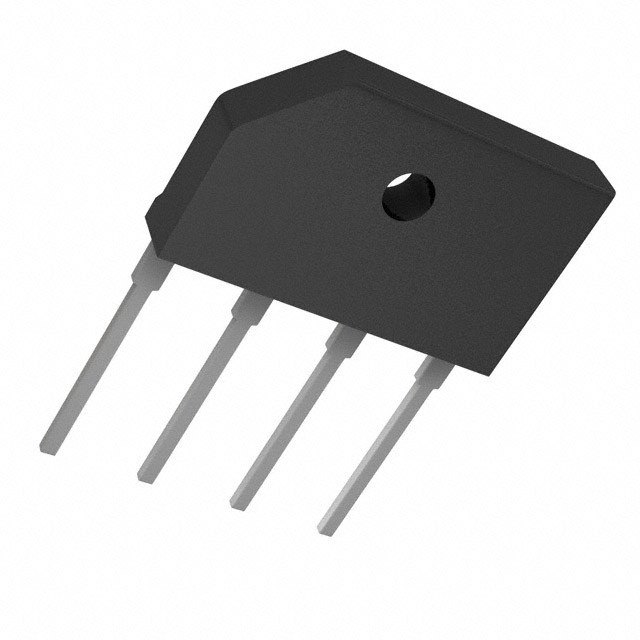
The KBJ410G is a single-phase bridge rectifier diode designed for standard rectification applications requiring 1 kV peak reverse voltage and 4 A average rectified current. Manufactured by GeneSiC Semiconductor, this component is housed in a 4-SIP KBJ through-hole package and maintains active product status with full RoHS compliance.
Identifying equivalent and substitute parts becomes necessary when the primary manufacturer's stock is unavailable, when alternative packaging formats are required, or when sourcing from multiple qualified suppliers is mandated by procurement specifications. This reference provides engineering-validated substitutes based on electrical and mechanical parameter compatibility.
Substiute Parts
Key Parameters
| Parameter | Value | Unit | Substitution Relevance |
|---|---|---|---|
| Voltage - Peak Reverse (Max) | 1 | kV | Critical - Must match or exceed |
| Current - Average Rectified (Io) | 4 | A | Critical - Must match or exceed |
| Voltage - Forward (Vf) (Max) @ If | 1.1 V @ 4 A | V | Performance - Lower values preferred |
| Current - Reverse Leakage @ Vr | 5 | µA @ 1000 V | Performance - Lower values preferred |
| Operating Temperature Range | -55 to 150 | °C (TJ) | Application-dependent |
| Mounting Type | Through Hole | - | Critical - Must match for PCB compatibility |
| Package / Case | 4-SIP, KBJ | - | Critical - Must match for mechanical fit |
| Diode Type | Single Phase | - | Critical - Application requirement |
| Technology | Standard | - | Critical - Defines rectification characteristics |
Substitute Part Grouping Explanation
Substitution eligibility for the KBJ410G is determined by strict alignment with the following critical parameters:
Electrical Requirements (Non-negotiable):
- Voltage - Peak Reverse (Max): Must equal or exceed 1 kV
- Current - Average Rectified (Io): Must equal or exceed 4 A
- Diode Type: Must be Single Phase
- Technology: Must be Standard
Mechanical Requirements (Non-negotiable):
- Mounting Type: Must be Through Hole
- Package / Case: Must be 4-SIP, KBJ format
Performance Parameters (Acceptable Variation):
- Voltage - Forward (Vf): Lower values indicate improved efficiency; values at or below 1.1 V @ 4 A are acceptable
- Current - Reverse Leakage: Lower values indicate superior blocking characteristics; 5 µA @ 1000 V is the reference threshold
- Operating Temperature Range: Extended ranges provide greater application flexibility
Compliance & Certification (Preferred):
- RoHS Status: RoHS Compliant or ROHS3 Compliant
- Moisture Sensitivity Level: MSL 1 (Unlimited) preferred
- ECCN and HTSUS classifications must align for regulatory consistency
Parameter Comparison
| Parameter | KBJ410G (GeneSiC) | KBJ410G (Diodes Inc.) | Compatibility |
|---|---|---|---|
| Manufacturer | GeneSiC Semiconductor | Diodes Incorporated | Different source, same part number |
| Voltage - Peak Reverse (Max) | 1 kV | 1 kV | Equivalent |
| Current - Average Rectified (Io) | 4 A | 4 A | Equivalent |
| Voltage - Forward (Vf) (Max) @ If | 1.1 V @ 4 A | 1 V @ 2 A | Diodes Inc. shows lower Vf at lower current |
| Current - Reverse Leakage @ Vr | 5 µA @ 1000 V | 5 µA @ 1000 V | Equivalent |
| Operating Temperature Range | -55°C to 150°C | -65°C to 150°C | Diodes Inc. extends lower temperature limit |
| Mounting Type | Through Hole | Through Hole | Equivalent |
| Package / Case | 4-SIP, KBJ | 4-SIP, KBJ | Equivalent |
| Diode Type | Single Phase | Single Phase | Equivalent |
| Technology | Standard | Standard | Equivalent |
| Packaging Format | Bulk | Tube | Different; affects handling and storage |
| RoHS Status | RoHS Compliant | ROHS3 Compliant | Both compliant; ROHS3 is current standard |
| Moisture Sensitivity Level | 1 (Unlimited) | 1 (Unlimited) | Equivalent |
| ECCN | EAR99 | EAR99 | Equivalent |
| HTSUS | 8541.10.0080 | 8541.10.0080 | Equivalent |
Engineering Selection Recommendations
Primary Substitution: KBJ410G (Diodes Incorporated)
The KBJ410G manufactured by Diodes Incorporated is a direct electrical and mechanical equivalent to the GeneSiC Semiconductor KBJ410G. Both components satisfy all critical substitution parameters:
- Identical peak reverse voltage (1 kV) and average rectified current (4 A) ratings
- Matching single-phase, standard-technology bridge rectifier configuration
- Identical through-hole mounting and 4-SIP KBJ package format
- Equivalent reverse leakage characteristics (5 µA @ 1000 V)
- Both RoHS compliant with MSL 1 moisture sensitivity rating
Differentiation Factors:
The Diodes Incorporated variant demonstrates two performance advantages:
-
Extended Operating Temperature Range: -65°C to 150°C versus -55°C to 150°C, providing 10°C additional low-temperature capability for applications requiring enhanced cold-weather performance.
-
Forward Voltage Characteristics: Specified at 1 V @ 2 A, indicating lower forward voltage drop compared to the GeneSiC specification of 1.1 V @ 4 A. This suggests improved efficiency in rectification applications, though direct comparison requires evaluation at identical current levels.
Packaging Consideration:
The Diodes Incorporated part is supplied in tube packaging, whereas the GeneSiC variant is supplied in bulk. Tube packaging provides improved component protection during storage and handling, reducing risk of mechanical damage or contamination.
Compliance Status:
Both parts maintain current regulatory compliance. The Diodes Incorporated variant carries ROHS3 Compliant designation, representing the current RoHS standard iteration. Both parts are REACH Unaffected and classified as EAR99 for export control purposes.
Selection Criteria:
Choose the Diodes Incorporated KBJ410G when:
- Extended low-temperature operation below -55°C is required
- Tube packaging is preferred for component protection
- Current-generation RoHS3 compliance documentation is mandated
- Lower forward voltage drop is beneficial for thermal management
Retain the GeneSiC Semiconductor KBJ410G when:
- Existing supply chain qualification specifies GeneSiC as the sole source
- Bulk packaging aligns with high-volume assembly processes
- Specific thermal or electrical characteristics of GeneSiC technology are required
Frequently Asked Questions (FAQ)
Q: Can the KBJ410G from Diodes Incorporated be used as a direct replacement for the GeneSiC Semiconductor KBJ410G?
A: Yes. Both components share identical electrical ratings (1 kV peak reverse voltage, 4 A average rectified current), matching diode type (single phase), identical technology classification (standard), and equivalent mechanical specifications (through-hole mounting, 4-SIP KBJ package). The components are electrically and mechanically interchangeable.
Q: What is the significance of the different packaging formats (Bulk vs. Tube)?
A: Bulk packaging supplies components in loose form, suitable for high-volume automated assembly where components are fed directly into pick-and-place equipment. Tube packaging places components in protective plastic tubes, reducing exposure to environmental contamination and mechanical damage during storage and transport. Tube packaging is preferred for lower-volume applications or when extended shelf storage is anticipated. Both formats contain the same component; the choice depends on assembly process requirements.
Q: Why do the forward voltage specifications differ between the two manufacturers?
A: The GeneSiC specification lists Vf (Max) as 1.1 V @ 4 A, while Diodes Incorporated specifies 1 V @ 2 A. These measurements are taken at different current levels. Forward voltage in diodes varies with current; lower current typically produces lower forward voltage. Direct comparison requires evaluation at identical current conditions. Both specifications fall within acceptable ranges for standard bridge rectifier technology.
Q: Does the extended operating temperature range of the Diodes Incorporated part affect compatibility?
A: No. The Diodes Incorporated variant extends the lower temperature limit from -55°C to -65°C, providing additional capability without reducing the upper limit (both reach 150°C). This extended range is a performance advantage for applications requiring operation in cold environments. For applications operating within the -55°C to 150°C range, both parts are fully compatible.
Q: Are both parts RoHS compliant?
A: Yes. The GeneSiC Semiconductor KBJ410G carries RoHS Compliant certification. The Diodes Incorporated KBJ410G carries ROHS3 Compliant certification, which represents the current iteration of the RoHS standard. Both certifications indicate compliance with Restriction of Hazardous Substances requirements. ROHS3 is the current standard; RoHS Compliant indicates earlier certification. Both are acceptable for modern applications.
Q: What does MSL 1 (Unlimited) moisture sensitivity rating mean?
A: MSL 1 (Unlimited) indicates the component has no moisture sensitivity limitations. The component does not require special moisture-controlled storage conditions (dry boxes or desiccant packaging) and can be stored under standard warehouse conditions indefinitely without degradation. Both KBJ410G variants carry this rating, eliminating moisture-related handling concerns.
Q: Can these parts be used interchangeably in existing designs without PCB modification?
A: Yes. Both components use identical through-hole mounting and 4-SIP KBJ package format. Pin spacing, lead diameter, and mechanical envelope are equivalent. No PCB layout changes are required for substitution. Direct component replacement on existing PCBs is mechanically and electrically valid.
Q: What is the ECCN classification and why does it matter?
A: ECCN (Export Control Classification Number) EAR99 indicates the component is subject to U.S. export control regulations but does not require a license for export to most countries. Both KBJ410G variants carry identical EAR99 classification, ensuring equivalent export compliance status. This classification is relevant for international supply chain management and regulatory documentation.
Q: Are there any performance differences in reverse leakage current between the two parts?
A: No. Both components specify identical reverse leakage current of 5 µA @ 1000 V. This parameter indicates the blocking capability of the rectifier in reverse bias condition. Equivalent specifications ensure identical performance in applications where reverse leakage is a design consideration.
Q: Which part should be selected for new designs?
A: For new designs, the Diodes Incorporated KBJ410G is recommended based on extended operating temperature range (-65°C to 150°C), current-generation ROHS3 compliance certification, and tube packaging format providing enhanced component protection. However, either part satisfies all electrical and mechanical requirements. Selection should align with established supplier relationships, inventory availability, and specific application temperature requirements.
Alternative Parts

SJ6012L2TP
Littelfuse Inc.
6 Alternative Parts

JMK107BBJ476MA-RE
Taiyo Yuden
10 Alternative Parts

GMK107BBJ475MA-T
Taiyo Yuden
5 Alternative Parts
SJ6020N2ARP
Littelfuse Inc.
3 Alternative Parts
SJ6025R2ATP
Littelfuse Inc.
4 Alternative Parts

2474-05L
API Delevan Inc.
1 Alternative Parts

4590R-684K
API Delevan Inc.
1 Alternative Parts

CM6560R-334
API Delevan Inc.
1 Alternative Parts

CM6460-104
API Delevan Inc.
1 Alternative Parts

5526-12
API Delevan Inc.
1 Alternative Parts