



Request Quote
(Ships tomorrow)
IXFN72N55Q2 Equivalent & Substitute Parts
Part Overview
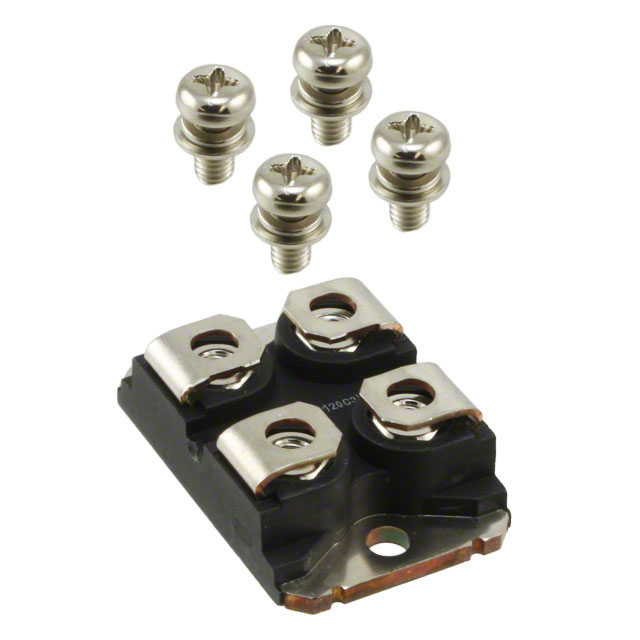
The IXFN72N55Q2 is an N-Channel MOSFET rated for 550V drain-to-source voltage with 72A continuous drain current at 25°C. This device is manufactured by IXYS and packaged in the SOT-227B (miniBLOC) chassis mount configuration. The part operates across a temperature range of -55°C to 150°C and dissipates up to 890W at the case temperature.
The IXFN72N55Q2 is classified as obsolete. Identifying equivalent and substitute parts is necessary to maintain design continuity, ensure supply chain availability, and support ongoing production requirements for applications utilizing this high-voltage, high-current switching device.
Substiute Parts
Key Parameters
| Parameter | Value | Unit |
|---|---|---|
| Drain-to-Source Voltage (Vdss) | 550 | V |
| Continuous Drain Current (Id) @ 25°C | 72 | A (Tc) |
| On-State Resistance (Rds On Max) @ 10V | 72 | mOhm |
| Gate Threshold Voltage (Vgs(th) Max) | 5 | V @ 8mA |
| Gate Charge (Qg Max) @ 10V | 258 | nC |
| Input Capacitance (Ciss Max) @ 25V | 10500 | pF |
| Power Dissipation (Max) | 890 | W (Tc) |
| Operating Temperature Range | -55 to 150 | °C (TJ) |
| Mounting Type | Chassis Mount | |
| Package Type | SOT-227B (miniBLOC) |
Substitute Part Grouping Explanation
Substitution of the IXFN72N55Q2 is determined by the following critical electrical and mechanical parameters:
Voltage Rating: The substitute part must support the application's maximum drain-to-source voltage requirement. The IXFN72N55Q2 operates at 550V; substitute parts with lower voltage ratings (such as 500V) are acceptable only if the application circuit design does not exceed the substitute's voltage specification.
Current Rating: The continuous drain current at 25°C must meet or exceed the application's steady-state current demand. The IXFN72N55Q2 provides 72A; substitute parts with lower current ratings require thermal and circuit analysis to confirm adequacy.
On-State Resistance (Rds On): This parameter directly affects power dissipation and thermal performance. The IXFN72N55Q2 specifies 72mOhm maximum at 10V gate drive. Substitute parts with comparable or lower Rds On values maintain equivalent switching efficiency.
Gate Charge and Input Capacitance: These parameters influence gate drive circuit design and switching speed. The IXFN72N55Q2 specifies 258nC gate charge and 10500pF input capacitance. Substitute parts with similar or lower values ensure compatibility with existing gate drive implementations.
Mounting and Package Type: The IXFN72N55Q2 uses chassis mount SOT-227B (miniBLOC) packaging. Substitute parts must use compatible package types to ensure mechanical fit and thermal interface compatibility.
Operating Temperature Range: The IXFN72N55Q2 operates from -55°C to 150°C. Substitute parts must support the same or wider temperature range to maintain reliability across the application's operating environment.
Parameter Comparison
| Parameter | IXFN72N55Q2 | APT51F50J | Unit |
|---|---|---|---|
| Manufacturer | IXYS | Microchip Technology | |
| Product Status | Obsolete | Active | |
| FET Type | N-Channel | N-Channel | |
| Drain-to-Source Voltage (Vdss) | 550 | 500 | V |
| Continuous Drain Current (Id) @ 25°C | 72 | 51 | A (Tc) |
| Rds On (Max) @ 10V | 72 | 75 | mOhm |
| Gate Threshold Voltage (Vgs(th) Max) | 5 | 5 | V |
| Gate Charge (Qg Max) @ 10V | 258 | 290 | nC |
| Input Capacitance (Ciss Max) @ 25V | 10500 | 11600 | pF |
| Power Dissipation (Max) | 890 | 480 | W (Tc) |
| Operating Temperature Range | -55 to 150 | -55 to 150 | °C (TJ) |
| Mounting Type | Chassis Mount | Chassis Mount | |
| Package Type | SOT-227B (miniBLOC) | ISOTOP® (SOT-227-4, miniBLOC) | |
| RoHS Status | ROHS3 Compliant | ROHS3 Compliant | |
| REACH Status | REACH Unaffected | REACH Unaffected |
Engineering Selection Recommendations
APT51F50J as Substitute for IXFN72N55Q2
The APT51F50J from Microchip Technology is an active product with current manufacturing support, addressing the obsolescence status of the IXFN72N55Q2. Both devices share identical operating temperature ranges (-55°C to 150°C) and comply with ROHS3 and REACH regulatory requirements.
The APT51F50J operates at 500V drain-to-source voltage, which is 50V lower than the IXFN72N55Q2's 550V rating. This voltage differential requires circuit-level verification to confirm that the application's maximum transient and steady-state voltages do not exceed 500V.
The APT51F50J provides 51A continuous drain current, compared to the IXFN72N55Q2's 72A rating. Applications requiring the full 72A capability must implement thermal management adjustments or circuit redesign to operate within the APT51F50J's current limits.
The on-state resistance values are comparable: 72mOhm for the IXFN72N55Q2 versus 75mOhm for the APT51F50J. This 3mOhm difference results in marginally higher power dissipation in the substitute part.
The APT51F50J's maximum power dissipation is 480W, significantly lower than the IXFN72N55Q2's 890W rating. Thermal design must account for this reduced dissipation capability, particularly in high-frequency switching or continuous high-current applications.
Gate charge and input capacitance values are similar between the two devices, ensuring compatibility with existing gate drive circuits. The APT51F50J specifies 290nC gate charge and 11600pF input capacitance, compared to 258nC and 10500pF for the IXFN72N55Q2.
Both devices use compatible chassis mount packaging within the SOT-227-4 (miniBLOC) family, supporting mechanical interchangeability with appropriate thermal interface verification.
Frequently Asked Questions (FAQ)
Q: Can the APT51F50J directly replace the IXFN72N55Q2 in all applications?
A: Direct replacement requires verification of three critical parameters: (1) the application's maximum drain-to-source voltage must not exceed 500V; (2) the steady-state and peak drain current must not exceed 51A; (3) the thermal design must accommodate the APT51F50J's 480W maximum power dissipation. Applications operating within these constraints support direct substitution.
Q: What is the significance of the voltage rating difference between 550V and 500V?
A: The 50V difference represents the maximum transient overvoltage margin. Applications with voltage transients or switching spikes that could exceed 500V require circuit protection or redesign to ensure the APT51F50J operates within its rated specification. The IXFN72N55Q2's higher voltage rating provides additional margin for such transients.
Q: How does the current rating difference (72A versus 51A) affect circuit design?
A: The 21A reduction in continuous drain current directly impacts thermal performance and current-carrying capacity. Applications operating at or near 72A require either thermal management improvements (increased heatsinking, forced air cooling) or circuit redesign to reduce steady-state current below 51A. Peak current handling during transient conditions must also be evaluated.
Q: Are the gate drive circuits compatible between these two devices?
A: Yes. Both devices specify identical gate threshold voltage (5V @ 8mA) and maximum gate-source voltage (±30V). The gate charge and input capacitance values are similar, ensuring that existing gate drive circuits operate within design specifications. Minor adjustments to gate drive timing may optimize switching performance but are not required for basic compatibility.
Q: What are the package compatibility considerations?
A: Both devices use SOT-227-4 (miniBLOC) chassis mount packaging. The IXFN72N55Q2 uses SOT-227B, while the APT51F50J uses ISOTOP®, which is a variant within the same package family. Mechanical fit and thermal interface compatibility are maintained. Verify that the heatsink mounting interface and thermal compound specifications are appropriate for both package variants.
Q: Why is the APT51F50J's power dissipation rating (480W) significantly lower than the IXFN72N55Q2's (890W)?
A: Power dissipation capability is determined by the device's thermal resistance and maximum junction temperature. The lower rating reflects the APT51F50J's thermal characteristics. In applications requiring sustained high power dissipation, the IXFN72N55Q2's higher rating provides greater thermal margin. The APT51F50J requires more aggressive thermal management in high-power applications.
Q: Are there regulatory or compliance differences between these devices?
A: Both devices are ROHS3 compliant and REACH unaffected. No regulatory barriers exist to substitution. The APT51F50J's active product status ensures ongoing compliance updates and manufacturing support, whereas the IXFN72N55Q2's obsolete status limits future availability and support.
Q: What is the impact of the higher gate charge (290nC versus 258nC) in the APT51F50J?
A: The 32nC increase in gate charge requires slightly more energy from the gate drive circuit during switching transitions. This results in marginally longer switching times and increased gate drive power consumption. Existing gate drive circuits designed for the IXFN72N55Q2 accommodate this difference without modification, though switching frequency performance may be slightly reduced.
Alternative Parts

SJ6012L2TP
Littelfuse Inc.
6 Alternative Parts

JMK107BBJ476MA-RE
Taiyo Yuden
10 Alternative Parts

GMK107BBJ475MA-T
Taiyo Yuden
5 Alternative Parts
SJ6020N2ARP
Littelfuse Inc.
3 Alternative Parts
SJ6025R2ATP
Littelfuse Inc.
4 Alternative Parts

2474-05L
API Delevan Inc.
1 Alternative Parts

4590R-684K
API Delevan Inc.
1 Alternative Parts

CM6560R-334
API Delevan Inc.
1 Alternative Parts

CM6460-104
API Delevan Inc.
1 Alternative Parts

5526-12
API Delevan Inc.
1 Alternative Parts