



Request Quote
(Ships tomorrow)
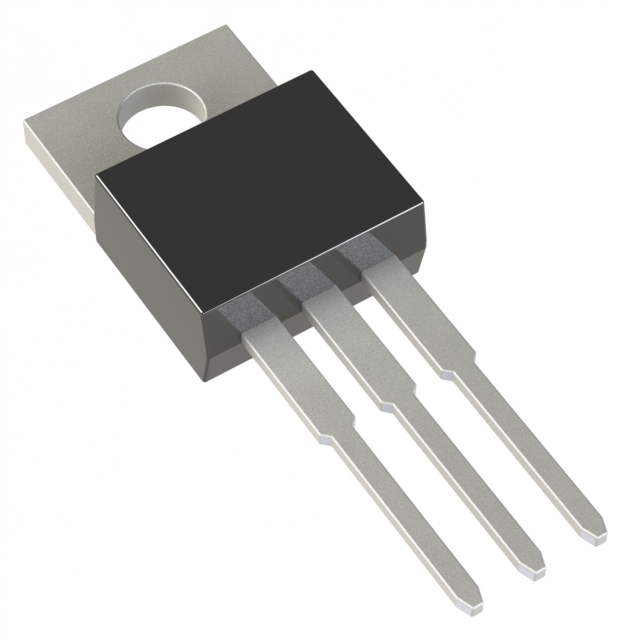
IRFBF20 N-Channel MOSFET 900V 1.7A TO-220AB Equivalent & Substitute Parts
Part Overview
The IRFBF20 is an N-Channel metal oxide semiconductor field-effect transistor (MOSFET) rated for 900V drain-to-source voltage with a continuous drain current of 1.7A at 25°C. This device is packaged in a through-hole TO-220AB configuration and is designed for high-voltage switching applications. The IRFBF20 is classified as obsolete, making identification of functionally equivalent substitute parts essential for ongoing design support, maintenance, and new production requirements. Equivalent devices must maintain compatibility across electrical performance parameters, thermal characteristics, and mechanical packaging standards.
Substiute Parts
Key Parameters
| Parameter | Value | Unit |
|---|---|---|
| Drain-to-Source Voltage (Vdss) | 900 | V |
| Continuous Drain Current (Id) @ 25°C | 1.7 | A (Tc) |
| On-State Resistance (Rds On) @ 1A, 10V | 8 | Ohm |
| Gate-Source Threshold Voltage (Vgs(th)) @ 250µA | 4 | V |
| Gate Charge (Qg) @ 10V | 38 | nC |
| Power Dissipation (Max) | 54 | W (Tc) |
| Operating Temperature Range | -55 to 150 | °C (TJ) |
| Mounting Type | Through Hole | — |
| Package / Case | TO-220-3 | — |
Substitute Part Grouping Explanation
Substitution of the IRFBF20 is determined by the following critical electrical and mechanical parameters:
Primary Substitution Criteria:
- Drain-to-Source Voltage (Vdss): Minimum 900V
- Continuous Drain Current (Id): Minimum 1.7A at 25°C
- On-State Resistance (Rds On): Maximum 8 Ohm at specified gate voltage
- Gate-Source Threshold Voltage (Vgs(th)): Within ±1V of 4V
- Package Type: TO-220-3 through-hole configuration
- Operating Temperature Range: -55°C to 150°C minimum
Substitution Logic: Parts are grouped into two categories based on voltage rating alignment:
- 900V Voltage Class Substitutes – Direct voltage equivalents maintaining the 900V Vdss specification
- 1000V Voltage Class Substitutes – Higher voltage rated devices that exceed the 900V requirement while maintaining compatible current and thermal characteristics
All substitute parts must maintain through-hole TO-220-3 packaging and support the full operating temperature range. Devices with improved electrical characteristics (lower Rds On, higher current rating, or higher power dissipation) are acceptable substitutes provided they do not introduce incompatibilities in the target application circuit.
Parameter Comparison
| Part Number | Manufacturer | Vdss (V) | Id @ 25°C (A) | Rds On (Ohm) | Vgs(th) (V) | Qg (nC) | Power Dissipation (W) | Package | Product Status |
|---|---|---|---|---|---|---|---|---|---|
| IRFBF20 | Vishay Siliconix | 900 | 1.7 | 8 | 4 | 38 | 54 | TO-220-3 | Obsolete |
| IRFBF20PBF | Vishay Siliconix | 900 | 1.7 | 8 | 4 | 38 | 54 | TO-220-3 | Active |
| FQP2N90 | onsemi | 900 | 2.2 | 7.2 | 5 | 15 | 85 | TO-220-3 | Obsolete |
| STP2NK90Z | STMicroelectronics | 900 | 2.1 | 6.5 | 4.5 | 27 | 70 | TO-220-3 | Active |
| STP3NK90Z | STMicroelectronics | 900 | 3 | 4.8 | 4.5 | 22.7 | 90 | TO-220-3 | Active |
| IXTP2N100 | IXYS | 1000 | 2 | 7 | 4.5 | 40 | 100 | TO-220-3 | Active |
| IXFP4N100Q | IXYS | 1000 | 4 | 3 | 5 | 39 | 150 | TO-220-3 | Not For New Designs |
Engineering Selection Recommendations
Primary Recommendation: IRFBF20PBF
The IRFBF20PBF is the direct functional equivalent of the IRFBF20, manufactured by Vishay Siliconix with identical electrical specifications. This part is currently in active production status and carries ROHS3 compliance certification, addressing the regulatory limitations of the obsolete IRFBF20. The IRFBF20PBF is supplied in tube packaging and maintains full parameter compatibility, making it the preferred substitution path for direct replacement applications.
Secondary Recommendations: 900V Voltage Class
For applications requiring enhanced performance margins within the 900V voltage class:
-
STP2NK90Z (STMicroelectronics): Active product status with improved on-state resistance (6.5 Ohm vs. 8 Ohm), reduced gate charge (27 nC vs. 38 nC), and higher power dissipation rating (70W vs. 54W). ROHS3 compliant. Suitable for designs requiring lower switching losses and improved thermal performance.
-
STP3NK90Z (STMicroelectronics): Active product status with significantly improved electrical characteristics including lower on-state resistance (4.8 Ohm), reduced gate charge (22.7 nC), and higher current rating (3A). Power dissipation rated at 90W. ROHS3 compliant. Recommended for applications where enhanced current handling and reduced conduction losses provide system-level benefits.
-
FQP2N90 (onsemi): Obsolete product status with improved current rating (2.2A) and power dissipation (85W). Lower on-state resistance (7.2 Ohm) and reduced gate charge (15 nC). Not recommended for new designs due to obsolescence status.
Alternative Recommendation: 1000V Voltage Class
- IXTP2N100 (IXYS): Active product status with 1000V Vdss rating, 2A continuous drain current, and 100W power dissipation. On-state resistance of 7 Ohm and gate charge of 40 nC provide performance comparable to the IRFBF20. ROHS3 compliant. Suitable for applications where higher voltage margin is beneficial or where circuit topology permits higher voltage operation.
Not Recommended: IXFP4N100Q
The IXFP4N100Q carries a "Not For New Designs" product status designation, making it unsuitable for new development or long-term production commitments despite superior electrical characteristics.
Frequently Asked Questions (FAQ)
Q: Can the IRFBF20PBF be used as a direct replacement for the IRFBF20?
A: Yes. The IRFBF20PBF is manufactured by the same supplier (Vishay Siliconix) with identical electrical specifications, gate charge, on-state resistance, and thermal ratings. The primary difference is product status (active vs. obsolete) and RoHS compliance (ROHS3 vs. non-compliant). Pin configuration and TO-220-3 packaging are identical.
Q: What is the difference between the 900V and 1000V substitute options?
A: The 900V substitutes (STP2NK90Z, STP3NK90Z, FQP2N90) maintain the exact voltage rating of the IRFBF20. The 1000V substitute (IXTP2N100) provides an additional 100V margin, which may be beneficial in circuits with voltage transients or where higher voltage headroom is required. Both voltage classes are electrically compatible with the IRFBF20 application circuit.
Q: Are all substitute parts RoHS compliant?
A: All recommended active-status substitutes (IRFBF20PBF, STP2NK90Z, STP3NK90Z, IXTP2N100) carry ROHS3 compliance certification. The obsolete IRFBF20 is non-compliant. The FQP2N90 is ROHS3 compliant but carries obsolete product status.
Q: How do gate charge differences affect circuit performance?
A: Gate charge (Qg) determines the energy required to switch the MOSFET on and off. Lower gate charge (STP3NK90Z at 22.7 nC, STP2NK90Z at 27 nC) reduces driver power dissipation and enables faster switching compared to the IRFBF20 (38 nC). Higher gate charge (IXTP2N100 at 40 nC) requires slightly more driver energy but remains within acceptable switching speed ranges for most high-voltage applications.
Q: What does "Not For New Designs" mean for the IXFP4N100Q?
A: This designation indicates the manufacturer does not recommend this part for new product development. While the part may remain available for legacy support, it should not be selected for new designs. The IXFP4N100Q is excluded from long-term availability guarantees and may be discontinued without notice.
Q: Can I use a substitute with higher current rating (e.g., STP3NK90Z at 3A vs. IRFBF20 at 1.7A)?
A: Yes. Higher current rating substitutes are acceptable provided the application circuit does not exceed the original IRFBF20 current specification. The higher rating provides additional safety margin and thermal headroom. On-state resistance and power dissipation characteristics must be evaluated to ensure thermal management remains adequate.
Q: Are there packaging differences between substitute parts?
A: All recommended substitutes use TO-220-3 through-hole packaging, maintaining mechanical and thermal interface compatibility. Supplier device package designations may vary (TO-220AB vs. TO-220) but refer to the same physical form factor. Pin assignments are identical across all substitutes.
Q: What is the significance of the Rds On specification?
A: On-state resistance (Rds On) determines conduction losses when the MOSFET is in the on-state. Lower Rds On values reduce power dissipation and heat generation. The IRFBF20 specifies 8 Ohm at 1A, 10V. Substitutes with lower Rds On (STP3NK90Z at 4.8 Ohm, STP2NK90Z at 6.5 Ohm) reduce conduction losses, while those with comparable or slightly higher values (IXTP2N100 at 7 Ohm) maintain equivalent thermal performance.
Q: Is the operating temperature range identical across all substitutes?
A: Yes. All substitute parts maintain the -55°C to 150°C operating temperature range (TJ), ensuring compatibility with the IRFBF20 thermal specifications and application environment requirements.
Alternative Parts

SJ6012L2TP
Littelfuse Inc.
6 Alternative Parts

JMK107BBJ476MA-RE
Taiyo Yuden
10 Alternative Parts

GMK107BBJ475MA-T
Taiyo Yuden
5 Alternative Parts
SJ6020N2ARP
Littelfuse Inc.
3 Alternative Parts
SJ6025R2ATP
Littelfuse Inc.
4 Alternative Parts

2474-05L
API Delevan Inc.
1 Alternative Parts

4590R-684K
API Delevan Inc.
1 Alternative Parts

CM6560R-334
API Delevan Inc.
1 Alternative Parts

CM6460-104
API Delevan Inc.
1 Alternative Parts

5526-12
API Delevan Inc.
1 Alternative Parts