



Request Quote
(Ships tomorrow)
HTSW-123-14-L-S Equivalent & Substitute Parts
Part Overview
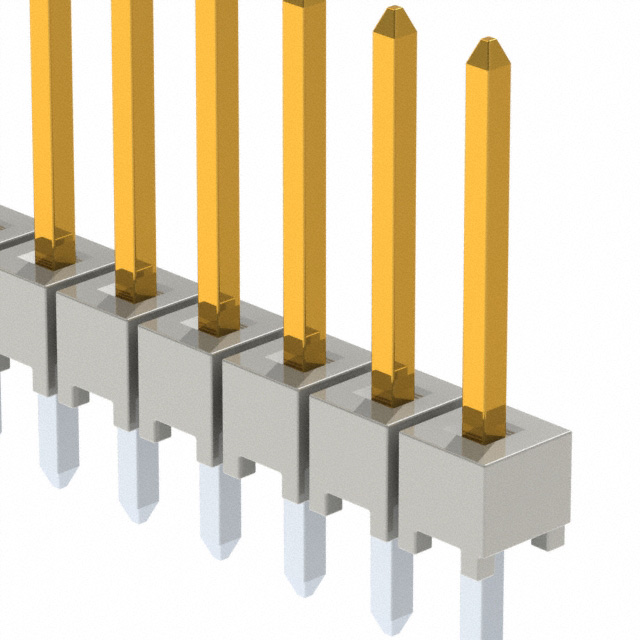
The HTSW-123-14-L-S is a rectangular connector header manufactured by Samtec Inc., designed for through-hole mounting applications requiring a 23-position, single-row configuration with 0.100" (2.54mm) pitch. This connector is classified as an active product and serves board-to-board or cable interconnection applications. Substitute parts are identified to provide alternative sourcing options when the primary part is unavailable or when inventory constraints require component flexibility.
Substiute Parts
Key Parameters
| Parameter | Value |
|---|---|
| Connector Type | Header |
| Contact Type | Male Pin |
| Pitch - Mating | 0.100" (2.54mm) |
| Number of Positions | 23 |
| Number of Rows | 1 |
| Mounting Type | Through Hole |
| Termination | Solder |
| Fastening Type | Push-Pull |
| Contact Finish - Mating | Gold |
| Insulation Material | Liquid Crystal Polymer (LCP) |
| Material Flammability Rating | UL94 V-0 |
| RoHS Status | ROHS3 Compliant |
Substitute Part Grouping Explanation
Substitution eligibility for the HTSW-123-14-L-S is determined by the following critical parameters:
- Pitch and Position Count: Substitute parts must maintain 0.100" (2.54mm) mating pitch and 23-position configuration to ensure mechanical and electrical compatibility with mating connectors and PCB layouts.
- Connector Type and Contact Configuration: Header connectors with male pin contacts are required for board-to-board or cable applications.
- Mounting and Termination: Through-hole mounting with solder termination is mandatory for PCB assembly compatibility.
- Contact Finish: Gold-plated mating contacts are required to maintain electrical performance and reliability standards.
- Insulation Material: Liquid Crystal Polymer (LCP) insulation ensures thermal and mechanical stability across the operating temperature range.
- Flammability Compliance: UL94 V-0 rating is a baseline requirement for safety-critical applications.
- RoHS Compliance: Parts must meet RoHS or ROHS3 compliance standards for regulatory alignment.
The substitute part 7-146276-3 (TE Connectivity AMP Connectors) satisfies all critical substitution criteria and is classified as a manufacturer-recommended equivalent.
Parameter Comparison
| Parameter | HTSW-123-14-L-S (Samtec) | 7-146276-3 (TE Connectivity) |
|---|---|---|
| Manufacturer | Samtec Inc. | TE Connectivity AMP Connectors |
| Series | HTSW | AMPMODU Mod II |
| Connector Type | Header | Header, Breakaway |
| Contact Type | Male Pin | Male Pin |
| Pitch - Mating | 0.100" (2.54mm) | 0.100" (2.54mm) |
| Number of Positions | 23 | 23 |
| Number of Rows | 1 | 1 |
| Mounting Type | Through Hole | Through Hole |
| Termination | Solder | Solder |
| Fastening Type | Push-Pull | Push-Pull |
| Contact Length - Mating | 0.320" (8.13mm) | 0.318" (8.08mm) |
| Contact Length - Post | 0.110" (2.79mm) | 0.125" (3.18mm) |
| Overall Contact Length | 0.530" (13.46mm) | 0.533" (14.65mm) |
| Insulation Height | 0.100" (2.54mm) | 0.090" (2.29mm) |
| Contact Shape | Square | Square |
| Contact Finish - Mating | Gold | Gold |
| Contact Finish Thickness - Mating | 10.0µin (0.25µm) | 15.0µin (0.38µm) |
| Contact Finish - Post | Tin | Tin |
| Contact Material | Phosphor Bronze | Copper Alloy |
| Insulation Material | Liquid Crystal Polymer (LCP) | Liquid Crystal Polymer (LCP) |
| Operating Temperature | -55°C ~ 125°C | -65°C ~ 105°C |
| Material Flammability Rating | UL94 V-0 | UL94 V-0 |
| RoHS Status | ROHS3 Compliant | RoHS Compliant |
| Product Status | Active | Active |
Engineering Selection Recommendations
Both the HTSW-123-14-L-S and 7-146276-3 are active products with UL94 V-0 flammability ratings and RoHS compliance certifications. The primary differences are contact material composition (Phosphor Bronze versus Copper Alloy), contact finish thickness on mating surfaces, and operating temperature ranges. The HTSW-123-14-L-S supports a wider upper operating temperature limit of 125°C compared to 105°C for the TE Connectivity equivalent. The 7-146276-3 features a breakaway connector option and slightly higher contact finish thickness on mating surfaces (15.0µin versus 10.0µin). Selection between these parts should be based on specific application temperature requirements and connector configuration needs.
Frequently Asked Questions (FAQ)
Q: Can the 7-146276-3 be used as a direct replacement for the HTSW-123-14-L-S?
A: Yes, the 7-146276-3 is a manufacturer-recommended substitute. Both connectors share identical pitch (0.100"), position count (23), mounting type (through-hole), and termination method (solder). Mechanical and electrical compatibility is maintained for standard board-to-board and cable applications.
Q: What are the key differences between these two connectors?
A: The primary differences are contact material (Phosphor Bronze versus Copper Alloy), mating contact finish thickness (10.0µin versus 15.0µin), insulation height (0.100" versus 0.090"), and operating temperature range (HTSW-123-14-L-S: -55°C to 125°C; 7-146276-3: -65°C to 105°C). The TE Connectivity part offers a breakaway connector option.
Q: Are there temperature limitations when substituting these parts?
A: Yes. If your application requires sustained operation above 105°C, the HTSW-123-14-L-S is the appropriate choice. For applications operating below 105°C, both parts are suitable.
Q: Do both connectors meet the same compliance standards?
A: Both parts are UL94 V-0 rated and RoHS compliant. The HTSW-123-14-L-S carries ROHS3 compliance, while the 7-146276-3 carries standard RoHS compliance. Both meet regulatory requirements for their respective product lines.
Q: What is the significance of contact finish thickness differences?
A: Contact finish thickness affects durability and wear resistance during mating cycles. The 7-146276-3 features a thicker gold plating (15.0µin) on mating contacts compared to the HTSW-123-14-L-S (10.0µin), providing enhanced protection in high-cycle mating applications.
Q: Are the insulation height differences critical for PCB layout?
A: Insulation height differences (0.100" versus 0.090") are minor and typically do not impact standard PCB designs. However, applications with tight vertical clearance constraints should verify compatibility with the specific connector variant selected.
Alternative Parts

SJ6012L2TP
Littelfuse Inc.
6 Alternative Parts

JMK107BBJ476MA-RE
Taiyo Yuden
10 Alternative Parts

GMK107BBJ475MA-T
Taiyo Yuden
5 Alternative Parts
SJ6020N2ARP
Littelfuse Inc.
3 Alternative Parts
SJ6025R2ATP
Littelfuse Inc.
4 Alternative Parts

2474-05L
API Delevan Inc.
1 Alternative Parts

4590R-684K
API Delevan Inc.
1 Alternative Parts

CM6560R-334
API Delevan Inc.
1 Alternative Parts

CM6460-104
API Delevan Inc.
1 Alternative Parts

5526-12
API Delevan Inc.
1 Alternative Parts