


Request Quote
(Ships tomorrow)
FDS3912 Equivalent & Substitute Parts
Part Overview
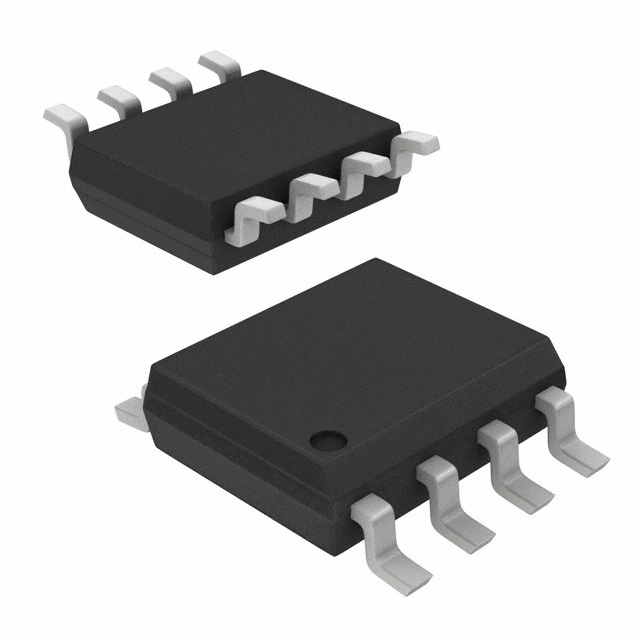
The FDS3912 is a dual N-channel MOSFET array manufactured by onsemi, designed for surface mount applications in the 8-SOIC package. This device features a 100V drain-to-source voltage rating with 3A continuous drain current capability and operates across a temperature range of -55°C to 175°C. The FDS3912 is classified as obsolete, necessitating identification of active equivalent parts to maintain design continuity and ensure long-term component availability for new production and field replacements.
Substiute Parts
Key Parameters
| Parameter | Value | Unit |
|---|---|---|
| Drain to Source Voltage (Vdss) | 100 | V |
| Current - Continuous Drain (Id) @ 25°C | 3 | A |
| Rds On (Max) @ Id, Vgs | 125 mOhm @ 3A, 10V | mOhm |
| Vgs(th) (Max) @ Id | 4 | V @ 250µA |
| Gate Charge (Qg) (Max) @ Vgs | 20 | nC @ 10V |
| Input Capacitance (Ciss) (Max) @ Vds | 632 | pF @ 50V |
| Power - Max | 900 | mW |
| Operating Temperature Range | -55 to 175 | °C (TJ) |
| Package / Case | 8-SOIC (0.154", 3.90mm Width) | - |
| Configuration | 2 N-Channel (Dual) | - |
Substitute Part Grouping Explanation
Substitution of the FDS3912 is determined by the following critical electrical and mechanical parameters:
Electrical Compatibility Criteria:
- Drain to Source Voltage (Vdss): Must equal or exceed 100V
- Configuration: Must maintain 2 N-Channel (Dual) topology
- Package / Case: Must be 8-SOIC form factor with identical 0.154" (3.90mm) width
- Gate Threshold Voltage (Vgs(th)): Must be compatible at 4V @ 250µA specification
- Operating Temperature Range: Must support minimum -55°C to 150°C operation
Current and Power Considerations:
- Continuous Drain Current (Id): Substitute must support minimum 2.7A; the FDS3912 specification of 3A establishes the baseline requirement
- Rds On: Lower on-resistance values are acceptable as they represent improved performance
- Power Dissipation: Substitute must handle thermal requirements within specified operating range
The FDS89161 meets all substitution criteria as an active product within the onsemi PowerTrench® series, offering equivalent voltage and package specifications with compatible gate characteristics.
Parameter Comparison
| Parameter | FDS3912 (Main Part) | FDS89161 (Substitute) | Compatibility |
|---|---|---|---|
| Manufacturer | onsemi | onsemi | Same |
| Category | Transistors, FETs, MOSFETs | Transistors, FETs, MOSFETs | Same |
| Configuration | 2 N-Channel (Dual) | 2 N-Channel (Dual) | Same |
| Drain to Source Voltage (Vdss) | 100V | 100V | Equivalent |
| Current - Continuous Drain (Id) @ 25°C | 3A | 2.7A | Substitute rated lower; acceptable for applications ≤2.7A |
| Rds On (Max) @ Id, Vgs | 125 mOhm @ 3A, 10V | 105 mOhm @ 2.7A, 10V | Substitute has lower on-resistance |
| Vgs(th) (Max) @ Id | 4V @ 250µA | 4V @ 250µA | Equivalent |
| Gate Charge (Qg) (Max) @ Vgs | 20 nC @ 10V | 4.1 nC @ 10V | Substitute has significantly lower gate charge |
| Input Capacitance (Ciss) (Max) @ Vds | 632 pF @ 50V | 210 pF @ 50V | Substitute has lower input capacitance |
| Power - Max | 900 mW | 1.6 W | Substitute rated higher; improved thermal capability |
| Operating Temperature Range | -55°C to 175°C (TJ) | -55°C to 150°C (TJ) | Substitute range is narrower by 25°C at upper limit |
| Package / Case | 8-SOIC (0.154", 3.90mm Width) | 8-SOIC (0.154", 3.90mm Width) | Identical |
| Mounting Type | Surface Mount | Surface Mount | Same |
| Product Status | Obsolete | Active | Substitute is currently manufactured |
| Series | PowerTrench® | PowerTrench® | Same technology platform |
Engineering Selection Recommendations
FDS89161 as Primary Substitute:
The FDS89161 is the recommended substitute for the obsolete FDS3912 based on the following engineering factors:
-
Product Status and Availability: The FDS89161 maintains active product status with current manufacturing and distribution, ensuring long-term component availability. The FDS3912 is obsolete and subject to discontinuation of supply.
-
Electrical Equivalence: Both devices share identical 100V Vdss rating, dual N-channel configuration, and 4V gate threshold voltage specification. The 8-SOIC package footprint is identical, enabling direct PCB layout compatibility without redesign.
-
Performance Characteristics: The FDS89161 demonstrates improved electrical performance with lower on-resistance (105 mOhm versus 125 mOhm) and significantly reduced gate charge (4.1 nC versus 20 nC), resulting in faster switching characteristics and reduced driver power requirements.
-
Thermal and Power Handling: The FDS89161 is rated for 1.6W maximum power dissipation compared to 900mW for the FDS3912, providing enhanced thermal margin in applications operating near power limits.
-
Compliance and Certifications: The FDS89161 carries RoHS3 compliance certification, meeting current environmental and regulatory requirements. Both parts maintain REACH Unaffected status and EAR99 export classification.
Application Constraints:
Substitution of FDS3912 with FDS89161 is valid for applications requiring continuous drain current of 2.7A or less. Applications requiring the full 3A continuous drain current rating of the FDS3912 must evaluate alternative parts or confirm that peak current demands do not exceed the FDS89161 specification.
The FDS89161 maximum operating junction temperature of 150°C is 25°C lower than the FDS3912 specification of 175°C. Applications operating in high-temperature environments above 150°C require alternative component selection.
Frequently Asked Questions (FAQ)
Q: Can the FDS89161 directly replace the FDS3912 in existing designs?
A: Direct replacement is possible for applications operating within the FDS89161 electrical specifications. The identical 8-SOIC package and matching pin configuration enable direct PCB substitution without layout modification. Verify that application current requirements do not exceed 2.7A continuous drain current and that maximum operating temperature does not exceed 150°C junction temperature.
Q: What is the primary difference in current rating between these parts?
A: The FDS3912 is rated for 3A continuous drain current at 25°C, while the FDS89161 is rated for 2.7A. This 0.3A difference represents approximately 10% lower current capacity. Applications designed for the full 3A specification must confirm that actual operating current remains below 2.7A or select alternative components.
Q: How do the gate charge specifications affect circuit design?
A: The FDS89161 exhibits significantly lower gate charge (4.1 nC versus 20 nC), requiring less charge transfer from the gate driver circuit. This reduction improves switching speed and reduces power dissipation in the gate drive circuit. Existing gate driver designs will function with the FDS89161 without modification, with the benefit of reduced driver current requirements.
Q: Are there package compatibility concerns?
A: Both the FDS3912 and FDS89161 utilize the 8-SOIC package with identical 0.154" (3.90mm) width specification. Pin assignments and footprint dimensions are identical, eliminating package-related compatibility issues. No PCB redesign is required for package substitution.
Q: What is the significance of the operating temperature range difference?
A: The FDS3912 operates to 175°C junction temperature, while the FDS89161 maximum is 150°C. This 25°C difference is significant only for applications operating in high-temperature environments. Standard industrial applications operating below 150°C are unaffected by this specification difference.
Q: Why is the FDS3912 listed as obsolete?
A: Obsolete status indicates that onsemi has discontinued manufacturing and distribution of the FDS3912. The FDS89161 represents the active product continuation within the PowerTrench® series, offering improved performance characteristics and current manufacturing support.
Q: Is the FDS89161 RoHS compliant?
A: Yes, the FDS89161 carries RoHS3 compliance certification, meeting current environmental regulations for hazardous substance restrictions. The FDS3912 does not specify RoHS status in available documentation.
Q: Can the lower on-resistance of the FDS89161 cause circuit compatibility issues?
A: Lower on-resistance (105 mOhm versus 125 mOhm) represents improved performance and does not create compatibility issues. Reduced on-resistance decreases power dissipation and heat generation, providing design margin rather than introducing problems. Existing circuit designs will function identically or with improved thermal performance.
Alternative Parts

SJ6012L2TP
Littelfuse Inc.
6 Alternative Parts

JMK107BBJ476MA-RE
Taiyo Yuden
10 Alternative Parts

GMK107BBJ475MA-T
Taiyo Yuden
5 Alternative Parts
SJ6020N2ARP
Littelfuse Inc.
3 Alternative Parts
SJ6025R2ATP
Littelfuse Inc.
4 Alternative Parts

2474-05L
API Delevan Inc.
1 Alternative Parts

4590R-684K
API Delevan Inc.
1 Alternative Parts

CM6560R-334
API Delevan Inc.
1 Alternative Parts

CM6460-104
API Delevan Inc.
1 Alternative Parts

5526-12
API Delevan Inc.
1 Alternative Parts