


Request Quote
(Ships tomorrow)
FDC2512 Equivalent & Substitute Parts
Part Overview
The FDC2512 is an N-Channel MOSFET manufactured by onsemi, rated for 150V drain-to-source voltage with 1.4A continuous drain current at 25°C. The device is housed in a SuperSOT™-6 package and is designed for surface mount applications. The FDC2512 is classified as obsolete, necessitating identification of active equivalent parts to maintain design continuity and ensure long-term component availability for new production and field replacements.
Substiute Parts
Key Parameters
| Parameter | Value | Unit |
|---|---|---|
| FET Type | N-Channel | — |
| Drain to Source Voltage (Vdss) | 150 | V |
| Current - Continuous Drain (Id) @ 25°C | 1.4 | A |
| Rds On (Max) @ Id, Vgs | 425 | mOhm @ 1.4A, 10V |
| Vgs(th) (Max) @ Id | 4 | V @ 250µA |
| Gate Charge (Qg) (Max) @ Vgs | 11 | nC @ 10V |
| Vgs (Max) | ±20 | V |
| Input Capacitance (Ciss) (Max) @ Vds | 344 | pF @ 75V |
| Power Dissipation (Max) | 1.6 | W (Ta) |
| Operating Temperature Range | -55 to 150 | °C (TJ) |
| Mounting Type | Surface Mount | — |
| Package / Case | SOT-23-6 Thin, TSOT-23-6 | — |
| RoHS Status | ROHS3 Compliant | — |
| Moisture Sensitivity Level (MSL) | 1 (Unlimited) | — |
Substitute Part Grouping Explanation
Substitution of the FDC2512 is determined by strict equivalence across the following critical electrical and mechanical parameters:
Electrical Equivalence Criteria:
- FET Type: N-Channel topology
- Drain to Source Voltage (Vdss): 150V minimum rating
- Continuous Drain Current (Id): 1.4A or greater at 25°C
- Gate-Source Voltage (Vgs): ±20V maximum rating
- Operating Temperature Range: -55°C to 150°C (TJ)
Mechanical Equivalence Criteria:
- Mounting Type: Surface Mount
- Package Classification: SOT-23-6 family (includes SuperSOT™-6 and SOT-26 variants)
Compliance Criteria:
- RoHS3 Compliance
- Moisture Sensitivity Level (MSL): 1 (Unlimited)
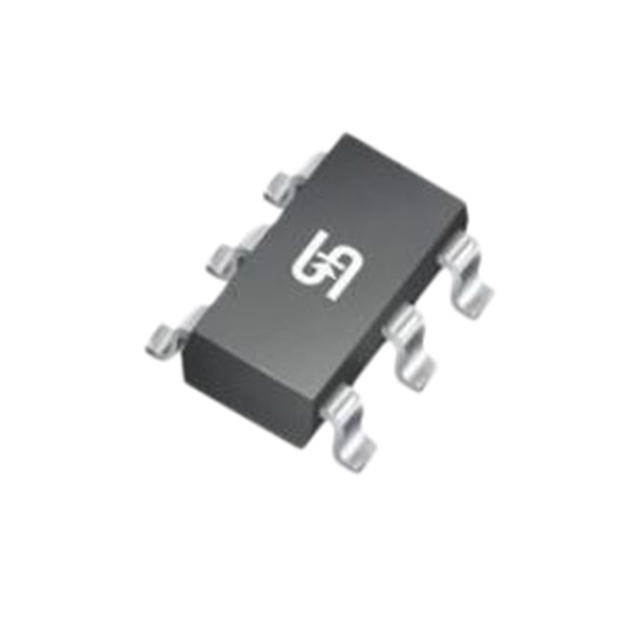
The TSM4800N15CX6 RFG meets all substitution criteria. Both devices share identical voltage and current ratings, compatible package footprints within the SOT-23-6 family, and equivalent environmental compliance certifications. The substitute part is classified as active, ensuring ongoing availability.
Parameter Comparison
| Parameter | FDC2512 (onsemi) | TSM4800N15CX6 RFG (Taiwan Semiconductor) | Unit |
|---|---|---|---|
| FET Type | N-Channel | N-Channel | — |
| Drain to Source Voltage (Vdss) | 150 | 150 | V |
| Current - Continuous Drain (Id) @ 25°C | 1.4 (Ta) | 1.4 (Tc) | A |
| Rds On (Max) @ Id, Vgs | 425 @ 1.4A, 10V | 480 @ 1.1A, 10V | mOhm |
| Vgs(th) (Max) @ Id | 4 @ 250µA | 3.5 @ 250µA | V |
| Gate Charge (Qg) (Max) @ Vgs | 11 @ 10V | 8 @ 10V | nC |
| Vgs (Max) | ±20 | ±20 | V |
| Input Capacitance (Ciss) (Max) @ Vds | 344 @ 75V | 332 @ 10V | pF |
| Power Dissipation (Max) | 1.6 (Ta) | 2.1 (Tc) | W |
| Operating Temperature Range | -55 to 150 | -55 to 150 | °C (TJ) |
| Mounting Type | Surface Mount | Surface Mount | — |
| Package / Case | SOT-23-6 Thin, TSOT-23-6 | SOT-23-6 | — |
| RoHS Status | ROHS3 Compliant | ROHS3 Compliant | — |
| Moisture Sensitivity Level (MSL) | 1 (Unlimited) | 1 (Unlimited) | — |
| Product Status | Obsolete | Active | — |
Engineering Selection Recommendations
Primary Substitute: TSM4800N15CX6 RFG
The TSM4800N15CX6 RFG is the qualified equivalent for the FDC2512. Selection of this substitute is based on the following engineering factors:
Electrical Compatibility: Both devices are rated for 150V Vdss and 1.4A continuous drain current. Gate-source voltage ratings are identical at ±20V. Operating temperature ranges are equivalent (-55°C to 150°C TJ). The substitute exhibits lower gate charge (8 nC versus 11 nC) and lower threshold voltage (3.5V versus 4V), which represent favorable performance characteristics for switching applications.
Mechanical Compatibility: Both devices employ surface mount technology with SOT-23-6 family packaging. The SuperSOT™-6 package of the FDC2512 and the SOT-26 package of the TSM4800N15CX6 RFG share identical footprints and pin configurations, enabling direct PCB layout substitution without redesign.
Compliance and Availability: The TSM4800N15CX6 RFG holds active product status with 3,793 units in stock, ensuring supply continuity. Both devices are ROHS3 compliant and carry MSL 1 (Unlimited) moisture sensitivity ratings, meeting identical environmental and regulatory requirements.
Product Status Transition: The FDC2512 is classified as obsolete. The TSM4800N15CX6 RFG is active, providing a direct path for design migration and long-term component sourcing.
Frequently Asked Questions (FAQ)
Q: Can the TSM4800N15CX6 RFG be used as a direct replacement for the FDC2512 in existing designs?
A: Yes. Both devices share identical electrical ratings (150V Vdss, 1.4A Id, ±20V Vgs) and compatible SOT-23-6 family packaging. No circuit modifications or PCB redesign are required for substitution.
Q: What are the differences in on-resistance between the FDC2512 and TSM4800N15CX6 RFG?
A: The FDC2512 specifies 425 mOhm maximum at 1.4A and 10V gate-source voltage. The TSM4800N15CX6 RFG specifies 480 mOhm maximum at 1.1A and 10V gate-source voltage. The substitute exhibits slightly higher on-resistance; thermal design calculations should account for this difference in power dissipation.
Q: Are the package footprints identical between SuperSOT™-6 and SOT-26?
A: Both packages are classified within the SOT-23-6 family and share identical pin configurations and footprints. Direct PCB substitution is possible without layout modifications.
Q: What is the difference in power dissipation ratings?
A: The FDC2512 is rated for 1.6W (Ta) maximum power dissipation. The TSM4800N15CX6 RFG is rated for 2.1W (Tc) maximum power dissipation. The substitute provides higher thermal capacity, which is advantageous for thermal margin in applications.
Q: Are both devices RoHS3 compliant?
A: Yes. Both the FDC2512 and TSM4800N15CX6 RFG are ROHS3 compliant and carry MSL 1 (Unlimited) moisture sensitivity ratings.
Q: Why is the FDC2512 classified as obsolete?
A: The FDC2512 has reached end-of-life status with onsemi. The TSM4800N15CX6 RFG is an active equivalent that provides functional and mechanical compatibility for new designs and field replacements.
Q: What is the gate charge difference, and does it affect circuit performance?
A: The FDC2512 specifies 11 nC maximum gate charge at 10V. The TSM4800N15CX6 RFG specifies 8 nC maximum gate charge at 10V. Lower gate charge in the substitute results in faster switching transitions and reduced gate drive power requirements, which are beneficial characteristics for most switching applications.
Q: Can the TSM4800N15CX6 RFG be used in high-temperature applications?
A: Yes. Both devices are rated for operating temperatures from -55°C to 150°C (TJ), making them suitable for equivalent high-temperature applications.
Alternative Parts

SJ6012L2TP
Littelfuse Inc.
6 Alternative Parts

JMK107BBJ476MA-RE
Taiyo Yuden
10 Alternative Parts

GMK107BBJ475MA-T
Taiyo Yuden
5 Alternative Parts
SJ6020N2ARP
Littelfuse Inc.
3 Alternative Parts
SJ6025R2ATP
Littelfuse Inc.
4 Alternative Parts

2474-05L
API Delevan Inc.
1 Alternative Parts

4590R-684K
API Delevan Inc.
1 Alternative Parts

CM6560R-334
API Delevan Inc.
1 Alternative Parts

CM6460-104
API Delevan Inc.
1 Alternative Parts

5526-12
API Delevan Inc.
1 Alternative Parts