



Request Quote
(Ships tomorrow)
Equivalent & Substitute Parts for E2E-X10E1
Part Overview
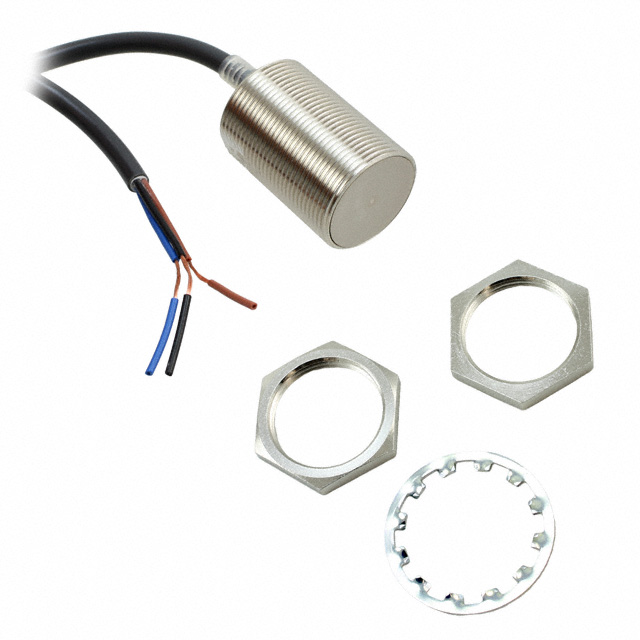
The E2E-X10E1 is an inductive proximity sensor manufactured by Omron Automation and Safety, designed for industrial automation applications requiring non-contact object detection. This cylindrical M30-threaded sensor operates with NPN normally-open output configuration and provides a 10mm sensing distance. The product is currently classified as obsolete, making identification of compatible substitute components essential for system maintenance, repair, and new installations where legacy compatibility is required.
Substiute Parts
Key Parameters
| Parameter | Value |
|---|---|
| Manufacturer Part Number | E2E-X10E1 |
| Manufacturer | Omron Automation and Safety |
| Sensor Type | Inductive |
| Sensing Distance | 0.394" (10mm) |
| Output Type | NPN-NO, 3-Wire |
| Response Frequency | 400Hz |
| Voltage Supply | 10V ~ 40V |
| Operating Temperature | -40°C ~ 85°C |
| Ingress Protection | IP67 |
| Package / Case | Cylinder, Threaded - M30 |
| Termination Style | Cable Leads |
| Material - Body | Nickel-Plated Brass |
| Product Status | Obsolete |
| RoHS Status | RoHS Compliant |
Substitute Part Grouping Explanation
Substitution of the E2E-X10E1 is determined by strict alignment of the following critical parameters:
- Sensor Type: Must be inductive to maintain detection principle compatibility
- Sensing Distance: Must be 0.394" (10mm) to preserve detection range in existing installations
- Output Configuration: Must be NPN-NO, 3-Wire to ensure signal compatibility with existing control circuits
- Response Frequency: Must be 400Hz to maintain switching speed performance
- Mechanical Form Factor: Must be Cylinder, Threaded - M30 for direct mounting compatibility
- Termination: Must be Cable Leads for wiring integration
- Environmental Ratings: Must maintain IP67 minimum ingress protection and -40°C ~ 85°C operating temperature range
- Body Material: Must be Nickel-Plated Brass for corrosion resistance equivalence
The E2E-X10C130 2M meets all substitution criteria as an active-status product from the E2E NEXT series, providing direct functional and mechanical replacement capability.
Parameter Comparison
| Parameter | E2E-X10E1 (Main Part) | E2E-X10C130 2M (Substitute) | Compatibility |
|---|---|---|---|
| Sensor Type | Inductive | Inductive | Match |
| Sensing Distance | 0.394" (10mm) | 0.394" (10mm) | Match |
| Output Type | NPN-NO, 3-Wire | NPN-NO, 3-Wire | Match |
| Response Frequency | 400Hz | 400Hz | Match |
| Voltage Supply | 10V ~ 40V | 10V ~ 30V | Substitute range is subset; compatible within 10V ~ 30V |
| Operating Temperature | -40°C ~ 85°C | -40°C ~ 85°C | Match |
| Ingress Protection | IP67 | IP67, IP69K | Substitute exceeds minimum requirement |
| Package / Case | Cylinder, Threaded - M30 | Cylinder, Threaded - M30 | Match |
| Termination Style | Cable Leads | Cable Leads | Match |
| Material - Body | Nickel-Plated Brass | Nickel-Plated Brass | Match |
| Product Status | Obsolete | Active | Substitute is current production |
| RoHS Status | RoHS Compliant | RoHS Compliant | Match |
Engineering Selection Recommendations
The E2E-X10C130 2M is the direct substitute for the obsolete E2E-X10E1. Selection is based on the following engineering criteria:
Functional Equivalence: All critical sensor parameters—inductive detection principle, 10mm sensing distance, NPN-NO output, 400Hz response frequency, and M30 mechanical interface—are identical between the main part and substitute.
Supply Voltage Consideration: The substitute operates within a narrower voltage range (10V ~ 30V) compared to the main part (10V ~ 40V). In applications where supply voltage exceeds 30V, the E2E-X10E1 specifications must be verified against system requirements before substitution.
Enhanced Environmental Protection: The E2E-X10C130 2M provides IP69K rating in addition to IP67, offering superior ingress protection suitable for high-pressure wash and harsh industrial environments.
Product Status and Compliance: The E2E-X10C130 2M is active production status with current RoHS compliance certification, ensuring long-term availability and regulatory alignment for new installations and system upgrades.
Series Advancement: The substitute belongs to the E2E NEXT series, representing the current generation of Omron inductive proximity sensors while maintaining backward compatibility with legacy E2E series installations.
Frequently Asked Questions (FAQ)
Q: Can the E2E-X10C130 2M directly replace the E2E-X10E1 in existing installations?
A: Yes, the E2E-X10C130 2M provides direct mechanical and functional replacement. Both sensors share identical M30 threaded mounting, cable lead termination, NPN-NO output configuration, and 10mm sensing distance. No circuit modifications are required for substitution within the specified voltage range of 10V ~ 30V.
Q: What is the voltage supply difference between these two sensors?
A: The E2E-X10E1 operates at 10V ~ 40V, while the E2E-X10C130 2M operates at 10V ~ 30V. If your system supplies voltage between 30V and 40V, verify that the substitute can operate at your specific supply voltage before implementation.
Q: Why is the E2E-X10E1 classified as obsolete?
A: The E2E-X10E1 has been superseded by newer models in the E2E NEXT series. The E2E-X10C130 2M represents the current production equivalent with enhanced environmental protection ratings and active manufacturer support.
Q: Are there any mechanical compatibility issues when substituting these sensors?
A: No. Both sensors use identical M30 threaded cylindrical form factors, cable lead termination, and nickel-plated brass body construction. Direct mounting replacement is possible without mechanical modification.
Q: Does the E2E-X10C130 2M provide better environmental protection?
A: Yes. While the E2E-X10E1 provides IP67 protection, the E2E-X10C130 2M provides both IP67 and IP69K ratings, offering enhanced protection against high-pressure water jets and harsh industrial wash environments.
Q: Are both sensors RoHS compliant?
A: Yes. Both the E2E-X10E1 and E2E-X10C130 2M are RoHS compliant, meeting current environmental and regulatory requirements for electronic component manufacturing and use.
Q: What is the response frequency specification, and is it identical between both sensors?
A: Both sensors operate at 400Hz response frequency, ensuring identical switching speed performance in control applications. This parameter is critical for real-time detection applications and is fully matched between the main part and substitute.
Alternative Parts

SJ6012L2TP
Littelfuse Inc.
6 Alternative Parts

JMK107BBJ476MA-RE
Taiyo Yuden
10 Alternative Parts

GMK107BBJ475MA-T
Taiyo Yuden
5 Alternative Parts
SJ6020N2ARP
Littelfuse Inc.
3 Alternative Parts
SJ6025R2ATP
Littelfuse Inc.
4 Alternative Parts

2474-05L
API Delevan Inc.
1 Alternative Parts

4590R-684K
API Delevan Inc.
1 Alternative Parts

CM6560R-334
API Delevan Inc.
1 Alternative Parts

CM6460-104
API Delevan Inc.
1 Alternative Parts

5526-12
API Delevan Inc.
1 Alternative Parts