


Request Quote
(Ships tomorrow)
DTC123JM-TP Equivalent & Substitute Parts
Part Overview
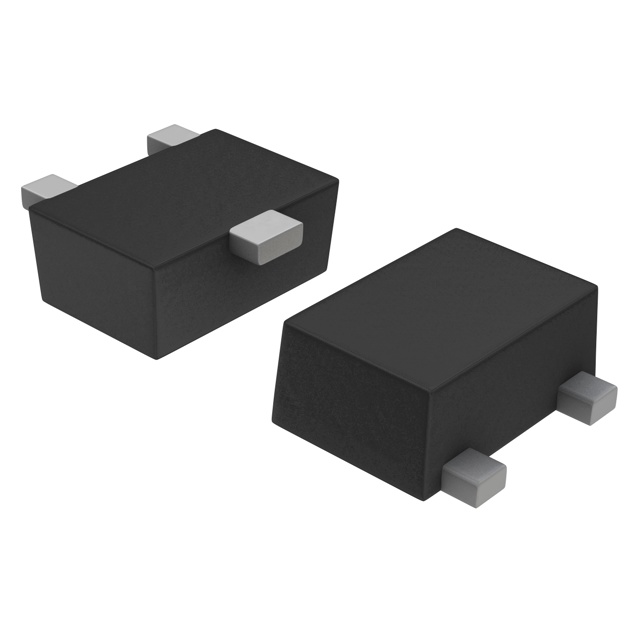
The DTC123JM-TP is an active pre-biased NPN bipolar junction transistor (BJT) manufactured by Micro Commercial Co, designed for surface mount applications in the SOT-723 package. This component operates at a maximum collector-emitter voltage of 50 V with a maximum collector current of 100 mA and a transition frequency of 250 MHz. The device is suitable for general-purpose switching and amplification applications requiring integrated base bias resistors.
Substitute parts are identified to provide design flexibility when the primary part becomes unavailable or when inventory constraints require alternative sourcing from qualified manufacturers. All substitute parts maintain electrical and mechanical compatibility within the specified parameter ranges.
Substiute Parts
Key Parameters
| Parameter | Value | Unit |
|---|---|---|
| Transistor Type | NPN - Pre-Biased | — |
| Voltage - Collector Emitter Breakdown (Max) | 50 | V |
| Current - Collector (Ic) (Max) | 100 | mA |
| Frequency - Transition | 250 | MHz |
| Power - Max | 100 | mW |
| Package / Case | SOT-723 | — |
| Mounting Type | Surface Mount | — |
| RoHS Status | ROHS3 Compliant | — |
| Moisture Sensitivity Level (MSL) | 1 (Unlimited) | — |
Substitute Part Grouping Explanation
Substitute parts for the DTC123JM-TP are qualified based on the following critical parameters:
Electrical Compatibility Criteria:
- Transistor type: NPN - Pre-Biased configuration
- Maximum collector-emitter breakdown voltage: 50 V or greater
- Maximum collector current: 100 mA or greater
- Transition frequency: 250 MHz or greater
- Maximum power dissipation: 100 mW or greater
Mechanical Compatibility Criteria:
- Package type: SOT-723 surface mount
- Mounting configuration: Surface mount technology (SMT)
Compliance Criteria:
- RoHS3 compliance status
- Moisture sensitivity level: MSL 1 or equivalent
- Active product status
The DTC123JM3T5G from onsemi meets all substitution criteria, maintaining identical electrical ratings for the primary switching parameters while offering equivalent or superior performance characteristics in the same physical package.
Parameter Comparison
| Parameter | DTC123JM-TP (Micro Commercial Co) | DTC123JM3T5G (onsemi) | Unit |
|---|---|---|---|
| Transistor Type | NPN - Pre-Biased | NPN - Pre-Biased | — |
| Current - Collector (Ic) (Max) | 100 | 100 | mA |
| Voltage - Collector Emitter Breakdown (Max) | 50 | 50 | V |
| DC Current Gain (hFE) (Min) | 80 @ 10mA, 5V | 80 @ 5mA, 10V | — |
| Vce Saturation (Max) | 300mV @ 250µA, 5mA | 250mV @ 1mA, 10mA | mV |
| Current - Collector Cutoff (Max) | 500nA | 500nA | nA |
| Frequency - Transition | 250 | 260 | MHz |
| Power - Max | 100 | 260 | mW |
| Package / Case | SOT-723 | SOT-723 | — |
| Mounting Type | Surface Mount | Surface Mount | — |
| RoHS Status | ROHS3 Compliant | ROHS3 Compliant | — |
| Moisture Sensitivity Level (MSL) | 1 (Unlimited) | 1 (Unlimited) | — |
| Product Status | Active | Active | — |
Engineering Selection Recommendations
Both the DTC123JM-TP and DTC123JM3T5G are active products with ROHS3 compliance and MSL 1 moisture sensitivity ratings, indicating equivalent environmental qualification and long-term availability. The DTC123JM3T5G offers superior power dissipation capability (260 mW versus 100 mW) and marginally higher transition frequency (260 MHz versus 250 MHz), making it suitable for applications requiring enhanced thermal performance or higher-frequency operation within the same package footprint.
Selection between these parts should be based on inventory availability, lead time requirements, and specific application thermal constraints. Both parts are qualified for direct substitution in existing designs without circuit modification, provided the application does not depend on the specific base bias resistor values of the original part.
Frequently Asked Questions (FAQ)
Q: Can the DTC123JM3T5G directly replace the DTC123JM-TP in existing designs?
A: Yes. Both parts share identical maximum electrical ratings for collector-emitter voltage (50 V), collector current (100 mA), and collector cutoff current (500 nA). The SOT-723 package dimensions and pinout are identical. Direct substitution is permissible without circuit redesign.
Q: What are the differences in saturation voltage between these parts?
A: The DTC123JM-TP exhibits a maximum saturation voltage of 300 mV at 250 µA base current and 5 mA collector current. The DTC123JM3T5G exhibits a maximum saturation voltage of 250 mV at 1 mA base current and 10 mA collector current. These measurements are taken at different operating points and reflect the internal bias resistor network differences between manufacturers.
Q: Are there any compliance or regulatory differences between these parts?
A: No. Both parts are ROHS3 compliant, REACH unaffected, and classified under ECCN EAR99. Both carry MSL 1 moisture sensitivity ratings, indicating unlimited shelf life under controlled storage conditions.
Q: Why does the DTC123JM3T5G have a higher maximum power rating?
A: The DTC123JM3T5G is rated for 260 mW maximum power dissipation compared to 100 mW for the DTC123JM-TP. This reflects the thermal design and internal resistor configuration of the onsemi device. Applications operating near the 100 mW limit of the original part benefit from the increased thermal margin provided by the substitute.
Q: Are the internal bias resistor networks identical between these parts?
A: No. The DTC123JM3T5G specifies base resistor (R1) of 2.2 kOhms and emitter-base resistor (R2) of 47 kOhms. The DTC123JM-TP does not provide these specifications in the available data. Applications sensitive to bias network characteristics should evaluate both parts under actual operating conditions.
Q: What is the transition frequency difference, and does it matter for my application?
A: The DTC123JM-TP is rated at 250 MHz transition frequency, while the DTC123JM3T5G is rated at 260 MHz. This 10 MHz difference is negligible for most general-purpose switching applications. Applications operating above 200 MHz should confirm frequency performance with device datasheets.
Q: Can I use either part interchangeably in high-volume production?
A: Yes, provided your supply chain and quality agreements support dual sourcing. Both parts are active products from established manufacturers with equivalent compliance certifications. Implement standard component qualification procedures for any new supplier introduction.
Alternative Parts

SJ6012L2TP
Littelfuse Inc.
6 Alternative Parts

JMK107BBJ476MA-RE
Taiyo Yuden
10 Alternative Parts

GMK107BBJ475MA-T
Taiyo Yuden
5 Alternative Parts
SJ6020N2ARP
Littelfuse Inc.
3 Alternative Parts
SJ6025R2ATP
Littelfuse Inc.
4 Alternative Parts

2474-05L
API Delevan Inc.
1 Alternative Parts

4590R-684K
API Delevan Inc.
1 Alternative Parts

CM6560R-334
API Delevan Inc.
1 Alternative Parts

CM6460-104
API Delevan Inc.
1 Alternative Parts

5526-12
API Delevan Inc.
1 Alternative Parts