


Request Quote
(Ships tomorrow)
DR1030-220-R Equivalent & Substitute Parts
Part Overview
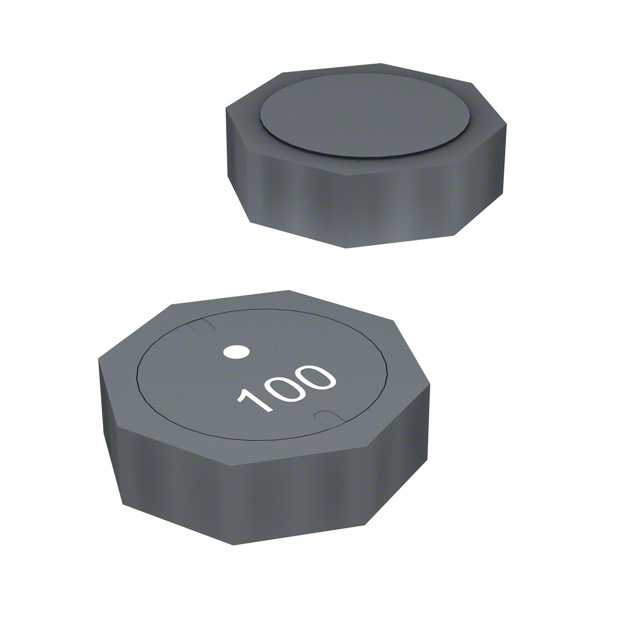
The DR1030-220-R is a 22 µH shielded drum core wirewound inductor manufactured by Eaton - Electronics Division. This surface mount component is designed for applications requiring fixed inductance with moderate current handling capability. The part is classified as Active product status with full RoHS3 compliance and unlimited moisture sensitivity rating. Substitute parts are identified when original inventory becomes unavailable, when supply chain constraints occur, or when design flexibility permits component optimization within specified electrical and mechanical parameters.
Substiute Parts
Key Parameters
| Parameter | Value | Unit | Significance for Substitution |
|---|---|---|---|
| Inductance | 22 | µH | Critical - must match exactly |
| Current Rating | 1.8 | A | Critical - substitute must meet or exceed |
| DC Resistance (DCR) | 114.6 max | mOhm | Critical - affects power dissipation |
| Saturation Current (Isat) | 2.19 | A | Critical - defines maximum usable current |
| Core Material | Ferrite | — | Critical - determines frequency response |
| Shielding | Shielded | — | Critical - EMI containment requirement |
| Tolerance | ±30% | — | Important - circuit design margin |
| Operating Temperature | -40 to 125 | °C | Important - environmental compatibility |
| Mounting Type | Surface Mount | — | Critical - PCB assembly compatibility |
| Package Type | Nonstandard | — | Critical - footprint and height constraints |
| RoHS Status | ROHS3 Compliant | — | Important - regulatory requirement |
Substitute Part Grouping Explanation
Substitution eligibility for the DR1030-220-R is determined by strict alignment with the following electrical and mechanical parameters:
Electrical Criteria:
- Inductance value must equal 22 µH at 100 kHz test frequency
- Current rating must be sufficient to handle 1.8 A continuous operation
- Saturation current must support the application's peak current demands
- DC resistance must not exceed the thermal budget of the original design (114.6 mOhm maximum)
- Core material must be ferrite to maintain frequency response characteristics
- Shielding must be present to contain electromagnetic interference
Mechanical Criteria:
- Mounting type must be surface mount for PCB compatibility
- Package classification must be nonstandard drum core type
- Physical dimensions must fit within the specified footprint (10.50mm L × 10.30mm W maximum)
- Height must not exceed 3.00 mm seated height to avoid assembly conflicts
Compliance Criteria:
- RoHS3 compliance is mandatory
- Moisture sensitivity level must be 1 (unlimited) or equivalent
- Operating temperature range must encompass -40°C to 125°C
The SRU1028-220Y qualifies as a substitute based on matching inductance, core material, shielding, mounting type, tolerance, temperature range, and compliance certifications. Electrical performance differences are documented in the parameter comparison table.
Parameter Comparison
| Parameter | DR1030-220-R (Eaton) | SRU1028-220Y (Bourns) | Compatibility Notes |
|---|---|---|---|
| Inductance | 22 µH | 22 µH | Exact match |
| Inductance Tolerance | ±30% | ±30% | Identical tolerance band |
| Current Rating | 1.8 A | 1.6 A | Substitute rated 0.2 A lower |
| Saturation Current (Isat) | 2.19 A | 1.4 A | Substitute has lower saturation margin |
| DC Resistance (DCR) | 114.6 mOhm max | 104 mOhm | Substitute has lower resistance |
| Core Material | Ferrite | Ferrite | Identical core type |
| Shielding | Shielded | Shielded | Both shielded designs |
| Mounting Type | Surface Mount | Surface Mount | Compatible assembly process |
| Package Type | Nonstandard | Nonstandard | Drum core configuration |
| Dimensions (L × W) | 10.50 × 10.30 mm | 10.00 × 10.00 mm | Substitute is slightly smaller |
| Height (Seated Max) | 3.00 mm | 3.10 mm | Substitute is 0.10 mm taller |
| Operating Temperature | -40 to 125°C | -40 to 125°C | Identical temperature range |
| Inductance Test Frequency | 100 kHz | 100 kHz | Same measurement standard |
| RoHS Status | ROHS3 Compliant | ROHS3 Compliant | Both meet RoHS3 requirements |
| Moisture Sensitivity Level | 1 (Unlimited) | 1 (Unlimited) | Identical MSL rating |
| Product Status | Active | Active | Both actively manufactured |
Engineering Selection Recommendations
Primary Selection (DR1030-220-R): The DR1030-220-R remains the preferred component when available. It provides the specified 1.8 A current rating with 2.19 A saturation current, establishing adequate margin for transient current conditions. The 114.6 mOhm maximum DC resistance is the design baseline for thermal calculations. Active product status and full RoHS3 compliance ensure continued availability and regulatory alignment.
Substitute Selection (SRU1028-220Y): The SRU1028-220Y is acceptable as a substitute when DR1030-220-R inventory is unavailable. This Bourns component maintains identical inductance value, tolerance, core material, shielding configuration, and temperature range. The lower DC resistance (104 mOhm) provides improved efficiency characteristics. However, the reduced current rating (1.6 A versus 1.8 A) and lower saturation current (1.4 A versus 2.19 A) require circuit-level verification that peak current demands do not exceed 1.6 A continuous operation. The slightly smaller footprint (10.00 × 10.00 mm) and marginally taller profile (3.10 mm versus 3.00 mm) must be confirmed against PCB layout constraints. Both components carry Active product status and ROHS3 compliance, ensuring equivalent regulatory standing.
Substitution Constraints: Substitution is not permitted if the application requires continuous current operation above 1.6 A or peak currents approaching 1.4 A saturation. Footprint-critical designs must verify the 0.50 mm reduction in length and width, and 0.10 mm increase in height do not create assembly or thermal management conflicts.
Frequently Asked Questions (FAQ)
Q: Can the SRU1028-220Y replace the DR1030-220-R in all applications?
A: No. The SRU1028-220Y has a lower current rating (1.6 A versus 1.8 A) and lower saturation current (1.4 A versus 2.19 A). Substitution is valid only when the circuit operates at or below 1.6 A continuous current and does not require the saturation margin of the original part.
Q: What is the significance of the different DC resistance values?
A: The DR1030-220-R specifies 114.6 mOhm maximum, while the SRU1028-220Y is 104 mOhm. Lower resistance reduces power dissipation and heat generation. If thermal design calculations were based on the 114.6 mOhm value, the substitute will perform better thermally. However, if the circuit relies on specific impedance characteristics, this difference must be evaluated.
Q: Are the physical dimensions compatible?
A: The SRU1028-220Y is slightly smaller in footprint (10.00 × 10.00 mm versus 10.50 × 10.30 mm) but marginally taller (3.10 mm versus 3.00 mm). PCB layout and assembly clearance must be verified, particularly for height-constrained applications or designs with components in close proximity.
Q: Do both parts meet the same regulatory requirements?
A: Yes. Both the DR1030-220-R and SRU1028-220Y are ROHS3 compliant with moisture sensitivity level 1 (unlimited). Both are classified as Active products with identical operating temperature ranges (-40°C to 125°C).
Q: What is the inductance tolerance, and does it affect substitution?
A: Both parts carry ±30% inductance tolerance at 100 kHz. This tolerance band is identical, so substitution does not introduce additional inductance variation. Circuit designs must account for this ±30% tolerance in both cases.
Q: Can I use the SRU1028-220Y if my application occasionally exceeds 1.6 A?
A: No. The 1.6 A rating is the continuous current specification. Exceeding this value will cause excessive heating and potential component failure. The saturation current of 1.4 A indicates the absolute maximum current before inductance degradation occurs.
Q: What does "shielded" mean for these inductors?
A: Both components feature shielded drum core construction, which contains the magnetic field within the component to minimize electromagnetic interference with adjacent circuits. This is a critical requirement for EMI-sensitive applications and must be maintained in any substitution.
Q: Are there any frequency-dependent differences between these parts?
A: The DR1030-220-R does not specify self-resonant frequency or Q factor. The SRU1028-220Y specifies Q of 26 at 2.52 MHz and self-resonant frequency of 16 MHz. For applications operating at frequencies approaching or exceeding these values, the SRU1028-220Y's frequency characteristics should be evaluated against circuit requirements.
Alternative Parts

SJ6012L2TP
Littelfuse Inc.
6 Alternative Parts

JMK107BBJ476MA-RE
Taiyo Yuden
10 Alternative Parts

GMK107BBJ475MA-T
Taiyo Yuden
5 Alternative Parts
SJ6020N2ARP
Littelfuse Inc.
3 Alternative Parts
SJ6025R2ATP
Littelfuse Inc.
4 Alternative Parts

2474-05L
API Delevan Inc.
1 Alternative Parts

4590R-684K
API Delevan Inc.
1 Alternative Parts

CM6560R-334
API Delevan Inc.
1 Alternative Parts

CM6460-104
API Delevan Inc.
1 Alternative Parts

5526-12
API Delevan Inc.
1 Alternative Parts