



Request Quote
(Ships tomorrow)
DG309CJ Equivalent & Substitute Parts Reference
Part Overview
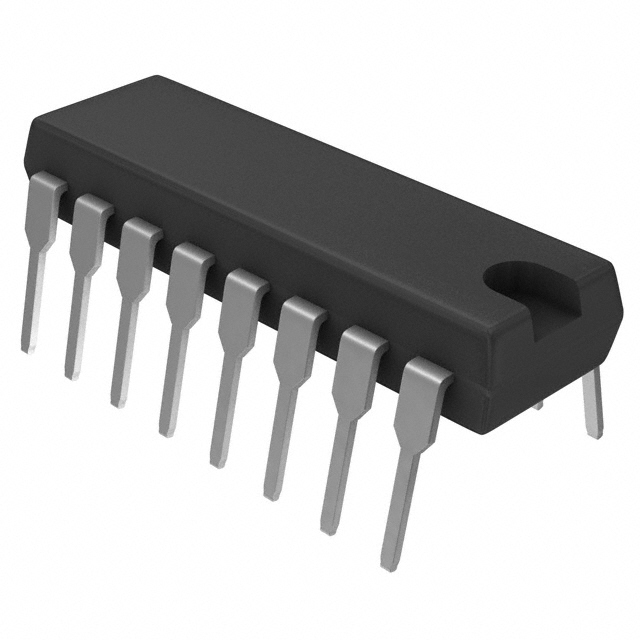
The Vishay Siliconix DG309CJ is an IC switch in the interface category, featuring a SPST - NC switch circuit with 4 independent channels, offered in a 16-PDIP through hole package. This product is obsolete, making it necessary to identify alternate models for design continuity and replacement in applications that require the same electrical and mechanical characteristics.
Substiute Parts
Key Parameters
| Parameter | DG309CJ Value |
|---|---|
| Manufacturer | Vishay Siliconix |
| Switch Circuit | SPST - NC |
| Multiplexer/Demultiplexer Circuit | 1:1 |
| Number of Circuits | 4 |
| On-State Resistance (Max) | 85 Ohm |
| Channel-to-Channel Matching (ΔRon) | 1.7 Ohm |
| Voltage - Supply, Single (V+) | 4V ~ 44V |
| Voltage - Supply, Dual (V±) | ±4V ~ 22V |
| Switch Time (Ton, Toff) (Max) | 200ns, 150ns |
| Charge Injection | 1pC |
| Channel Capacitance (CS(off), CD(off)) | 5pF, 5pF |
| Current - Leakage (IS(off)) (Max) | 500pA |
| Crosstalk | -95dB @ 100kHz |
| Operating Temperature | -40°C ~ 85°C (TA) |
| Mounting Type | Through Hole |
| Package / Case | 16-DIP (0.300", 7.62mm) |
| Supplier Device Package | 16-PDIP |
| RoHS Status | RoHS non-compliant |
| Product Status | Obsolete |
Substitute Part Grouping Explanation
Substitution logic is based strictly on the following electrical and mechanical parameters: switch circuit type, number of circuits, channel configuration, on-state resistance, power supply ranges, switching speed, operating temperature, channel capacitance, leakage current, package type, and mounting. Only substitute parts matching or appropriately aligning with these key parameters are listed in this reference.
Parameter Comparison
| Part Number | Manufacturer | Switch Circuit | Multiplexer/Demultiplexer Circuit | Number of Circuits | On-State Resistance (Max) | Channel-to-Channel Matching (ΔRon) | Voltage - Supply, Single (V+) | Voltage - Supply, Dual (V±) | Switch Time (Ton, Toff) (Max) | Charge Injection | Channel Capacitance (CS(off), CD(off)) | Current - Leakage (IS(off)) (Max) | Crosstalk | Operating Temp. | Mounting Type | Package / Case | Supplier Device Package | RoHS Status | Product Status |
|---|---|---|---|---|---|---|---|---|---|---|---|---|---|---|---|---|---|---|---|
| DG309CJ | Vishay Siliconix | SPST - NC | 1:1 | 4 | 85 Ohm | 1.7 Ohm | 4V ~ 44V | ±4V ~ 22V | 200ns, 150ns | 1pC | 5pF, 5pF | 500pA | -95dB @ 100kHz | -40°C ~ 85°C | Through Hole | 16-DIP (0.300", 7.62mm) | 16-PDIP | RoHS non-compliant | Obsolete |
| DG309BDJ-E3 | Vishay Siliconix | SPST - NC | 1:1 | 4 | 85 Ohm | 1.7 Ohm | 4V ~ 44V | ±4V ~ 22V | 200ns, 150ns | 1pC | 5pF, 5pF | 500pA | -95dB @ 100kHz | -40°C ~ 85°C | Through Hole | 16-DIP (0.300", 7.62mm) | 16-PDIP | ROHS3 Compliant | Active |
| DG309CJ-E3 | Vishay Siliconix | SPST - NC | 1:1 | 4 | 85 Ohm | 1.7 Ohm | 4V ~ 44V | ±4V ~ 22V | 200ns, 150ns | 1pC | 5pF, 5pF | 500pA | -95dB @ 100kHz | -40°C ~ 85°C | Through Hole | 16-DIP (0.300", 7.62mm) | 16-PDIP | ROHS3 Compliant | Active |
| ALD4211PCL | Advanced Linear Devices Inc. | SPST - NC | 1:1 | 4 | 135 Ohm | 2.7 Ohm | 3V ~ 12V | ±1.5V ~ 6V | 130ns, 130ns | 0.2pC | 3pF, 3pF | 100pA | -90dB @ 100kHz | -40°C ~ 85°C | Through Hole | 16-DIP (0.300", 7.62mm) | 16-PDIP | ROHS3 Compliant | Active |
| DG309CJ+ | Analog Devices Inc./Maxim Integrated | SPST - NC | 1:1 | 4 | 100 Ohm | - | 5V ~ 30V | ±5V ~ 20V | 250ns, 150ns | -10pC | 11pF, 8pF | 5nA | - | 0°C ~ 70°C | Through Hole | 16-DIP (0.300", 7.62mm) | 16-PDIP | ROHS3 Compliant | Active |
| MAX4511CPE+ | Analog Devices Inc./Maxim Integrated | SPST - NC | 1:1 | 4 | 160 Ohm | - | 9V ~ 36V | ±4.5V ~ 18V | 500ns, 400ns | 1.5pC | 10pF, 5pF | 500pA | -66dB @ 1MHz | 0°C ~ 70°C | Through Hole | 16-DIP (0.300", 7.62mm) | 16-PDIP | ROHS3 Compliant | Obsolete |
Engineering Selection Recommendations
For replacement and substitution, preference is given to active status parts with matching electrical and mechanical parameters to those of DG309CJ. RoHS3 compliant substitutes such as DG309BDJ-E3 and DG309CJ-E3 align closely with original specifications, and offer enhanced compliance for environmental and regulatory requirements. All listed substitutes use the same 16-PDIP through hole package and maintain the specified operating temperature range. Obsolete alternatives such as MAX4511CPE+ should only be considered where required by legacy designs.
Frequently Asked Questions (FAQ)
Q: What are the critical substitution criteria for DG309CJ?
A: The substitution criteria include switch circuit configuration (SPST - NC), number of switch circuits (4), channel configuration (1:1), on-state resistance, supply voltage range, switching time, leakage current, channel capacitance, operating temperature, and package type (16-PDIP, through hole).
Q: How important is package compatibility for substitution?
A: Package compatibility is essential to ensure proper fit on existing PCBs and maintain the integrity of mechanical assembly. All listed substitutes use the 16-DIP (0.300", 7.62mm) through hole package.
Q: Does RoHS compliance affect substitute selection?
A: RoHS compliance is a key consideration for environmental and regulatory requirements. Where possible, selecting a RoHS3 compliant part (e.g., DG309BDJ-E3 or DG309CJ-E3) is preferable.
Q: Can substitute parts with higher or lower on-state resistance be used?
A: Selection must be based strictly on provided parameters. Minor variations in on-state resistance are presented in the table above for engineering review according to allowed specifications.
Q: Are all substitutions direct drop-in replacements?
A: Substitute suitability depends on strict adherence to the listed key parameters. Substitute parts listed here offer electrical and mechanical compatibility as provided.
Q: How do operating temperature ranges affect interchangeability?
A: All parts with an operating temperature range of -40°C ~ 85°C can be interchanged directly within this temperature range. Parts with different ranges are listed for engineering consideration.
Q: What should be considered regarding obsolete status of substitutes?
A: Obsolete substitutes should only be used when absolutely required for backwards compatibility or when inventory is available. Active status and compliant substitutes are preferred for new designs.
Alternative Parts

SJ6012L2TP
Littelfuse Inc.
6 Alternative Parts

JMK107BBJ476MA-RE
Taiyo Yuden
10 Alternative Parts

GMK107BBJ475MA-T
Taiyo Yuden
5 Alternative Parts
SJ6020N2ARP
Littelfuse Inc.
3 Alternative Parts
SJ6025R2ATP
Littelfuse Inc.
4 Alternative Parts

2474-05L
API Delevan Inc.
1 Alternative Parts

4590R-684K
API Delevan Inc.
1 Alternative Parts

CM6560R-334
API Delevan Inc.
1 Alternative Parts

CM6460-104
API Delevan Inc.
1 Alternative Parts

5526-12
API Delevan Inc.
1 Alternative Parts