


Request Quote
(Ships tomorrow)
CS8182DTRKG Linear Voltage Regulator - Equivalent & Substitute Parts
Part Overview
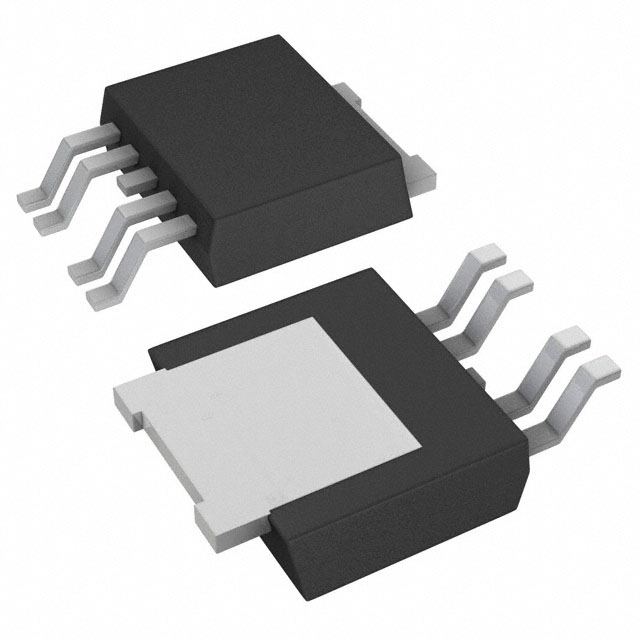
The CS8182DTRKG is a linear voltage regulator IC from onsemi, classified as a Power Management (PMIC) device. It provides positive adjustable output regulation with 200mA current capacity in a DPAK-5 surface mount package. The device features enable control, over-temperature protection, reverse polarity protection, and short circuit protection across an operating temperature range of -40°C to 125°C.
This part is marked as obsolete. Identifying equivalent and substitute parts is necessary to ensure design continuity, maintain supply chain reliability, and support ongoing production or maintenance requirements for systems utilizing this regulator.
Substiute Parts
Key Parameters
| Parameter | Value |
|---|---|
| Manufacturer Part Number | CS8182DTRKG |
| Manufacturer | onsemi |
| Category | Power Management (PMIC) |
| Package / Case | TO-252-5, DPAK (4 Leads + Tab), TO-252AD |
| Output Configuration | Positive |
| Output Type | Adjustable |
| Current - Output | 200mA |
| Voltage - Input (Max) | 45V |
| Voltage Dropout (Max) | 0.6V @ 200mA |
| Operating Temperature | -40°C ~ 125°C |
| Product Status | Obsolete |
| RoHS Status | ROHS3 Compliant |
Substitute Part Grouping Explanation
Substitution eligibility for the CS8182DTRKG is determined by the following critical parameters:
- Package Compatibility: Both parts must use TO-252-5 DPAK surface mount packaging to ensure PCB footprint compatibility
- Output Configuration: Positive adjustable output regulation is required
- Current Rating: 200mA output current capacity must be maintained
- Voltage Input Range: Maximum input voltage rating must be sufficient for the application
- Dropout Voltage: Must be acceptable for the specific circuit design
- Operating Temperature Range: Must cover the required thermal operating window
- Protection Features: Over-temperature and reverse polarity protection are baseline requirements
- Regulatory Compliance: RoHS3 compliance is mandatory for current procurement
The NCV8182CDTRKG meets these substitution criteria while offering enhanced specifications in certain areas.
Parameter Comparison
| Parameter | CS8182DTRKG (Main Part) | NCV8182CDTRKG (Substitute) |
|---|---|---|
| Manufacturer | onsemi | onsemi |
| Package / Case | TO-252-5, DPAK | TO-252-5, DPAK |
| Output Configuration | Positive | Positive |
| Output Type | Adjustable | Adjustable |
| Current - Output | 200mA | 200mA |
| Voltage - Input (Max) | 45V | 35V |
| Voltage Dropout (Max) | 0.6V @ 200mA | 0.5V @ 200mA |
| Current - Quiescent (Iq) | 55 µA | 150 µA |
| PSRR | 60dB (120Hz) | 85dB (100Hz) |
| Operating Temperature | -40°C ~ 125°C | -40°C ~ 150°C (TJ) |
| Product Status | Obsolete | Active |
| Protection Features | Over Temperature, Reverse Polarity, Short Circuit | Over Current, Over Temperature, Reverse Polarity |
| RoHS Status | ROHS3 Compliant | ROHS3 Compliant |
| Grade | Standard | Automotive |
| Qualification | Not specified | AEC-Q100 |
Engineering Selection Recommendations
The NCV8182CDTRKG is a direct substitute for the CS8182DTRKG based on matching package, output configuration, current rating, and core protection features. Key considerations for selection:
Advantages of NCV8182CDTRKG:
- Active product status ensures ongoing availability and supply chain support
- Lower dropout voltage (0.5V vs 0.6V) provides improved efficiency
- Extended operating temperature range (-40°C to 150°C vs -40°C to 125°C)
- Higher PSRR specification (85dB vs 60dB) offers superior noise rejection
- Automotive-grade qualification (AEC-Q100) and automotive designation provide enhanced reliability documentation
Design Considerations:
- Maximum input voltage is reduced from 45V to 35V; applications requiring input voltages above 35V cannot use the substitute
- Quiescent current is higher (150 µA vs 55 µA); low-power standby applications may be affected
- Both parts maintain RoHS3 compliance and identical packaging
Selection of NCV8182CDTRKG is appropriate for new designs and ongoing production where input voltage does not exceed 35V and the automotive-grade qualification is acceptable or beneficial.
Frequently Asked Questions (FAQ)
Q: Can NCV8182CDTRKG replace CS8182DTRKG in existing designs?
A: Yes, provided the application input voltage does not exceed 35V. The substitute maintains identical package footprint, output current rating, and adjustable output configuration. Verify that the reduced maximum input voltage (35V vs 45V) is compatible with your circuit design.
Q: What is the impact of the higher quiescent current in NCV8182CDTRKG?
A: The NCV8182CDTRKG draws 150 µA quiescent current compared to 55 µA in the CS8182DTRKG. In applications with continuous operation, this represents an additional 95 µA of supply current draw. For low-power or battery-powered designs, this difference may be significant and should be evaluated against power budget requirements.
Q: Are both parts pin-compatible?
A: Yes. Both parts use the TO-252-5 DPAK package with identical pinout and footprint. No PCB modifications are required for substitution.
Q: Why is NCV8182CDTRKG rated for automotive applications?
A: The NCV8182CDTRKG carries automotive-grade designation and AEC-Q100 qualification, indicating it meets automotive industry reliability and testing standards. This qualification is not present in the CS8182DTRKG. The automotive grade does not restrict use in non-automotive applications.
Q: What protection features differ between the two parts?
A: CS8182DTRKG provides over-temperature, reverse polarity, and short circuit protection. NCV8182CDTRKG provides over-current, over-temperature, and reverse polarity protection. Both include the critical over-temperature and reverse polarity protections; the difference is short circuit versus over-current detection methodology.
Q: Is the extended temperature range of NCV8182CDTRKG beneficial for standard applications?
A: The NCV8182CDTRKG operates to 150°C junction temperature versus 125°C for CS8182DTRKG. This extended range provides additional thermal margin in high-temperature environments but offers no advantage in applications operating within the standard -40°C to 125°C range.
Alternative Parts

SJ6012L2TP
Littelfuse Inc.
6 Alternative Parts

JMK107BBJ476MA-RE
Taiyo Yuden
10 Alternative Parts

GMK107BBJ475MA-T
Taiyo Yuden
5 Alternative Parts
SJ6020N2ARP
Littelfuse Inc.
3 Alternative Parts
SJ6025R2ATP
Littelfuse Inc.
4 Alternative Parts

2474-05L
API Delevan Inc.
1 Alternative Parts

4590R-684K
API Delevan Inc.
1 Alternative Parts

CM6560R-334
API Delevan Inc.
1 Alternative Parts

CM6460-104
API Delevan Inc.
1 Alternative Parts

5526-12
API Delevan Inc.
1 Alternative Parts