



Request Quote
(Ships tomorrow)
CONN011 N Type Coaxial Connector Receptacle Equivalent & Substitute Parts
Part Overview
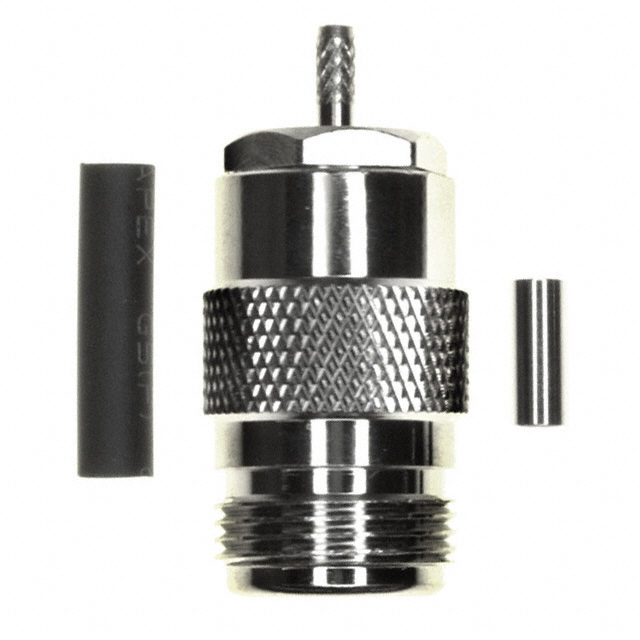
The CONN011 is an N Type coaxial connector receptacle manufactured by TE Connectivity Linx, designed for 50 Ohm RF applications with solder termination. This component is classified as obsolete, making identification of equivalent and substitute parts essential for ongoing system maintenance and new design implementations. The connector supports frequencies up to 11 GHz and operates across a temperature range of -65°C to 165°C, making it suitable for demanding RF and microwave applications.
Substiute Parts
Key Parameters
| Parameter | Value |
|---|---|
| Connector Style | N Type |
| Connector Type | Receptacle, Female Socket |
| Impedance | 50 Ohms |
| Contact Termination | Solder |
| Shield Termination | Crimp |
| Mounting Type | Free Hanging (In-Line) |
| Fastening Type | Threaded |
| Frequency - Max | 11 GHz |
| Operating Temperature | -65°C ~ 165°C |
| Voltage Rating | 500 V |
| Mating Cycles | 500 |
| Dielectric Material | Polytetrafluoroethylene (PTFE) |
| Body Material | Brass |
| Center Contact Plating | Gold |
Substitute Part Grouping Explanation
The Amphenol RF part number 172204 qualifies as a substitute for CONN011 based on the following critical parameters:
- Connector Style Match: Both components are N Type connectors
- Connector Type Match: Both are receptacle, female socket configurations
- Impedance Match: Both maintain 50 Ohm impedance
- Contact Termination Match: Both use solder termination
- Shield Termination Match: Both employ crimp shield termination
- Mounting Type Match: Both are free hanging (in-line) configurations
- Fastening Type Match: Both use threaded fastening
- Frequency Compatibility: Both support up to 11 GHz operation
- Operating Temperature Range Match: Both operate from -65°C to 165°C
- Dielectric Material Match: Both use PTFE dielectric
- Body Material Match: Both use brass construction
- Center Contact Plating Match: Both feature gold plating
Parameter Comparison
| Parameter | CONN011 (TE Connectivity Linx) | 172204 (Amphenol RF) |
|---|---|---|
| Connector Style | N Type | N Type |
| Connector Type | Receptacle, Female Socket | Jack, Female Socket |
| Impedance | 50 Ohms | 50 Ohms |
| Contact Termination | Solder | Solder |
| Shield Termination | Crimp | Crimp |
| Mounting Type | Free Hanging (In-Line) | Free Hanging (In-Line) |
| Fastening Type | Threaded | Threaded |
| Frequency - Max | 11 GHz | 11 GHz |
| Operating Temperature | -65°C ~ 165°C | -65°C ~ 165°C |
| Voltage Rating | 500 V | 1500 V |
| Mating Cycles | 500 | 500 |
| Insertion Loss | 0.3 dB | 0.15 dB |
| Dielectric Material | Polytetrafluoroethylene (PTFE) | Polytetrafluoroethylene (PTFE) |
| Body Material | Brass | Brass |
| Center Contact Material | Brass | Phosphor Bronze |
| Center Contact Plating | Gold | Gold |
| Product Status | Obsolete | Active |
Engineering Selection Recommendations
The Amphenol RF 172204 is the designated substitute for the obsolete CONN011. Selection of this substitute is supported by the following factors:
Product Status: The CONN011 is classified as obsolete, while the 172204 maintains active product status, ensuring continued availability and manufacturer support for new procurements and system maintenance.
Compliance and Certifications: The 172204 is RoHS3 compliant and REACH affected, providing compliance with current environmental and regulatory standards. The CONN011 is REACH unaffected, reflecting its obsolete classification.
Performance Advantages: The 172204 demonstrates superior electrical performance with insertion loss of 0.15 dB compared to the CONN011's 0.3 dB, and provides a higher voltage rating of 1500 V versus 500 V, offering enhanced margin for high-power applications.
Mechanical Compatibility: Both connectors share identical mounting, fastening, and termination characteristics, ensuring direct mechanical and electrical compatibility in existing designs.
Frequently Asked Questions (FAQ)
Q: Can the Amphenol RF 172204 directly replace the TE Connectivity Linx CONN011 in existing designs?
A: Yes. Both connectors share identical N Type configuration, 50 Ohm impedance, solder contact termination, crimp shield termination, free hanging mounting, and threaded fastening. Mechanical and electrical compatibility is maintained across all critical parameters.
Q: What are the key differences between these two connectors?
A: The primary differences are: (1) Product status—CONN011 is obsolete while 172204 is active; (2) Voltage rating—172204 provides 1500 V versus CONN011's 500 V; (3) Insertion loss—172204 exhibits 0.15 dB versus CONN011's 0.3 dB; (4) Center contact material—172204 uses phosphor bronze versus CONN011's brass; (5) Compliance—172204 is RoHS3 compliant while CONN011 is not.
Q: Are there packaging differences between these connectors?
A: Yes. The CONN011 is supplied without specified packaging, while the 172204 is packaged in bags. This difference does not affect electrical or mechanical compatibility but may influence procurement and handling procedures.
Q: What cable groups are compatible with the 172204 substitute?
A: The 172204 supports RG-174, 188, 188A, 316, LMR-100, and M17/119-RG174 cable groups. The CONN011 specification lists RG-174 as the primary cable group.
Q: Are the mating cycle ratings equivalent?
A: Yes. Both connectors are rated for 500 mating cycles, providing identical mechanical durability specifications.
Q: Does the lower insertion loss of the 172204 provide any system benefits?
A: The 172204's insertion loss of 0.15 dB is lower than the CONN011's 0.3 dB, representing a 50% reduction. This lower loss may provide improved signal integrity in RF and microwave applications, particularly in systems with tight link budgets or extended cable runs.
Alternative Parts

SJ6012L2TP
Littelfuse Inc.
6 Alternative Parts

JMK107BBJ476MA-RE
Taiyo Yuden
10 Alternative Parts

GMK107BBJ475MA-T
Taiyo Yuden
5 Alternative Parts
SJ6020N2ARP
Littelfuse Inc.
3 Alternative Parts
SJ6025R2ATP
Littelfuse Inc.
4 Alternative Parts

2474-05L
API Delevan Inc.
1 Alternative Parts

4590R-684K
API Delevan Inc.
1 Alternative Parts

CM6560R-334
API Delevan Inc.
1 Alternative Parts

CM6460-104
API Delevan Inc.
1 Alternative Parts

5526-12
API Delevan Inc.
1 Alternative Parts