



Request Quote
(Ships tomorrow)
CLL4683 TR Zener Diode Equivalent & Substitute Parts
Part Overview
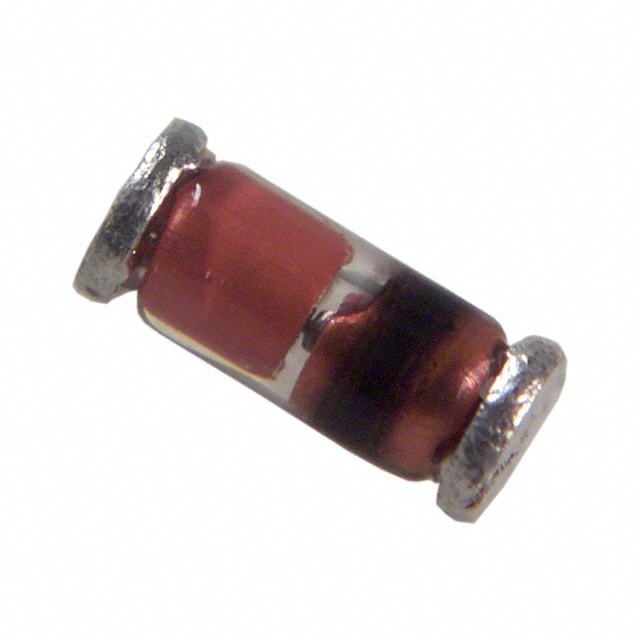
The CLL4683 TR is a 3 V, 500 mW Zener diode manufactured by Central Semiconductor Corp in SOD-80 (DO-213AC, MINI-MELF) surface mount packaging. This component is classified as obsolete, necessitating identification of active equivalent and substitute parts for ongoing design requirements and procurement needs. The part operates across a temperature range of -65°C to 200°C with ±5% voltage tolerance and 800 nA reverse leakage current at 1 V.
Substiute Parts
Key Parameters
| Parameter | Value | Unit |
|---|---|---|
| Voltage - Zener (Nom) | 3 | V |
| Power - Max | 500 | mW |
| Tolerance | ±5% | - |
| Current - Reverse Leakage @ Vr | 800 | nA @ 1 V |
| Voltage - Forward (Vf) (Max) @ If | 1.5 | V @ 100 mA |
| Operating Temperature Range | -65 to 200 | °C |
| Mounting Type | Surface Mount | - |
| Package / Case | DO-213AC, MINI-MELF, SOD-80 | - |
Substitute Part Grouping Explanation
Substitution of the CLL4683 TR is determined by the following critical parameters:
Primary Substitution Criteria:
- Zener voltage: 3 V nominal
- Maximum power dissipation: 500 mW
- Mounting type: Surface Mount
- Package compatibility: SOD-80 (DO-213AC, MINI-MELF)
Secondary Compatibility Factors:
- Voltage tolerance (±5% preferred for direct replacement)
- Reverse leakage current characteristics
- Forward voltage characteristics
- Operating temperature range (minimum -65°C to 150°C required)
Substitute parts are grouped into two categories:
Category 1: Same Package (SOD-80) - Direct Mechanical Substitutes Vishay TLZ and TZM series components maintain identical SOD-80 packaging, enabling direct PCB placement without layout modifications. These parts are active products with current manufacturing status.
Category 2: Alternative Package (SOD-123) - Functional Equivalent with Package Change The CMHZ4683 TR provides electrical equivalence but requires PCB redesign due to SOD-123 packaging, which differs mechanically from SOD-80.
Parameter Comparison
| Part Number | Manufacturer | Vz (V) | Power (mW) | Tolerance | Package | Temp Range (°C) | Status | Compliance |
|---|---|---|---|---|---|---|---|---|
| CLL4683 TR | Central Semiconductor | 3 | 500 | ±5% | SOD-80 | -65 to 200 | Obsolete | EAR99 |
| CMHZ4683 TR | Central Semiconductor | 3 | 500 | ±5% | SOD-123 | -65 to 150 | Active | EAR99 |
| TLZ3V0-GS08 | Vishay | 3 | 500 | - | SOD-80 | -65 to 175 | Active | ROHS3, EAR99 |
| TLZ3V0-GS18 | Vishay | 3 | 500 | - | SOD-80 | -65 to 175 | Active | ROHS3, EAR99 |
| TLZ3V0A-GS08 | Vishay | 3 | 500 | - | SOD-80 | -65 to 175 | Active | ROHS3, EAR99 |
| TLZ3V0A-GS18 | Vishay | 3 | 500 | - | SOD-80 | -65 to 175 | Active | ROHS3, EAR99 |
| TLZ3V0B-GS08 | Vishay | 3 | 500 | - | SOD-80 | -65 to 175 | Active | ROHS3, EAR99 |
| TLZ3V0B-GS18 | Vishay | 3 | 500 | - | SOD-80 | -65 to 175 | Active | ROHS3, EAR99 |
| TZMC3V0-GS08 | Vishay | 3 | 500 | ±5% | SOD-80 | -65 to 175 | Active | ROHS3, AEC-Q101, EAR99 |
| TZMC3V0-GS18 | Vishay | 3 | 500 | ±5% | SOD-80 | -65 to 175 | Active | ROHS3, AEC-Q101, EAR99 |
| TZMC3V0-M-08 | Vishay | 3 | 500 | ±5% | SOD-80 | -65 to 175 | Active | ROHS3, AEC-Q101, EAR99 |
Engineering Selection Recommendations
For Direct Replacement (No PCB Redesign Required):
The Vishay TZMC3V0 series (TZMC3V0-GS08, TZMC3V0-GS18, TZMC3V0-M-08) provides the closest functional equivalence to the CLL4683 TR. These parts maintain 3 V nominal zener voltage, 500 mW power rating, ±5% tolerance matching the original specification, and SOD-80 packaging for direct PCB compatibility. All TZMC3V0 variants are active products with AEC-Q101 automotive qualification and ROHS3 compliance, ensuring long-term availability and regulatory alignment.
For Applications Requiring Automotive Qualification:
The TZMC3V0 series is the only substitute group carrying AEC-Q101 qualification, making it mandatory for automotive applications. The -GS08 and -GS18 designations indicate different tape reel configurations; selection depends on procurement and assembly requirements.
For Standard Industrial Applications:
The Vishay TLZ3V0 series (TLZ3V0-GS08, TLZ3V0-GS18, TLZ3V0A-GS08, TLZ3V0A-GS18, TLZ3V0B-GS08, TLZ3V0B-GS18) provides active alternatives with identical SOD-80 packaging and 3 V / 500 mW specifications. These parts lack explicit ±5% tolerance specification but maintain electrical compatibility. ROHS3 compliance is confirmed for all TLZ variants.
For Package-Agnostic Designs:
The CMHZ4683 TR from Central Semiconductor offers functional equivalence with active product status but requires PCB layout modification due to SOD-123 packaging. This option is suitable only when mechanical redesign is feasible.
Temperature Range Consideration:
The CLL4683 TR operates to 200°C; all active substitutes operate to maximum 175°C. Applications requiring operation above 175°C cannot use these substitutes without thermal design modification.
Frequently Asked Questions (FAQ)
Q: Can the TLZ3V0 series directly replace the CLL4683 TR without PCB modification?
A: Yes. The TLZ3V0 series maintains identical SOD-80 packaging and 3 V / 500 mW electrical specifications, enabling direct PCB placement. No layout changes are required.
Q: What is the difference between TZMC3V0-GS08 and TZMC3V0-GS18?
A: Both parts are electrically identical 3 V / 500 mW zener diodes in SOD-80 packaging. The suffix designates tape reel configuration: GS08 and GS18 refer to different reel sizes for automated assembly. Selection depends on your procurement and pick-and-place equipment specifications.
Q: Is the TZMC3V0 series suitable for automotive applications?
A: Yes. The TZMC3V0 series carries AEC-Q101 automotive qualification, making it suitable for automotive-grade designs. The TLZ3V0 series does not carry this qualification.
Q: Why does the CLL4683 TR have a 200°C maximum operating temperature while substitutes are limited to 175°C?
A: This reflects different design specifications between manufacturers. The CLL4683 TR was designed for extended temperature operation. All active substitutes operate to 175°C maximum. Applications requiring 175°C to 200°C operation cannot use these substitutes.
Q: Can I use the CMHZ4683 TR as a substitute?
A: The CMHZ4683 TR is electrically equivalent but uses SOD-123 packaging instead of SOD-80. This requires PCB redesign and is not a direct mechanical substitute. Use only if PCB layout modification is acceptable.
Q: What does ±5% tolerance mean for zener voltage?
A: The zener voltage will be within ±5% of the nominal 3 V specification. For the CLL4683 TR and TZMC3V0 series, this means the actual zener voltage will be between 2.85 V and 3.15 V. The TLZ3V0 series does not specify tolerance.
Q: Are all substitute parts ROHS3 compliant?
A: All Vishay TLZ and TZMC series substitutes are ROHS3 compliant. The CMHZ4683 TR does not specify ROHS status in the provided data.
Q: What is the difference between TLZ3V0A and TLZ3V0B variants?
A: Both maintain 3 V / 500 mW specifications in SOD-80 packaging. The variants differ in reverse leakage current: TLZ3V0A specifies 50 µA @ 1 V, while TLZ3V0B specifies 10 µA @ 1 V. Selection depends on circuit requirements for leakage current performance.
Q: Can I mix different substitute part numbers in the same design?
A: Yes, provided all selected parts meet your circuit requirements for zener voltage, power rating, temperature range, and leakage current specifications. Mixing is acceptable from an engineering standpoint but may complicate procurement and inventory management.
Alternative Parts

SJ6012L2TP
Littelfuse Inc.
6 Alternative Parts

JMK107BBJ476MA-RE
Taiyo Yuden
10 Alternative Parts

GMK107BBJ475MA-T
Taiyo Yuden
5 Alternative Parts
SJ6020N2ARP
Littelfuse Inc.
3 Alternative Parts
SJ6025R2ATP
Littelfuse Inc.
4 Alternative Parts

2474-05L
API Delevan Inc.
1 Alternative Parts

4590R-684K
API Delevan Inc.
1 Alternative Parts

CM6560R-334
API Delevan Inc.
1 Alternative Parts

CM6460-104
API Delevan Inc.
1 Alternative Parts

5526-12
API Delevan Inc.
1 Alternative Parts